Cities Adopt Car-Free Zones To Push Drivers Out Of Cars
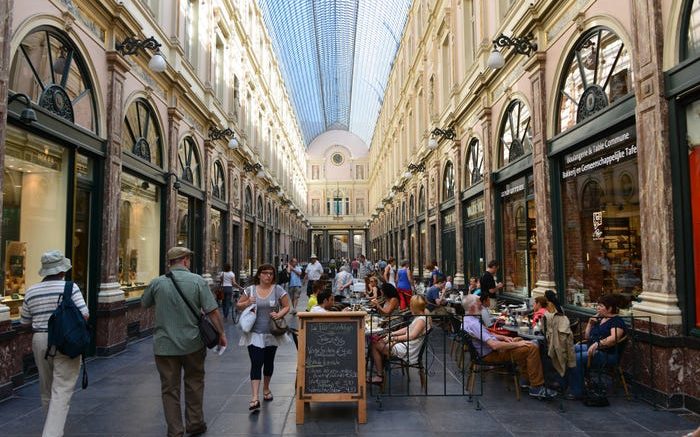 Terrasse au Vaudeville in Brussels, Belgium. Stephane Mignon/Flickr
Thanks
to Green New Deal ideology, cities around the world are banning cars to
force drivers to give them up: San Francisco, New York, Olso, Madrid,
Chengdu, Hamburg, Copenhagen, Brussels and Mexico City, among others. ⁃
TN Editor
In her 1961 book The Death and Life of Great American Cities, urbanist
writer Jane Jacobs posed a prescient concern. She forecasted one of two
possible outcomes for our urban future: “erosion of cities by
automobiles, or attrition of automobiles by cities.”
To put it simply, Jacobs declared that if cars (and the
highways and streets they run on) were left unchecked, the nature of the
city would be gradually stripped away. She predicted that sprawl would
make streets unwalkable, detaching neighborhoods and public spaces from
one another. It sounded all doom and gloom, unless cities could impede
that growth by limiting cars and reduce their influence on the streets.
The problem isn’t cars themselves, she argued, but the
cumulative effect of an urban planning system that prioritizes cars over
other modes of transportation. “The point of cities is multiplicity of
choice,” Jacobs wrote. “It is impossible to take advantage of
multiplicity of choice without being able to get around easily.”
Cities across the US and the world are experimenting with
the “attrition of automobiles” by closing certain streets and areas to
cars. San Francisco recently approved a $600-million plan to remove private vehicles from
its busy Market Street, which will be renovated into space for street
cars, buses, cyclists, and pedestrians. (Taxis will share the curbside
lane with buses and commercial delivery vehicles, but Uber and Lyft cars
are not allowed on the street.)
In October, New York City turned a one-mile stretch of 14th Street
into a busway, banning all cars except some trucks and emergency
vehicles. European cities like Barcelona, Madrid, and Oslo have established car-free zones in downtown centers, and these initiatives can prompt backlash but are often strongly supported by residents.Citizens enjoy having a variety of options to fulfill their transportation needs, and cities are realizing that. In the past, before vehicles like electric scooters or city bikes were widely available, people were limited to cars, buses, or the subway. With more diverse transit options, cities are forced to plan for improved safety and access, to build streets that accommodate all types of transportation. And that means scaling back on what they’ve built themselves around for decades: the car.
The idea of a car-reduced city isn’t entirely new; cities
have looked to close streets to vehicular traffic and create pedestrian
corridors for decades. But what is new is the surge in micro-mobility
options afforded to people, which have pushed cities to reassess how to
organize their streets. The impending threat of climate change has also
added pressure on local officials to cut back on carbon emissions.
(Transportation is one of the top producers of carbon emissions for the US.)
These small, often electric vehicles — shareable
bicycles, scooters, and mopeds — have popped up on city streets in
recent years. Dockless scooters appear in cities overnight seemingly
without warning, from companies like Spin, Bird, Lime, and Skip;
ride-sharing giants Uber and Lyft also invested in dockless bikes.
Their sudden arrival has caused confusion and even anger (mainly with the scooters) among residents and the local politicians tasked with regulating them. Some cities have required their swift removal, while others have more openly embraced scooters and started crafting laws for their usage. And whether scooters are actually environmentally sound is questionable.
But one thing is certain: Residents find these vehicles
convenient, and they influence how people travel short distances —
closing the gap left by cars, buses, and trains as a more direct means
of transportation. Certain areas in cities, particularly low-income
communities, are located far from transit hubs or lack direct bus or
subway routes. Micro-mobility is a cheap, accessible option that could
benefit communities previously overlooked by urban planners.
“Perhaps one of the greatest benefits of scooters will be
that they will force a larger discussion of whom or what we prioritize
when we design cities,” wrote Vox’s Umair Irfan.
That’s a philosophical approach some cities are taking,
but it’s also being played out like a turf war, says Uwe Brandes,
director of the Global Cities Initiative at Georgetown University: “How
much territory in the public realm should be allocated to individual
modes?”
Read full story here…Source: technocracy.net
Blogger's note:
subterrnews.blogspot.com does not send cookies, or collect any information on
those using the blog. However, the blogspot is on google, and google may
collect information, and send cookies. Many of the links that we
connect to do not send out cookies or collect information, but some do.
Your keying in to this blog you have agreed to this.
The views expressed in the articles
do not necessarily represent the opinions of this blog. They are the views, and opinions of the
author(s) of the article.
0 comments:
Post a Comment