Suspicionless Searches Of Traveler’s e-Devices Ruled Unconstitutional
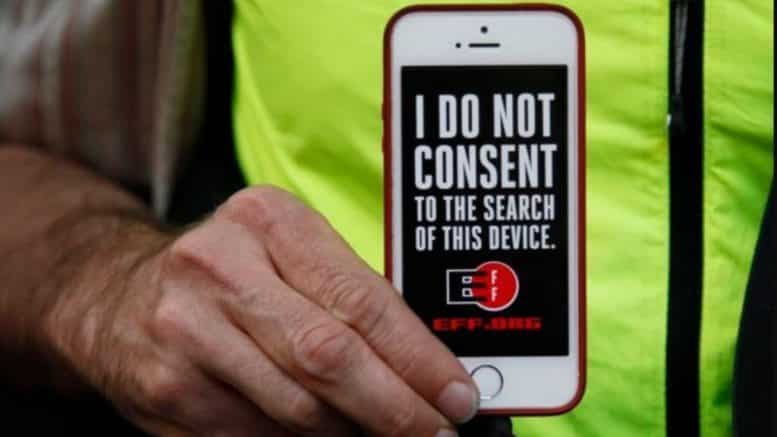 Image: EFF

Technocrats
in government agencies that conduct warrantless electronic searches
will undoubtedly be grinding their teeth over this ruling that will
force them to honor the Fourth Amendment that protects citizens from
unlawful search and seizure. ⁃ TN Editor
The ruling came in a lawsuit, Alasaad v. McAleenan, filed by the American Civil Liberties Union (ACLU), Electronic Frontier Foundation (EFF), and ACLU of Massachusetts, on behalf of 11 travelers whose smartphones and laptops were searched without individualized suspicion at U.S. ports of entry.
“This ruling significantly advances Fourth Amendment protections for millions of international travelers who enter the United States every year,” said Esha Bhandari, staff attorney with the ACLU’s Speech, Privacy, and Technology Project. “By putting an end to the government’s ability to conduct suspicionless fishing expeditions, the court reaffirms that the border is not a lawless place and that we don’t lose our privacy rights when we travel.”
“This is a great day for travelers who now can cross the international border without fear that the government will, in the absence of any suspicion, ransack the extraordinarily sensitive information we all carry in our electronic devices,” said Sophia Cope, EFF Senior Staff Attorney.
The district court order puts an end to Customs and Border Control (CBP) and Immigration and Customs Enforcement (ICE) asserted authority to search and seize travelers’ devices for purposes far afield from the enforcement of immigration and customs laws. Border officers must now demonstrate individualized suspicion of illegal contraband before they can search a traveler’s device.
The number of electronic device searches at U.S. ports of entry has increased significantly. Last year, CBP conducted more than 33,000 searches, almost four times the number from just three years prior.
International travelers returning to the United States have reported numerous cases of abusive searches in recent months. While searching through the phone of Zainab Merchant, a plaintiff in the Alasaad case, a border agent knowingly rifled through privileged attorney-client communications. An immigration officer at Boston Logan Airport reportedly searched an incoming Harvard freshman’s cell phone and laptop, reprimanded the student for friends’ social media postings expressing views critical of the U.S. government, and denied the student entry into the country following the search.
Read full story here…
Source: technocracy.news
Blogger's note:
subterrnews.blogspot.com does not send cookies, or collect any information on
those using the blog. However, the blogspot is on google, and google may
collect information, and send cookies. Many of the links that we
connect to do not send out cookies or collect information, but some do.
You are keying in to this blog, and you have agreed to this.
The views expressed in the articles
do not necessarily represent the opinions of this blog. They are the views, and opinions of the
author(s) of the article.
0 comments:
Post a Comment