Ordo Ab Chao: A Look At The Trilateral Commission
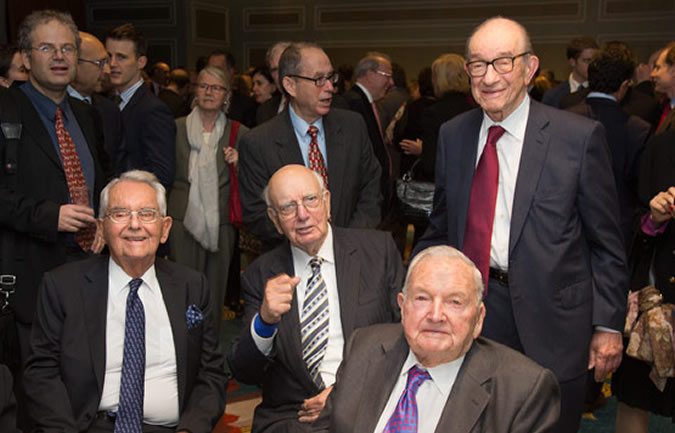 Trilateral Commission Members Pete Peterson, Paul Volker, David Rockefeller and Alan Greenspan - Photo: Brian Stanton

This
is an excellent read on the Trilateral Commission and not just because
it cites the early works of Antony Sutton and myself. The Commission was
the fountainhead of Sustainable Development, aka Technocracy. ⁃ TN
Editor
Following on from this let’s take a brief look at the structure of the Trilateral Commission before attempting to gain an understanding of their goals.
In the late 1970s researchers Antony Sutton and Patrick Wood published a two volume book called, ‘Trilaterals Over Washington‘. The opening chapters go into extensive detail on the composition of the commission which is broken down into three key parts: The Operators, The Propagandists and Technicians, and the Power Holders.
The Operators are shown as being a quartet of politicians, bureaucrats, establishment lawyers and trade unionists. According to the authors, operators ‘retain administrative positions only as long as they are successful in using political power to gain political objectives‘. To remain attached to the Commission, they are obligated to ‘go along to get along‘ by expressing loyalty to the institutions aims.
A step above The Operators are the Propagandists and Technicians. In this instance, Propagandists are the media who seek to control the public news cycle, whereas Technicians are the academics and research controllers who devise the plans required to ‘promote and implement objectives.’ It is these plans which politicians and bureaucrats attempt to bring before the legislature for implementation. However, Propagandists and Technicians are only successful in their endeavour if they manage to ‘conceive and promote plans within the overall framework welcome to the Power Holders.’
In short, Propagandists and Technicians are ‘the intellectual linkage between the Power Holders and The Operators.’ Without them, plans cannot be devised and disseminated down to government.
A level up from the Propagandists and Technicians are The Power Holders, a concentrated mix of multinational corporate directors and international bankers. Sutton and Wood declared that the Power Holders exist to,
lay down guidelines for the
propagandists and the research directors, and pass through objectives to
the operators for implementation. Remember, a Richard Nixon goes to see
international banker David Rockefeller, not the other way around.
The Power Holders are, in part, those who make-up the Trilateral
Commission’s Executive Committee. Since its introduction in 1973,
membership of the Commission has been by invitation only. Deciding who
to extend invitations to is a matter for the chairmen of each regional
group in the Commission and fellow members of the Committee. For
reference, the three regional groups consist of North America, Europe
and Asia Pacific.From its inception to the present day, the Trilateral Commission has been populated by individuals representing multiple different think tanks, councils and institutions. Some of these include the UK’s House of Commons and House of Lords, the Council on Foreign Relations (CFR), The Brookings Institution, Bilderberg, The Carlyle Group and the Belfer Centre for Science and International Affairs.
On examination of the Commission’s membership list, a clear interlock begins to emerge between the Commission and outside institutions. For example, the chairman of the CFR, Richard Haass, is a member, as is the chairman of the Carlyle Group, David Rubenstein. The Trilateral Commission could be construed as a forum that brings together some of the most influential men and women within industry, those who openly share the Commission’s international objectives.
At the time of publishing their book, Sutton and Wood discovered that of the twelve members of the North American Committee, three of them (David Rockefeller, William Coleman and Henry Kissinger) were intimately connected to Chase Manhattan Bank in New York. In the case of David Rockefeller, not only was he the founder of the Trilateral Commission and chairman of the Executive Committee, he was also the chairman of Chase Manhattan. The authors go on to reveal that, at the time, eight members of the board at Chase were members of Rockefeller’s Commission. In other words, the power base at the Trilateral Commission was firmly rooted within the circles of banking.
For historical context, it is important to note that one of the Trilateral Commission’s founding members was former U.S. President Jimmy Carter. After securing the Presidency in 1976, Carter filled his administration with eighteen members of the Commission – the most prominent of which was Zbigniew Brzezinski. The Commission’s website declares that ‘members who take up positions in their national administration give up Trilateral Commission membership.’ But this does not mean that they do not remain allied to the Commission’s aspirations.
This was certainly the case with Zbigniew Brzezinski. Brzezinski was the founding director of the Trilateral Commission, and after being selected as Jimmy Carter’s National Security Advisor promptly relinquished his membership. In the 1980’s he returned to the Commission to resume his duties on the Executive Committee.
Prior to the Commission being founded, Brzezinski wrote a book in 1969 titled ‘Between Two Ages; America’s Role in the Technotronic Era.’ It was here where Brzezinski began to lay out what in his mind was the necessity for international collaboration over the sovereignty of the nation state:
Tension is unavoidable as man
strives to assimilate the new into the framework of the old. For a time
the established framework resiliently integrates the new by adapting it
in a more familiar shape. But at some point the old framework becomes
overloaded. The new input can no longer be redefined into traditional
forms, and eventually it asserts itself with compelling force.
Today, the old framework of
international politics — with their spheres of influence, military
alliances between nation-states, the fiction of sovereignty, doctrinal
conflicts arising from nineteenth-century crises — is clearly no longer
compatible with reality.
The suppression of national sovereignty in favour of a global form of
centralised governance is a leading pillar of the Trilateral
Commission.In the book, Brzezinski described how ‘necessary political innovation‘ – such as a ‘re-examination‘ of the American Constitution – could be applied:
Political innovation will not come
from direct constitutional reform, desirable as that would be. The
needed change is more likely to develop incrementally and less overtly.
Nonetheless, its eventual scope may be far-reaching, especially as the
political process gradually assimilates scientific-technological change.
What Brzezinski is describing here is the model of gradualism. The
likes of the Bank for International Settlements have openly discussed
the benefits of using gradualism as a method for exacting change in
regards to monetary policy. Instead of jumping forward with a plan, it
is much more beneficial to use covert methods of control that span over
the decades. The Trilateral Commission have long since recognised that
exercising patience is advantageous when it comes to implementing what
is a global agenda.In a further denouncement of the nation state, Brzezinski posited that it had ‘ceased to be the principal creative force‘. Taking its place were international banks and multinational corporations (the two entities which Antony Sutton and Patrick Wood cited as the Power Holders of the Trilateral Commission). Therefore, with the ‘nation-state gradually yielding its sovereignty‘, banks and corporations were now ‘acting and planning in terms that are far in advance of the political concepts of the nation-state‘.
From Brzezinski’s analysis, we begin to understand how Corporatism has superseded individual nations. Nearly fifty years on, global corporations have become the vehicle for integrating the planet under the banner of globalisation. This has been facilitated in large part by cross party mergers and acquisitions, which in 2018 have reached record levels. Indeed, the wealth of major corporations now surpasses that of entire countries.
The goal of a global society where the collective takes precedent over the individual is deeply entrenched within the Trilateral Commission. To achieve such a goal requires an extreme level of dedication and conviction. Perhaps the one passage in Brzezinski’s book that speaks of an almost ethereal purpose is where he discusses how man encompass a ‘yearning to understand himself and his environment.’
However crudely and primitively,
man has always sought to crystallize some organizing principle that
would, by creating order out of chaos, relate him to the universe and
help define his place in it.
Order out of chaos has been the prevailing model for globalists
dating back to at least the First World War. It was out of chaos that
the League of Nations, The Bank for International Settlements, the
International Monetary Fund, the World Bank and the United Nations were
founded. All of which are symbols of internationalism.In 1998, during a 25 year celebration evening of the Trilateral Commission, Brzezinski hinted at the idea of order originating out of chaos:
Not quite a decade ago, the Cold
War came to an end and we all started searching for another formula
which would capture the essence of the new situation in which we found
ourselves. A phrase emerged which was meant to describe the fundamental
character of the security condition of the world, and it was the ‘New
World Order’. The New World Order was to imply accommodation,
cooperation.
Brzezinski went on to say that after the fall of the Soviet Union, ‘assertive multilateralism‘ came into being. According to Brzezinski, the hope at the time was for the United Nations to help ‘shore up the New World Order‘:
Very quickly we discovered that assertive multilateralism was an oxymoron and that the New World Order wasn’t there.
When Brzezinski wrote of old frameworks becoming ‘overloaded‘, this could be construed today as the gradual breakdown of what world leaders proclaim as the ‘rules based global order‘. The advents of Brexit, Donald Trump and Italian ‘populism‘ serve to reinforce this perception. Media outlets continue to associate a rise in nationalistic / protectionist tendencies as the ‘rules based global order‘ coming under increasing strain. Were Brzezinski alive today, he might well cite resistance to the ‘international order‘ seen throughout the western world as an indication that it is more a myth than a reality.It was at the same 25 year celebratory event where alternative speakers spoke devotedly about internationalism and in condemnation of nationalism and sovereignty. Sadako Ogata, a former member of the Trilateral Commission’s Executive Committee, remarked how ‘international interdependence requires new and more intensive forms of international cooperation to counteract economic and political nationalism‘. This relates to a recent statement by French President Emmanuel Macron on trade tariffs implemented by Donald Trump, in which he said that ‘economic nationalism leads to war‘.
Ogata also warned of a ‘reawakening of inward-looking attitudes‘ and stressed how the most vulnerable elements of society must be included, such as migrants and refugees. Since the onset of the ‘Arab Spring‘ in 2010, Europe has seen a exponential rise in displaced residents seeking refuge from war ravaged countries. This has contributed to a ‘reawakening‘ of nationalist / protectionist sentiments within both the public and political sphere.
Peter Sutherland, a former European member of the Commission, spoke of how integration in Europe comes down to a ‘willingness on the part of old nations to share sovereignty.’ Sutherland went as far to say that absolute sovereignty was no longer a ‘viable option into the future‘ – not even for the United States. Instead, it was multilateralism which was the essential ingredient for ‘binding our interdependence together.’
Georges Berthoin, once European Chairman of the Trilateral Commission, declared the enlarged European community that grew out of two world wars had originated ‘without nationalistic and imperial undertones.’
Outside of the membership, former Presidents Bill Clinton, George H.W. Bush and Jimmy Carter wrote letters expressing sorrow for not being able to attend the Commission’s anniversary event. It should be noted that prior to entering the White House, all three gentlemen have previously been members of the Commission.
Clinton wrote about the efforts of the G7 and ‘numerous private / public institutions‘ who were all ‘dedicated to deepening international cooperation.’
Bush on the other hand expressed concern about ‘today’s voices of protection from left and right – those that seem to feel we should no longer enter into international trade agreements.’ This mirrors closely what is going on today through the Trump administration.
Lastly, Jimmy Carter was adamant that the Trilateral Commission had ‘encouraged understanding and cooperation rather than conflict.’ What Carter did not mention is that to reach a place of ‘understanding‘ and ‘cooperation‘, conflict almost always ensues first. It is then that globalist organisations like the Commission seek to implement order out of chaos.
When you combine all of these beliefs, it becomes clear that the Trilateral Commission exists to promote internationalism at the expense of national sovereignty. But rather than being a hindrance to their objectives, resurgent nationalism and protectionism provides exactly the sought of chaos in which the Commission and other institutions working through them can exploit in order to promote a global agenda for greater integration between nations.
Read full story here…
Source: technocracy.news
Blogger's note:
subterrnews.blogspot.com does not send cookies, or collect any information on
those using the blog. However, the blogspot is on google, and google may
collect information, and send cookies. Many of the links that we
connect to do not send out cookies or collect information, but some do.
You are keying in to this blog, and you have agreed to this.
The views expressed in the articles
do not necessarily represent the opinions of this blog. They are the views, and opinions of the
author(s) of the article.
0 comments:
Post a Comment