Technocracy: The Digital Panopticon Of The World Economic Forum

The
World Economic Forum is totally supporting all of the UN’s Sustainable
Development Goals (SDGs), aka Technocracy. Here is an A to Z analysis of
each SDG and what they really mean. Please take time to read
through each point, listen to each short video and then share as widely
as possible. Also note that this article introduces new TN contributor,
Jacob Nordangård, PhD from Sweden. ⁃ TN Editor
The work is part of WEF’s new initiative Frontier 2030, led by Danish Anne Marie Engtoft Larsen (who also contributed to Klaus Schwab’s book Shaping the Fourth Industrial Revolution). Noteworthy is that six of the seven main authors of the report are women. Big Mother coming to our rescue?
The world, if all goes according to plan, is to be completely transformed over the course of a decade. Just like Maurice Strong at the first Stockholm Conference in 1972, the United Nations claims that we have “only ten years” to save the world, and both the UN and WEF have dubbed the next ten years the Decade of Action.
This campaign is very well coordinated and includes governments, international organisations, and representatives of “civil society”. Also onboard are the big tech giants who all see great opportunities for profit (read: tens or even hundreds of billions of dollars) in “saving and improving the world”. All according to WEF’s principle of Public-Private Partnership (originating with Mussolini, implemented in Sweden, and successfully propagated internationally by David Rockefeller).
The United Nation’s 17 Global Goals
give a blueprint for what we globally and collectively must do if we are
to end extreme poverty, protect our natural environment, revert climate
change and create a more sustainable, equal and prosperous future for
all. (Unlocking Technology for the Global Goals)
So, what is this technological solution all about?The report gives an overview on how 4IR could help reach the 17 SDGs. This is a plan that promises Utopia but offers only Technocracy as a solution, with no other options available.
The report presents a technocratic society where the whole world is to be controlled and governed with the help of AI, satellites, robotics, drones, the Internet of Things, and with artificial food on the menu. A global digital panopticon where all human activities are to be recorded, analysed, and corrected with the help of Social Credits – yes, even here in the West!
The Fourth Industrial Revolution is now openly displayed as a powerful weapon against the masses with a digital god (AI) who will judge and control us in real time. This is the ultimate form of social engineering and a serious threat to the freedom of humanity.
In this vision, man is also meant to be altered to become something other than a human being.
It is conceivable, on the other hand,
that geocybernetics will follow completely different (or complementary)
courses that lie more in the realm of social management. Here the
demographic issue overrides other themes: Is there an optimal number of
human beings to be supported by the ecosphere ? What is the right mix of
condensing people in cities and dispersing them across landscapes?
(Hans Joachim Schellnhuber)
WEF’s solution to each of the Sustainable Development Goals
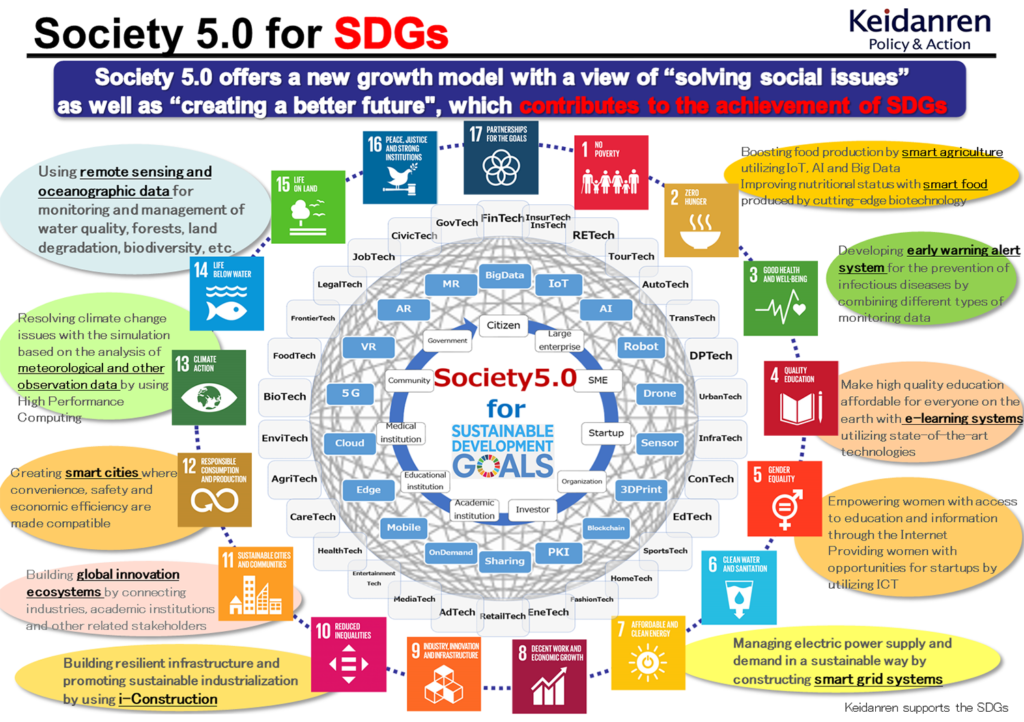
Here are some examples of the many 4th Industrial Revolution measures for Goal 1-16 proposed by the World Economic Forum (with examples from Youtube by corporations marketing their version of each solution).Goal 1. No poverty
“Poverty alleviation and social protection”Solutions:
- AI-enabled digital footprint for credit/mobile money access
- Blockchain digital identity solutions to enable economic identities, incl. for refugees
Video
Goal 2. Zero hunger
“Access to food, improved nutrition and food-production security”Solutions:
- Low-cost, low-GHG emissions synthetic proteins.
- AI, sensors and blockchain to eliminate spoilage/loss in food value chain, including smart food storage
Video
Goal 3. Good health and well-being
“Advancing global health for all ages, and healthcare services”
Solutions:
- Smart homecare, smart wearables and virtual healthcare assistants
- Monitoring and predicting health metrics and disease, including smart implants, wearables
= Get diagnosed by an artificial doctor and have your body monitored via implanted sensors.
Goal 4. Quality education
“Inclusive access to education, quality of education and learning facilities”
Solutions:
- AI-driven assessments to enable the delivery of continuous feedback
- AI-designed digital curriculums, teaching plans and content across devices
= Leave the indoctrination to an AI. It never gets tired and will nag until you give up.
Goal 5. Gender equality
“Facilitating gender equality, protecting and empowering women and girls”Solutions:
- AI-enabled real-time gender data analytics
- AI to identify unbiased selection to support inclusivity
= Replace human intelligence with an AI to avoid incorrect
judgments. Analyse data to identify and correct unbalanced gender
representations.
Goal 6. Clean water and sanitation
“Access to and sustainable management of water, and water sanitation”Solutions:
- AI-enhanced scenario modelling for water infrastructure risks and performance
- Smart water-infrastructure predictive maintenance
= Monitor all water systems. Never mind those who don’t have any water at all.
Goal 7. Affordable and clean energy
“Adopting sustainable energy, and energy-system optimization”Solutions:
- 4IR-enabled decentralized and coordinated energy-grid management, incl. IoT, AI
- Smart infrastructure for operational efficiency and maintenance
= Monitor all energy systems in real time.
Goal 8. Decent work and economic growth
“Sustained and inclusive job creation and productivity, and improving workers’ rights”Solutions:
- Robotics for process automation for increased productivity
- AI-enabled digital support hubs for workers
= Replace workers with robots and use AI to guide the remaining workforce.
Goal 9. Industry, infrastructure and innovation
“Building inclusive, resilient and sustainable infrastructure and industry”Solutions:
- IoT-enabled tracking and optimization of industrial machinery
- Robotics for manufacturing and construction process automation
= Monitor all industrial processes and automate to make people more and more irrelevant.
Goal 10. Reduced inequalities
“Facilitating equality and international collaboration”
Solutions:- AI-enabled digital footprint for mobile money access
- Next-gen demographics data analytics
Goal 11. Sustainable cities and communities
“Building smart, inclusive, safe and resilient urban systems”Solutions:
- “Sensor-based grid and AI-based urban network management (pollution, waste, water, energy)”
- “Next-gen satellite, drone and IoT landuse detection and management”
Video
Goal 12. Responsible consumption and production
“Supply-chain optimization and sustainable consumption patterns”Solutions:
- “AI- and IoT-enabled consumption and production data analytics”
- “AI-optimized logistics and distribution networks to minimize costs, emissions and waste”
Video
Goal 13. Climate action
“Combating climate change and its impacts”Solutions:
- “Earth management big data platform e.g. monitoring carbon emissions”
- “Smart and transparent land-use management”
Video
Goal 14. Life below water
“Conserving and managing the use of marine habitats and resources”Solutions:
- “Habitat monitoring and analytics (e.g. monitoring pH and pollution)”
- “AI-enabled data platforms to monitor and manage fishing activity and compliance”
Goal 15. Life on land
“Protecting and restoring terrestrial ecosystems”Solutions:
- “Real-time habitat and land-use mapping, monitoring and detection of illegal or adverse activities”
- “4IR-enabled wildlife tracking, monitoring, analytics and pattern forecasting and real-time detection, e.g. disease, animal capture”
Goal 16. Peace, justice and strong institutions
“Promoting peaceful society, building effective institutions”Solutions:
- “AI-enabled identity tax fraud identification (using browsing data, retail data and payments history)”
- “Blockchain-enabled citizen loyalty and reward platforms”
Video
In addition, a number of technologies are listed that are
in a developing phase (low maturity) which could potentially be used to
meet the goals. Here we find, among other things:
- Genetic rescue and genome modification for endangered and extinct species and resilience
- Low-cost, low-GHG emissions synthetic proteins (AI and synthetic biology)
- Decoding well-being and longevity using AI and sensors for personalized health maps and sequenced genomes and phenotypic data
- Gene editing (e.g. CRISPR) to tackle human diseases driven by gene mutation
Goal 17: Partnerships for the goals
“Building sustainable global partnerships”This last goal is not included in WEFs table of 4IR solutions, but both the UN and the Group of 20 (G20) are being strengthened at a rapid pace and the 4IR solutions for each goal that was introduced before the 2019 G20 Summit are strikingly similar.
Risks of the new technology
The WEF report does see some risks with their Brave New World:
For all of the enormous
potential that scaling Fourth Industrial Revolution technologies offer
for accelerating action to reach the Global Goals, these technologies
also have the potential to exacerbate many existing societal challenges,
and to create new risks that could hinder the Global Goals.
- The AI-led technology system may act prejudiced and biased.
- It is difficult to achieve full employment if everything is to be automated.
- Control and power over the technology risks being concentrated to a few actors.
Technology solutions,
including AI, blockchain, the IoT, cloud services, 5G and quantum
computing can consume large amounts of energy due to the computer
processing power required and the number of operations or sensors
feeding into the digital system or network.
- The advanced technological system consumes enormous amounts of energy.
- AI and computer vision can be used to find and exploit rare raw materials instead of protecting nature.
- Electronic scrap from all the computers, sensors and devices needed for the technology solution can give rise to environmental pollution.
In 2021, the amount of e-waste generated is predicted to grow to 52.2 million tonnes,71 with just 20% formally recycled.
- Abuse of the personal data collected can damage reputation, finances and security.
- Cyberattacks can cripple the system.
Other Warnings
Dirk Helbing, head of the EU project FuturICT,
has for some years warned that a fascist surveillance state is about to
be built, more advanced than anything ever seen through
history. Helbing notes that all functions that a fascist state may need
have already been implemented digitally or are being implemented, and
can be used on a universal scale at any time.
We are faced with the
emergence of a new kind of totalitarianism of global dimensions that
must be stopped immediately. An emergency operation is inevitable, if we
want to save democracy, freedom, and human dignity. (…) Arguments such
as terrorism, cyber threats and climate change have been used to
undermine our privacy, our rights, and our democracy.
Just as the United Nations has declared the Decade of Action, it is time for all who stand up for free humanity and to reject the technocratic global surveillance state which now threatens us all.
Source: technocracy.news
Blogger's note:
subterrnews.blogspot.com does not send cookies, or collect any information on
those using the blog. However, the blogspot is on google, and google may
collect information, and send cookies. Many of the links that we
connect to do not send out cookies or collect information, but some do.
You are keying in to this blog, and you have agreed to this.
The views expressed in the articles
do not necessarily represent the opinions of this blog. They are the views, and opinions of the
author(s) of the article.
0 comments:
Post a Comment