
This article was originally published on The New Yorker in January 1972.
Early on
March 16, 1968, a company of soldiers in the United States Army’s
Americal Division were dropped in by helicopter for an assault against a
hamlet known as My Lai 4, in the bitterly contested province of Quang
Ngai, on the northeastern coast of South Vietnam. A hundred G.I.s and
officers stormed the hamlet in military-textbook style, advancing by
platoons; the troops expected to engage the Vietcong Local Force 48th
Battalion—one of the enemy’s most successful units—but instead they
found women, children, and old men, many of them still cooking their
breakfast rice over outdoor fires. During the next few hours, the
civilians were murdered. Many were rounded up in small groups and shot,
others were flung into a drainage ditch at one edge of the hamlet and
shot, and many more were shot at random in or near their homes. Some of
the younger women and girls were raped and then murdered. After the
shootings, the G.I.s systematically burned each home, destroyed the
livestock and food, and fouled the area’s drinking supplies. None of
this was officially told by Charlie Company to its task-force
headquarters; instead, a claim that a hundred and twenty-eight Vietcong
were killed and three weapons were captured eventually emerged from the
task force and worked its way up to the highest American headquarters,
in Saigon. There it was reported to the world’s press as a significant
victory.
The G.I.s mainly kept to themselves what they had done, but there had
been other witnesses to the atrocity—American helicopter pilots and
Vietnamese civilians. The first investigations of the My Lai case, made
by some of the officers involved, concluded (erroneously) that twenty
civilians had inadvertently been killed by artillery and by heavy cross
fire between American and Vietcong units during the battle. The
investigation involved all the immediate elements of the chain of
command: the company was attached to Task Force Barker, which, in turn,
reported to the 11th Light Infantry Brigade, which was one of three
brigades making up the Americal Division. Task Force Barker’s victory
remained just another statistic until late March, 1969, when an ex-G.I.
named Ronald L. Ridenhour wrote letters to the Pentagon, to the State
Department, to the White House, and to twenty-four congressmen
describing the murders at My Lai 4. Ridenhour had not participated in
the attack on My Lai 4, but he had discussed the operation with a few of
the G.I.s who had been there. Within four months, many details of the
atrocity had been uncovered by Army investigations, and in September,
1969, William L. Calley, Jr., a twenty-six-year-old first lieutenant who
served as a platoon leader with Charlie Company, was charged with the
murder of a hundred and nine Vietnamese civilians. No significant facts
about the Calley investigation or about the massacre itself were made
public at the time, but the facts did gradually emerge, and eleven days
after the first newspaper accounts the Army announced that it had set up
a panel to determine why the initial investigations had failed to
disclose the atrocity. The panel was officially called the Department of
the Army Review of the Preliminary Investigations into the My Lai
Incident, and was unofficially known as the Peers Inquiry, after its
director, Lieutenant General William R. Peers, “who was Chief of the
Office of Reserve Components at the time of his appointment. The
three-star general, then fifty-five years old, had spent more than two
years as a troop commander in Vietnam during the late nineteen-sixties,
serving as commanding general of the 4th Infantry Division and later as
commander of the I Field Force. As such, he was responsible for the
military operations and pacification projects in a vast area beginning
eighty miles north of Saigon and extending north for two hundred and
twenty miles.Peers and his assistants, who eventually included two New York lawyers, began working in late November, 1969, and they soon determined that they could not adequately explore the coverup of the atrocity without learning more about what had actually happened on the day the troops were at My Lai 4. On December 2, 1969, the investigating team began interrogating officers and enlisted men in each of the units involved—Charlie Company, Task Force Barker, the 11th Brigade, and the Americal Division. In all, four hundred witnesses were interrogated—about fifty in South Vietnam and the rest in a special-operations room in the basement of the Pentagon—before Peers and a panel of military officers and civilians that varied in size from three to eight men. The interrogations inevitably produced much self-serving testimony. To get at the truth, the Peers commission recalled many witnesses for further interviews and confronted them with testimony that conflicted with theirs. Only six witnesses who appeared before the commission refused to testify, although all could legally have remained silent; perhaps one reason that Peers got such coöperation is that the majority of the witnesses were career military men, and few career military men can afford to seem to be hiding something before a three-star general.
By March 16, 1970, when the investigation ended, the Peers commission had compiled enough evidence to recommend to Secretary of the Army Stanley R. Resor and Army Chief of Staff William C. Westmoreland that charges be filed against fifteen officers; a high-level review subsequently conducted by lawyers representing the office of the Judge Advocate General, the Army’s legal adviser, concluded that fourteen of the fifteen should be charged, including Major General Samuel W. Koster, who was commanding general of the Americal Division at the time of My Lai 4. By then, Koster had become Superintendent of the United States Military Academy, at West Point, and the filing of charges against him stunned the Army. One other general was charged, as were three colonels, two lieutenant colonels, three majors, and four captains. Army officials revealed shortly after the charges were filed that the Peers commission had accumulated more than twenty thousand pages of testimony and more than five hundred documents during fifteen weeks of operation. The testimony and other material alone, it was said, included thirty-two books of direct transcripts, six books of supplemental documents and affidavits, and volumes of maps, charts, exhibits, and internal documents. Defense Department spokesmen explained that, to avoid damaging pre-trial publicity, none of this material could be released to the public until the legal proceedings against the accused men were completed, and officials acknowledged that the process might take years. In addition, it was explained, when the materials were released they would have to be carefully censored, to insure that no material damaging to America’s foreign policy or national security was made available to other countries. In May, 1971, fourteen months after the initial Peers report, officials were still saying that “it might be years” before the investigation was made public. By then, charges against thirteen of the fourteen initial defendants had been dismissed without a court-martial.
Over the past eighteen months, I have been provided with a complete transcript of the testimony given to the Peers Inquiry, and also with volumes of other materials the Peers commission assembled, including its final summary report to Secretary Resor and General Westmoreland. What follows is based largely on those papers, although I have supplemented them with documents from various sources, including the Army’s Criminal Investigation Division, which had the main responsibility for conducting the initial investigations into both the My Lai 4 massacre and its coverup. In addition, I interviewed scores of military and civilian officials, including some men who had been witnesses before the Peers commission and some who might have been called to testify but were not. I also discussed some of my findings with former members of the Army who had been directly connected with the Peers commission.
Unquestionably, a serious concern for the rights of possible court-martial defendants does exist at all levels of the Army. A careful examination of the testimony and documents accumulated by the Peers commission makes equally clear that military officials have deliberately withheld from the public important but embarrassing factual information about My Lai 4. For example, the Army has steadfastly refused to reveal how many civilians were killed by Charlie Company on March 16th—a decision that no longer has anything to do with pre-trial publicity, since the last court-martial (that of Colonel Oran K. Henderson, the commanding officer of the 11th Brigade) has been concluded. Army spokesmen have insisted that the information is not available. Yet in February, 1970, the Criminal Investigation Division, at the request of the Peers commission, secretly undertook a census of civilian casualties at My Lai 4 and concluded that Charlie Company had slain three hundred and forty-seven Vietnamese men, women, and children in My Lai 4 on March 16, 1968—a total twice as large as had been publicly acknowledged. In addition, the Peers commission subsequently concluded that Lieutenant Calley’s first platoon, one of three that made the attack upon My Lai 4, was responsible for ninety to a hundred and thirty murders during the operation—roughly one-third of the total casualties, as determined by the C.I.D. The second platoon apparently murdered as many as a hundred civilians, with the rest of the deaths attributable to the third platoon and the helicopter gunships. Despite the vast amount of evidence indicating that the murders at My Lai 4 were widespread throughout the company, only Calley was found guilty of any crime in connection with the attack. Eleven other men and officers were eventually charged with murder, maiming, or assault with intent to commit murder, but the charges were dropped before trial in seven cases and four men were acquitted after military courts-martial. In addition, of the fourteen officers accused by the Peers commission in connection with the coverup only Colonel Henderson was brought to trial. Even more striking was evidence that the attack on My Lai 4 was not the only massacre carried out by American troops in Quang Ngai Province that morning. The Army Investigators learned that Task Force Barker had committed three infantry companies to the over-all operation in the My Lai area. Alpha Company had moved into a blocking position above My Lai 4, where it would theoretically be able to trap Vietcong soldiers as they fled from the Charlie Company assault on the hamlet. Bravo Company, the third unit in the task force, was ordered to attack a possible Vietcong headquarters area at My Lai 1, a hamlet about a mile and a half northeast of My Lai 4. The men of Bravo Company were also told to prepare for a major battle with an experienced Vietcong unit. But, as the Peers commission later learned, there were no Vietcong at My Lai 1, either.
Bravo Company
was told about the planned assault on My Lai 1 at a briefing on the
night of March 15th. The men of Task Force Barker were called together
by their officers that night and told (so one G.I. recalled), “This is
what you’ve been waiting for—search and destroy—and you got it.” Captain
Earl R. Michles, the company commander, outlined the mission and its
objective to his artillery forward observer, the platoon leaders, and
other selected members of his command group. The key target, he said,
was My Lai 1, a small, often attacked hamlet that was thought to be the
headquarters and hospital area of the Vietcong 48th Battalion. Army maps
showed that My Lai 1 and the neighboring hamlets of My Lai 2, My Lai 3,
and My Lai 4 were part of the village of Son My—a heavily populated
area, embracing dozens of hamlets, that was known to the G.I.s as
Pinkville, because Son My’s high population density caused it to appear
in red on Army maps. To the Americans who operated in the area,
Pinkville meant Vietcong guerrillas and booby traps. More than ninety
per cent of the Americal Division’s combat injuries and deaths in early
1968 resulted from Vietcong booby traps and land mines. Bravo Company
was to be flown into the area by helicopter to engage the Vietcong at My
Lai 1, and was then to move south into other supposed Vietcong hamlets
along the South China Sea. Precisely what information Michles and his
platoon leaders gave their men is impossible to determine, but their
briefings—like a similar briefing by Captain Ernest L. Medina, the
commander of Charlie Company, at another Task Force Barker fire base, a
few miles away—left the soldiers with the impression that everyone they
would see on March 16th was sure to be either a Vietcong soldier or a
sympathizer.
Michles’s radio operator, Specialist Fourth Class Lawrence L.
Congleton, recalled that after the briefing “there was a general
conception that we were going to destroy everything.” Only a few of more
than forty former Bravo Company G.I.s who were interviewed by members
of the Peers commission or who talked with me recalled hearing a
specific order to kill civilians. Larry G. Holmes, who was a private
first class at the time of the operation, summed up the recollections of
many G.I.s when he told the commission, “We had three hamlets that we
had to search and destroy. They told us they . . . had dropped leaflets
and stuff and everybody was supposed to be gone. Nobody was supposed to
be there. If anybody is there, shoot them.” No specific instructions
were given about civilians and prisoners, the men told the commission.
“We were to leave nothing standing, because we were pretty sure that
this was a confirmed V.C. village,” former Private First Class Homer C.
Hall testified. One ex-G.I., Barry P. Marshall, told the Peers
commission that he had overheard a conversation between Lieutenant
Colonel Frank A. Barker, Jr., the commander of the task force, and
Michles (both of whom were killed in a helicopter crash three months
after the operation). “I don’t want to give the idea that Colonel Barker
wanted us to kill every blankety-blank person in here,” Marshall said.
“They were just talking. . . . Colonel Barker was just saying that he
wished he could get in here and get rid of the V.C. . . . I know Captain
Michles’s own personal feeling was that he wanted to take every
civilian out of there and move them out of the area to a secure place,
and then go in and fight the V.C. It’s so hard, when you’ve got all
these people milling around in there, to really conduct an operation of
any significance.”On the morning of the assault, nine troop-transport helicopters, accompanied by two gunships, began ferrying the men of Charlie Company from their assembly point, at Landing Zone Dottie. From Dottie, which also was the site of the task-force headquarters area, the helicopters ferried the men about seven miles southeast to their target area, just outside My Lai 4. The helicopters completed that task by 7:47 a.m., according to the official task-force journal for the day, and then flew a few miles north to Bravo Company’s assembly point to begin shuttling the men of Bravo Company to My Lai 1 for the second stage of the assault. It is not clear why Charlie Company’s assault took place first. Large numbers of Vietcong were thought to be in both hamlets, and, according to the official rationale for the mission, surprise was a key factor. As it was, the first elements of Bravo Company did not reach their target area until 8:15 a.m., and it then took twelve minutes for the full company to assemble. The men were apprehensive, and nothing at their target area soothed them. As they jumped off the aircraft, their rifles at the ready, they heard gunfire in the distance.
The shots were coming from My Lai 4, a mile and a half to the southwest, where by this time Charlie Company was in the midst of massacre. Specialist Fourth Class Ronald J. Easterling, a former machine gunner in Bravo Company’s third platoon, told the Peers commission, “When we landed we had to take cover . . . because we thought we were getting shot at. We found out later, well, about fifteen minutes or so, it was Charlie Company from over in the other direction. Some of their bullets were coming our direction unintentionally . . .” Although the sounds were frightening, there was no immediate threat to Bravo Company; no enemy shots were fired at the G.I.s as they left the helicopters. The men milled around for a few moments and then began to move out.
The first platoon, headed by First Lieutenant Thomas K. Willingham, marched a few hundred yards east. Its mission was to cross a narrow bridge to a small peninsula—a spit of land on which the small hamlet of My Khe 4 was situated—in the South China Sea. The second platoon, headed by First Lieutenant Roy B. Cochran, was to systematically search My Lai 1 and destroy it. But My Lai 1 was screened by a thick hedge and heavily guarded by booby traps. “Within minutes, a mine hidden in the hedgerow was tripped and the men of Bravo Company heard screams. In the explosion, Lieutenant Cochran was killed and four G.I.s were seriously injured. Helicopters were called in to evacuate the wounded men. The platoon was hastily reorganized, with a sergeant in command, and ordered to continue its mission. Another booby trap was tripped; once more there were screams and smoke. This time, three G.I.s were injured, and the unit was in disarray. The surviving G.I.s in the platoon insisted that they were not going to continue the mission, and said as much to Captain Michles. Colonel Barker flew in himself to see to the evacuation of the wounded, and then, rather than call on the first or the third platoon to complete the mission, he cancelled Bravo Company’s order to search and destroy My Lai 1. “[He] told them not even try to go in there,” Congleton, the radio operator, recalled to the Peers commission. “Just sort of forget about that part of the operation.” Relieved at not having to enter My Lai 1, the second platoon began a rather aimless and halfhearted movement through huts and hamlets to the south, across the water from My Khe 4 and the first platoon.
My Khe 4 was a scraggly, much harassed collection of straw-and-mud houses, inhabited by perhaps a hundred women, children, and old men. After carefully crossing the bridge, some of the G.I.s in the first platoon could see the unsuspecting villagers through heavy brush and trees. Lieutenant Willingham, according to many witnesses, ordered two machine gunners in his platoon to set up their weapons outside the hamlet. And then, inexplicably, one of the gun crews began to spray bullets into My Khe 4, shooting at the people and their homes. A few G.I.s later told the Peers commission that a hand grenade had been thrown at them; others said that some sniper shots had been fired. But no one was shot, and none of the G.I.s said they had ever actually seen the grenade explosion; they had only “heard about it.”
By now, it was about nine-thirty, and the men in the rear of the first platoon were ordered to pass forward extra belts of machine-gun ammunition and hand grenades. When the gun crew stopped, the platoon, led by four point men, or advance scouts, walked into the hamlet and began firing directly at Vietnamese civilians and into Vietnamese homes. The gunfire was intense. Former Private Terry Reid, of Milwaukee, recalled that he was standing a few hundred feet below the hamlet when it began. He knew that civilians were being shot. “As soon as they started opening up, it hit me that it was insanity,” he told me during an interview in May, 1971. “I walked to the rear. Pandemonium broke loose. It sounded insane—machine guns, grenades. One of the guys walked back, and I remember him saying, ‘We got sixty women, kids, and some old men.’ ”
After the shootings in My Khe 4, a few of the G.I.s in the first platoon started systematically blowing up every bunker and tunnel. Some Vietnamese attempted to flee the bunkers before the explosives were thrown in. They were shot. “Try and shoot them as they are coming out,” one member of the first platoon was instructed. Another ex-G.I. told me what happened to those who stayed in the bunkers: “You didn’t know for sure there were people in them until you threw in the TNT, and then you’d hear scurrying around in there. There wasn’t much place for them to go.” A helicopter flew extra supplies of dynamite and other explosives to the men, apparently at Willingham’s request. More than a hundred and fifty pounds of TNT was used, one ex-G.I. said, and between twenty and thirty homes were blown up. At some point that morning, according to several members of the platoon, word was passed along to stop the killing, and many of the surviving residents of the hamlet were allowed to flee to a nearby beach. They lived to tell Army investigators about the massacre. Others remained huddled in the family shelters inside their homes.

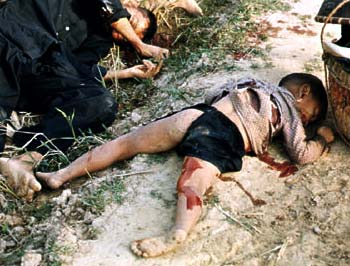
South
Vietnamese women and children in Mỹ Lai before being killed in the
massacre, 16 March 1968. According to court testimony, they were killed
seconds after the photo was taken. The woman on the right is adjusting
her blouse buttons following a sexual assault that happened before the
massacre. (Photo by
Precisely how many residents of My Khe 4 were slain will never be
known. The Army later charged Lieutenant Willingham with involvement in
the death of twenty civilians, but the charges were dismissed by an Army
general a few months later without a hearing. Some survivors told
military investigators early in 1970 that from ninety to a hundred
women, children, and old men were slain. One ex-G.I. who kept a count
said he knew of a hundred and fifty-five deaths; other estimates ranged
from sixty to ninety. The official log of Task Force Barker for March
16th shows that Bravo Company claimed an enemy kill of thirty-eight in
three separate messages to the task force during the day. At 9:55 a.m., it reported killing twelve Vietcong; at 10:25 a.m., it claimed eighteen more; and it claimed eight more at 2:20 p.m., some two hours after the massacre. At 3:55 p.m., it reported that none of its victims were women or children.Early in 1968, the 11th Infantry Brigade had established a standard procedure for making body counts, which required an on-site identification of a dead enemy soldier before the body could be reported. All the officers of Task Force Barker interviewed by the Peers commission indicated an awareness of this regulation, and claimed that the task force adhered to it. Yet an ex-G.I., one of the first men to enter My Khe 4, gave me this version of how the totals of twelve and eighteen were arrived at: “I had this little notebook that I used to mark down the kills of the point men in. This day—well, this was a red-letter day. Seems like for about fifteen or twenty minutes there all I was doing was recording kills. Willingham got on the radio asking how many kills we got. Old Jug [the nickname of one of the point men] said he got twelve, and we called in what we had. Willingham checked with us a couple times in the early part of the day.” Another ex-G.I. testified before the Peers commission that some of his fellow-soldiers had counted thirty-nine bodies and had then told Willingham that “the biggest part of them was women and children.” Willingham’s reports were relayed by Michles, without challenge, to the task-force headquarters, although Congleton, the radioman, later told me, “When the first platoon started turning in kill counts, I figured they were destroying everything over there. At the time, I didn’t think that it was anything exceptional—maybe just a little more killing than usual.”
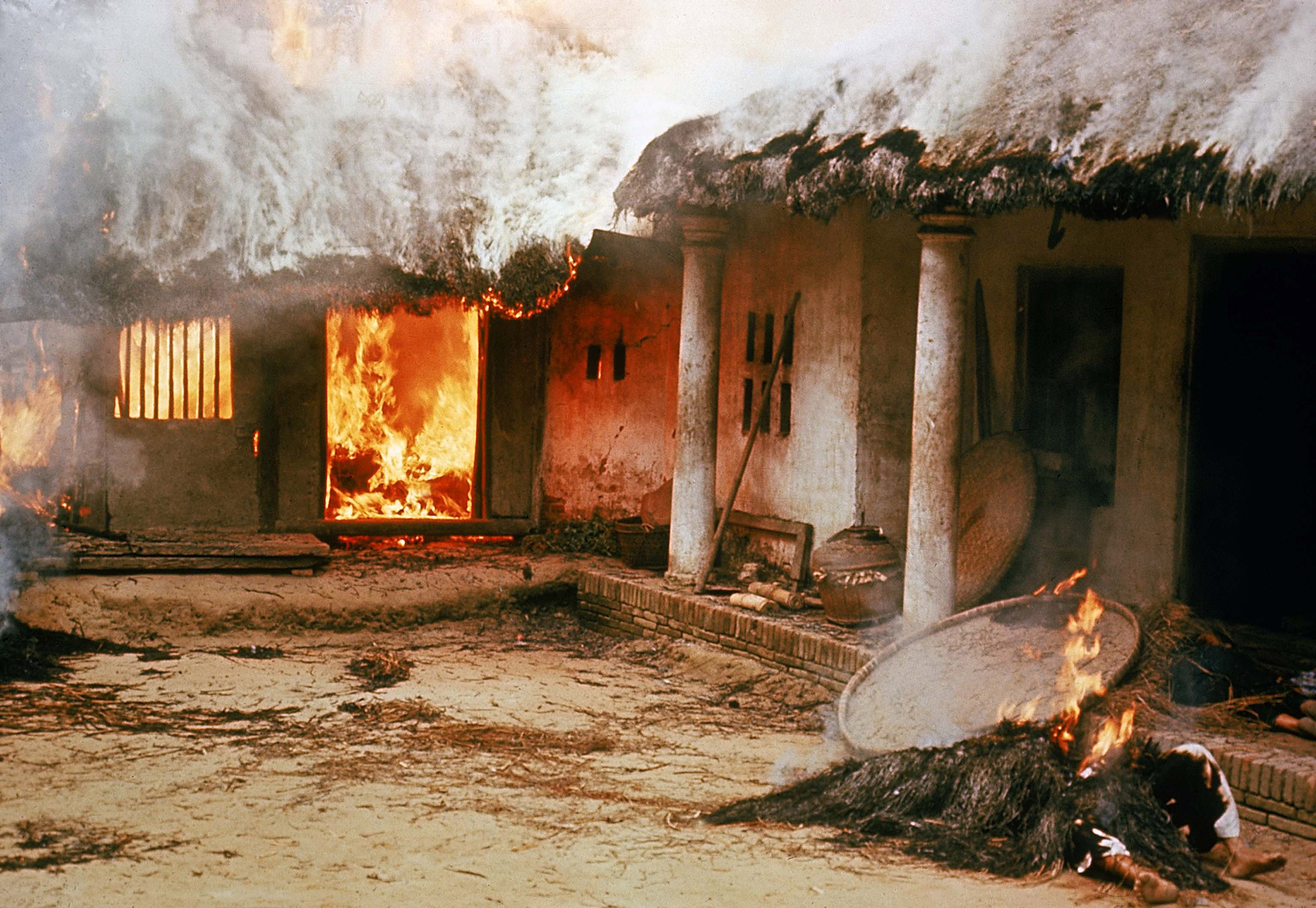
Dead bodies outside a burning dwelling (Photo by Ronald Haeberle/Public Domain)
The first platoon spent the night near My Khe 4, but the rest of
Bravo Company joined Charlie Company to set up a defense near a cemetery
along the South China Sea. In the morning, the first and second
platoons of Bravo Company reunited and spent the next day marching south
along the coast to the Tra Khuc River, burning every hamlet along the
way. Again there was an element of revenge. A popular member of the
first platoon had lost a foot early in the morning while he was probing
for a mine along the bridge leading from the My Khe 4 peninsula to the
mainland. The Peers commission subsequently determined that the platoon
had failed to post guards on the bridge overnight, although the bridge
provided the only access to the peninsula. A few men testified that the
wounded G.I. was in fact attempting to defuse the mine with his bayonet
when it went off, wounding him. But most of the G.I.s saw the mine as
another example of treacherous enemy tactics, and this renewed their
anger at anyone Vietnamese. That day, Task Force Barker provided a team
of demolition experts, who blew up bunkers after the hamlets along the
route were razed by fire. The techniques used in destroying the houses
along the coast apparently amazed the Peers investigators. One G.I.
testified that it was not his responsibility, as a demolition man, but
that of the infantry to make sure no civilians were inside any of the
bunkers he destroyed. He generally dropped two or three pounds of TNT
into each bunker, he said, without checking for occupants. Another
demolition man told of using as much as thirty pounds of dynamite to
destroy each bunker, also without inspecting inside. Asked by a member
of the Peers commission whether any effort was made to determine “if
there were people inside,” one G.I. responded, “Not that I know of.”Again, it is impossible to determine how many Vietnamese citizens were killed as they huddled inside their bunkers during Bravo Company’s march to the south. The G.I.s burned and destroyed almost every home they came to. Terry Reid, the private who told me that the My Khe 4 shooting seemed “insane” to him, had been considered a malcontent by his fellow-G.I.s, because he often criticized Bravo Company’s killing tactics. Of the march, he told me that he almost broke into tears as it continued. “We’d go through these village areas and just burn,” he said. “You’d see a good Vietnamese home—made with bricks or hard mud, and filled with six or seven grandmothers, four or five old men, and little kids—just burned. You’d see these old people watching their homes.” The Army’s practice of destroying bunkers and tunnels after burning the homes had always baffled him anyway, Reid said. “They call them bunkers and tunnels, but you know what they are—basements. Just basements.”
On March 18th, the third day of the operation, Bravo Company’s mission suddenly changed. Task Force Barker called in medical units, and the men were ordered to round up the civilians for baths, examinations, and in some cases interrogation by intelligence officials. Between five hundred and a thousand civilians were treated for diseases or were given food and clothing by the G.I.s. “It seemed like we just changed our policy altogether that day,” Congleton later told the Peers commission. “We went from a search-and-destroy to a pacification, because we went to this village and we washed all the kids. Maybe somebody had a guilty feeling or something like that.” Talking with me about this change a year after his testimony, Congleton said, “We reversed the whole plan just like we were going to redeem ourselves.” Former Private First Class Morris G. Michener thought that “most of the people were a little ashamed of themselves, and I was very ashamed of even being part of the group.”
On March 19th, Bravo Company was lifted by helicopter from the peninsula. A few of the Bravo Company soldiers later heard about the excesses committed by Charlie Company and about impending investigations there, but somehow there was little concern about the atrocities they themselves had committed. Only one G.I., Ronald Easterling, the machine gunner with the third platoon, considered reporting the My Khe 4 massacre to his superiors, but, as he later told the Peers commission, he quickly dropped the idea. “I guess I just let it go when I shouldn’t have,” Easterling explained. “I thought the company commander knew these things were going on. . . . it was all general knowledge through the whole company, and I didn’t see any sense in talking it over with the company. . . .”
By the time the Army’s charges against Lieutenant Calley became known in the United States, most of the men of Bravo Company were back home and out of the Army. Only a few associated their activities in Bravo Company on March 16th with the operation that Calley was accused of participating in. One who did was Reid. He walked into a newspaper office in Oshkosh, Wisconsin, in November, 1969, a few days after the Calley story broke, and gave an interview about the atrocities he had observed while he was serving with the 11th Brigade. He told of one operation in which, after some G.I.s had been wounded by a booby trap, his company responded by killing sixty women, children, and old men. Reid told me not long ago that he didn’t realize until months later that what had happened in his outfit was directly connected with Task Force Barker’s mission in Son My on March 16th. “Sometimes I thought it was just my platoon, my company, that was committing atrocious acts, and what bad luck it was to get in it,” Reid said. “But what we were doing was being done all over.”
The incident at My Khe 4 would perhaps be just another Vietnam atrocity story if it weren’t for four facts: its vital connection with the My Lai 4 tragedy; the American public’s ignorance of it; the total, detailed knowledge of it among the Peers investigators, the Department of the Army, and higher Pentagon officials; and the failure of any of these agencies to see that the men involved were prosecuted.
On March 16,
1968, Major General Koster, the commander of the Americal Division, was
near the peak of a brilliant Army career. At the age of forty-eight, he
was a two-star general whose next assignment would be as Superintendent
of the United States Military Academy. After that would probably come a
promotion to lieutenant general, and perhaps an assignment as a corps
commander in Germany, or even in South Vietnam again. Another promotion,
to the rank of full general, would quickly follow, along with an
assignment, possibly, as commander of one of the overseas United States
Armies. By the middle or late nineteen-seventies, then, he would be
among a group of ambitious, competent generals seeking Presidential
appointment as Army Chief of Staff. Like most future candidates for the
job of Chief of Staff, Koster had been earmarked as a “comer” by his
fellow-officers since his days at West Point. In 1949, he had served in
the high-prestige post of tactical officer at the Point, assigned to a
cadet company as the man responsible for their training. By 1960, he had
served in the operations office—the sensitive planning and coordinating
post known to the military as G-3—of the Far East Command, in Tokyo,
and also as Secretary of Staff of the Supreme Headquarters of the Allied
Powers, Europe, in Paris. His career was patterned after that of his
chief patron and supporter, General Westmoreland, who in 1968 headed all
military operations in South Vietnam. Westmoreland and Koster had
served together in the Pentagon during the nineteen-fifties, both in key
staff jobs, and Westmoreland had later become Superintendent of West
Point.
Koster’s assignment in the fall of 1967 as commanding general of the
Americal Division could be underestimated at first by outsiders: the
Americal, a hastily assembled conglomeration of independent infantry
units, was far from an élite outfit. But the job, as the Peers
investigation learned, was extremely important to the young general; he
had been handpicked by Westmoreland after a sharp debate inside military
headquarters in Saigon over the future combat role of the division. As
the Americal was initially set up, it was composed of three separate
five-thousand-man combat infantry brigades, each with its own support
units, such as artillery and cavalry. Within a year, the division was
restructured to make it more conventional and to provide more
centralized control. But when Koster took over, it was a new kind of
fighting unit, highly endorsed by Westmoreland, and pressure on the new
commander was inevitable. Adding to the pressure was the low calibre of
some of the officers initially assigned to the Americal by headquarters
units. Lieutenant Colonel Clinton E. Granger, Jr., who served briefly in
the G-3 office of the new division late in 1967 , told the Peers
commission about his personnel problems. “In the G-3 section the quality
of the personnel was not what one would ask in a division, to be
perfectly honest,” he said. “Among the field-grade officers, there was
only one major in the entire section who graduated from Leavenworth [the
Army command-and-staff school, in Kansas], and of all of them there
were only two who had not been passed over for promotion to lieutenant
colonel. That would indicate that in some cases not the highest calibre
of people were being provided.”Koster responded to the staff problems by running a virtual one-man show. He trusted no one else to make decisions on the division’s operations and maneuvers. Every military engagement or tactic, including such details as the allotment of helicopters for combat assaults, had to be personally approved by him. He filled the two most important positions in his headquarters, chief of staff and head of G-3 operations, with artillery officers—highly unusual assignments for such men in a combat infantry division. Both men, however, were West Pointers—the only ones in key headquarters jobs. Colonel Nels A. Parson, Jr., the chief of staff of the Americal Division, was inhibited by his inexperience in infantry tactics; he spent much of his time, according to testimony other officers gave the Peers commission, seeing to it that fences were painted and grass was kept closely cropped. Lieutenant Colonel Jesmond D. Balmer, Jr., the operations officer, was bolder than Parson, but he had no greater success. He told the Peers commission, “I was not a textbook G-3, either as taught at Leavenworth or throughout the Army or practiced at any other divisions. The commanding general was in fact his own G-3. . . . I was not operating that division. I was doing certain planning and trying to keep the T.O.C. [tactical-operations center] going. . . . I can’t visualize that any staff officer there would visualize Balmer, even now, as being a key mover in that division. I was far from it.” Balmer indicated that Colonel Parson had an even worse relationship with General Koster, explaining, “It was very evident to all concerned that General Koster had no confidence or did not trust much responsibility, except answering the telephone in the headquarters and doing the normal headquarters chief-of-staff job, to Colonel Parson, and to a similar degree this went down to the staff. . . . It was the most unhappy group of staff officers and unhappy headquarters I have ever had any contact with and certainly ever heard tell of it.”
Koster’s relationship with his second-in-command, Brigadier General George H. Young, Jr., one of two assistant division commanders, was less frosty, but it was still far from warm. Young, who was about a year younger than his superior, had graduated from the Citadel military academy, in Charleston, South Carolina. He, too, could exercise only a limited degree of command authority, although he had been placed in administrative control of the division’s maneuver battalions, including the aviation and artillery units. He could recommend decisions but not carry them out. Most of the other headquarters officers were either “non-ring knockers”—men who had begun their careers as enlisted men or as graduates of college reserve programs—or graduates of military schools, such as the Citadel, that many West Pointers consider second-rate.
For most of the officers and men, the commanding general was a cold figure who compelled respect—and a touch of fear. “General Koster was so smart he was too smart for the rest of us,” retired Lieutenant Colonel Charles Anistranski told me during an interview several months ago. Anistranski, who served as the Americal Division’s G-5 (in charge of pacification and civil affairs) early in 1968, told me that he particularly remembered the General’s crisp method of barking orders. “Koster would say, ‘I don’t like that, and I want you to do this and that.’ ” The General wouldn’t take part in after-dinner drinking bouts at the Officers’ Club, the former colonel said, but chose to return to his quarters instead. James R. Ritchie III, who served as an administrative sergeant at Americal Division headquarters in 1967-68, remembered Koster as being very cold. “I worked near him in that office for over five months, and I was never introduced to him,” he told me. “I passed notes to him but really I never knew the man” Ritchie said of the headquarters staff, “They were all afraid. They were all afraid of Koster.”
The normal work schedule of General Koster and his aides seemed to have little relationship to the realities of the guerrilla war going on a few miles away. Koster lived in an air-conditioned four-room house on a hill at division headquarters, in Chu Lai; he was served by a full-time enlisted man and a young officer. A few yards away was a fortified bunker with full communications, in case of attack. He spent most of his workday in a helicopter, visiting the brigades and battalions under his command. Every morning, he would give a short speech to new soldiers arriving at the division replacement center. Usually, his aides told the Peers commission, he tried to be where the action was—to monitor his troops in combat. For, just like a young company commander, Koster was being judged largely on the basis of how many enemy soldiers his men claimed to have killed.
General Koster’s arrival by helicopter at local units would cause as much of a flurry—and as much fear—as a visit from Westmoreland caused at division headquarters. And, these visits notwithstanding, Koster remained remote from the problems and fears of the “grunts”—ground soldiers—assigned to his command. When complaints arose, they were often deliberately withheld from the General by his aides. Sergeant Ritchie, as one of the chief administrative clerks in division headquarters, worked directly for Colonel Parson. He recalled that he was ordered to screen all the mail personally addressed to Koster. “Parson wanted to know anything that was on Koster’s desk other than routine stuff,” Ritchie said. “A lot of stuff I know never got to Koster.” Instead, it was handled by Parson. Most of the senior staff officers at headquarters knew of the practice, but they did not complain, even when letters they had addressed to Koster brought replies from Colonel Parson, because Parson was their rating officer, and for an ambitious lieutenant colonel who had not attended West Point one bad rating could be the end of a career. This kind of reasoning went up the chain of command. In May, 1968, for example, a Special Forces camp in the Americal Division’s area of operations was overrun by North Vietnamese troops, with heavy losses to an Americal battalion that attempted to relieve the camp. Koster ordered an investigation, but, as the Peers commission was told by Colonel Jack L. Treadwell, who became division chief of staff in late 1968, it was not filed with higher headquarters, “because it made the division look bad.”
Image on the right: SP4 Dustin setting fire to a dwelling (Photo by Ronald L. Haeberle/Public Domain)

Ironically, the publication of the rules of engagement allowed commanders to treat brutalities such as murder, rape, and arson as mere violations of rules, and in any event such serious crimes were rarely reported officially. Lieutenant Colonel Warren J. Lucas, the Americal Division’s provost marshal, or chief law-enforcement officer, told the Peers commission that most of the war-crimes investigations conducted by his unit involved the theft of goods or money from civilians or, occasionally, a charge that G.I.s had raped a prisoner of war at an interrogation center. The concept of murder during a combat operation simply wasn’t raised. Sometimes, Lucas said, he or his men would hear rumors or reports of serious incidents in the field, but, he added, “if it was declared a combat action, I did not move into it at all with my investigators.” Of course, the men who could report such incidents were the officers in charge; in effect, their choice was between a higher body count and a war-crimes investigation. Murder during combat and similarly serious violations of international law were never “reported through military-police channels,” Colonel Lucas told the Peers commission. Even if they had been, he could not have begun an investigation of such incidents without the approval of Chief of Staff Parson or General Koster. During his one-year tour of duty with the Americal, Lucas apparently never conducted such an investigation. What happened was that after the publication of the rules the military honor system went into effect. Under that system, as it was applied in the Americal Division, violations of the rules of engagement simply did not take place.
Lieutenant Colonel Anistranski, the officer in charge of the Americal’s civil-affairs and pacification program, explained in his interview with me how the system worked. “Every time a hamlet would burn, it was reported to me,” he said. “If it was in a friendly area, we’d go back and rebuild it. Sometimes it would come up at the nightly briefing. General Koster would come up to me and say, ‘Check it out.’ I’d get the S-5 [the lower-ranking officer in charge of civil affairs of the unit in question] and say, ‘You’d better get on it; the old man wants to know what happened out there.’ They’d come back after a little while and say it was set on fire during a fire fight. I’d go and tell the old man that.”
Some soldiers could, of course, have been court-martialled for committing war crimes. This might have limited the number of violations, but it would also have signalled to higher headquarters that violations did occur. Koster’s efficacy as a commander would have been questioned, and the name of the division would have been sullied by the inevitable press reports. Thus, talk of war crimes simply wasn’t heard at Americal Division headquarters. The men there took their jobs at face value. Father Carl E. Creswell served as an Episcopal chaplain at Chu Lai and resigned from the Army soon after his tour with the division. He later told the Peers commission, “I became absolutely convinced that as far as the United States Army was concerned there was no such thing as murder of a Vietnamese civilian. I’m sorry, maybe it’s a little bit cynical. I’m sure it is, but that’s the way the system works.”
The freedom to kill with impunity inevitably led to the inadvertent murder of many civilians in violation of both the Geneva conventions and the division rules of engagement. The statistics tell the story: A consistent problem for the military throughout the war has been the great disparity between the number of Vietcong soldiers that have been reported killed and the number of weapons that have been captured. Although the obvious answer seemed to be that Vietcong were not the only victims of American gunfire, artillery, and gunship strikes, officers at the top headquarters commands simply could not—or would not—accept that answer. Thus, commanding officers in the Americal Division were always urging their troops to “close with the enemy” instead of relying on helicopter or artillery support, and thereby increase their chances of capturing enemy weapons. Often, the rationale for the statistical imbalance was strained. Brigadier General Carl W. Hoffman, who served as chief operations officer of the III Marine Amphibious Force early in 1968, agreed with General Peers that Task Force Barker’s March 16th report of a hundred and twenty-eight Vietcong deaths and three captured weapons represented “a ratio that we would not normally like to see,” and went on, “However, we had experienced other reports in which we later found that the attacking troops had found a graveyard with fresh graves, and they determined then that these deaths had occurred on previous days because of artillery fire or gunship fire. Therefore, the total on a given day could be quite high and the weapons invariably would be very low. . . . we did see other instances in which we had very few weapons captured and quite a number of enemy bodies counted.”
“It’s like a game,” Colonel Anistranski, the division’s pacification-and-civil-affairs officer, remarked during my interview with him. “Everybody come on, we’re going to have a bonfire. The way Koster used to look at me, he knew they [the brigades] were lying. He tried to stop it, but there’s . . . so much going on.” Anistranski remembered that on occasion Koster would storm out of the nightly briefing, obviously angered, after hearing reports of large numbers of Vietcong killed by his troops and no captured weapons. “He’d get mad,” Anistranski said. “But me? I used to look at it and laugh. ‘There’s another battalion commander who’s pushing the full-colonel list,’ I’d say.” He could laugh, Anistranski added, but the General was trapped by his position. “Koster had bird colonels working for him; he had to accept their word.”
In early 1968,
the Americal Division consisted of three combat infantry brigades. One
of them, the 11th, was commanded by Colonel Oran K. Henderson. Henderson
had at that time been in the Army twenty-five years, and, like most
colonels, he had made it clear that he wanted very much to become a
general. A non-West Pointer, he had failed during a tour of duty in
Vietnam in 1963 and 1964 to get the command assignments necessary for
promotion; he spent nearly two of the next four years in subordinate
roles with the 11th Brigade in Hawaii, moving with the unit to Vietnam
in late 1967 as deputy commander. On March 15, 1968, the Army gave him a
chance: on that day, he took command of the brigade’s three infantry
battalions and one artillery battalion. During formal ceremonies at the
brigade’s headquarters area, at Duc Pho, Henderson accepted the unit’s
colors from the outgoing commander, Brigadier General Andy A. Lipscomb,
who was retiring from the service. Lipscomb had recommended Henderson
for the job, and was delighted when General Koster approved the choice.
Henderson “was completely loyal to me,” Lipscomb later told the Peers
commission. “When I left, and I made out an efficiency report on Colonel
Henderson, I recommended him for promotion to brigadier general, which I
didn’t do to too many colonels along the way.”
At the time of his appointment, Henderson had seen little combat in
Vietnam. He told the Peers commission that Task Force Barker’s attack on
My Lai 4 “was the first combat action I had been involved in or
observed,” and explained, “As the brigade executive officer up to this
point and time, I was pretty well limited to Due Pho. Occasionally, I
could get an H-23 [observation helicopter] and get out on the periphery
or something. But as a general rule I was stuck at Duc Pho. I had not
participated in a C.A. [combat assault], nor had I observed any combat
action except that at the Duc Pho Province.” He was referring to
occasional Vietcong mortar attacks on the brigade headquarters area.
Upon taking over the top job in the brigade, Henderson immediately began
acting like every other commander in Vietnam. Each day, he would
assemble a few personal aides and fly all over his area of
responsibility, observing the infantry battalions in action. The new
commander was formal and crisp with his staff; he had what military men
call “command presence.” In other officers he inspired nothing less than
fear. Captain Donald J. Keshel, the brigade civil-affairs officer, told
the Peers investigators, “I’m scared to death of Colonel
Henderson. . . . He’s just got to be the hardest man I’ve ever worked
for.” But Henderson himself feared at least one man—General Koster,
whose rating of him as a brigade commander would make or break his
chances of becoming a general. Koster had doubts about Henderson’s
intellectual ability, and these were known to the Colonel. He got along
easily with General Young, Koster’s assistant division commander, but
his relations with the division commander himself seemed to be tense.
“You could always distinguish rank when they were talking,” Michael C.
Adcock, a former sergeant who served as one of Colonel Henderson’s radio
operators, told me.Henderson, and Lipscomb before him, also followed the usual commander’s practice of emphasizing body counts, so competition for enemy kills was constant among the battalions and companies of the 11th Brigade. There were three-day passes for the men who achieved high body counts; sometimes whole units would be rewarded. At one point, Henderson personally ordered a program set up offering helicopter pilots three- to five-day passes for bringing in military-age Vietnamese males for questioning. The program, which was initiated because the brigade was unable to develop reliable intelligence information on the Vietcong, was known informally among 11th Brigade air units as Operation Body Snatch. Within weeks, the operation had degenerated to the point where the pilots, instead of “snatching” civilians, were deliberately killing them, sometimes by running them down with their helicopter skids. Other pilots devised even more macabre forms of murder, one of which involved the use of a lasso to stop a Vietnamese peasant who was attempting to flee. Helicopter crewmen would then jump out, strip the victim, and replace the rope around his neck, and the helicopter would begin to move at low speed, with the Vietnamese running along. When the victim could no longer keep up, he would fall, snapping his neck.
Many witnesses told the Peers commission of having received no meaningful instruction in the Geneva conventions or in the proper treatment of prisoners of war during training in Hawaii or in South Vietnam. “In Hawaii, the emphasis was on tactical combat operations throughout,” Specialist Fifth Class James E. Ford, a public-information clerk for the brigade, told the Peers investigators. “I think perhaps during that time . . . they might have said something about pacification and about the S-5’s function, civil affairs. But I don’t think it was an active part of the tactical training, though.”
Although Army manuals state that a brigade civil-affairs official should hold the rank of major, the 11th Brigade’s S-5, Keshel, was only a captain. The Army is loath to say so in public, but the job of division G-5 or brigade S-5 is considered a lowly one—a position for anyone who desires rapid promotion to avoid. Captain Keshel was in charge of making cash payments to Vietnamese victims of accidental American shootings. He made about thirty such solatium payments, as they were called (at that time, they amounted to about thirty-three dollars for each adult and half as much for children fifteen years of age or under), over a period of eight or nine months, ending in the fall of 1968. The total seemed high to him, Keshel told the Peers commission, and he mentioned his concern to Colonel Henderson. Henderson, in turn, “mentioned it to the battalion commanders at one of his briefings,” Keshel said, and he continued, “And all of the battalion commanders, boy, they really got down on me, now, they said, ‘Well, you know we got lieutenants out there with the platoon, or rifle-company commanders out there with the companies, he’d get fire from a village, he’s got to return fire to protect his command, and when this happens, perhaps a civilian will get shot.’ ”
The concept of a battlefield war crime just did not exist in the 11th Brigade. Major John L. Pitttman, the provost marshal of the unit, testified before the Peers commission that he could not recall giving the military policemen under his command any instructions or training in their obligations to report war crimes. On two or three occasions, Pittman said, he did report instances of prisoner mistreatment to both Lipscomb and Henderson. At a staff meeting, Lipscomb or Henderson always responded the same way—not by ordering an investigation but by putting out instructions against such practices.
Even if Henderson and some of his staff officers remained largely uninformed about the war taking place a few miles from their headquarters, the Colonel did meet the other basic requirements of a Vietnam commander: he had a superior mess hall and a rebuilt officers’ club, and there was considerable emphasis on being an officer and a gentleman. G.I.s who served in the 11th Brigade frequently talked to me with bitterness about the life style of the senior officers. “They had a fantastic mess hall,” former Specialist Fifth Class Jay A. Roberts, who worked in the public-information office, near headquarters, recalled. “The officers would have cocktail hour for an hour every night before dinner.” Other G.I.s talked about the ice cream, the shrimp, and the steak that were often on hand for the officers. Also frequently noted was the fact that the headquarters’ allotment of air-conditioners was utilized for Henderson’s mess hall and his personal quarters. Plans to blow up the mess hall—perhaps only half serious—were constantly being developed by the headquarters clerks. Some G.I.s boasted of having devised ways to appropriate bottles of whiskey and cold beer from the officers’ walk-in cooler. Former Specialist Fourth Class Frank D. Beardslee served as driver for Colonel Barker, the commander of Task Force Barker, and often took him to the Duc Pho Officers’ Club at five-thirty in time for the cocktail hour. “It was just like they were in Washington,” Beardslee said of the officers. “They would talk about promotions and all that stuff—just like a cocktail party back in the world.”
Shortly before Lipscomb, a West Pointer, retired, the brigade public-information office presented him with a scrapbook of photographs and news clippings highlighting his service with the 11th Brigade. Similar scrapbooks were made up for most senior officers who left the unit. Former Sergeant Ronald L. Haeberle, who served as a photographer for the brigade’s public-information office, considered such work routine at the time, and later, when criticized by the Peers panel for not turning photographs he had made of the My Lai 4 massacre over to higher authorities, he said he had never considered such a step, explaining, “You know something . . . ? If a general is smiling wrong in a photograph, I have learned to destroy it. . . . My experience as a G.I. over there is that if something doesn’t look right, a general smiling the wrong way . . . I stopped and destroyed the negative.”
F or a
non-West Pointer, Colonel Barker had everything going for him. In
January, 1968, General Koster had pulled him out of his job as
operations officer of the 11th Brigade and given him command of a
three-company task force of four hundred men that had been put together
to find and destroy the enemy in the Batangan Peninsula area, in the
eastern part of Quang Ngai Province. The peninsula was “Indian country”
as far as American and South Vietnamese soldiers were concerned. Few
operations had ever been mounted against the village of Son My, which
was widely considered to be the staging and headquarters area for the
Vietcong 48th Battalion, one of the strongest units in Quang Ngai. The
area was heavily booby-trapped, and the men of Task Force Barker—the
Colonel followed a custom by naming the unit after himself—suffered as a
result. By March 15th, about fifteen G.I.s in the three companies had
been killed and more than eighty had been wounded—a high percentage of
casualties but not one that necessarily reflected much direct
confrontation with the enemy. For example, four men in Charlie Company
were killed and thirty-eight were wounded in those ten weeks, but the
Peers commission determined that only three of the casualties, including
one death, had resulted from direct contact with the enemy. But
“Barker’s Bastards,” as the men of the task force were quickly dubbed by
the brigade public-information office, were seemingly able to do what
no other unit in the brigade could—find and destroy the enemy. “We
devoted quite a bit of coverage to Task Force Barker,” Ford, the brigade
public-information clerk, told the Peers commission. “Up until Task
Force Barker deployed, we hadn’t been seeing too much action. As a
result, our public-information coverage was kind of slim. . . . They
were getting contact, and we were getting good copy out of it.” Barker’s
men had the highest body count by far of any unit in the 11th Brigade,
other officers would speak admiringly of the commander’s “luck” in
getting solid contact. Specialist Fourth Class Donald R. Hooton, one of
the Bravo Company infantrymen, had a different point of view. “Everybody
said, ‘He’s got the most phenomenal luck,’ ” Hooton told me recently.
“What they meant is that we’d go out and gun down a lot of people.”
But the G.I.s—even Hooton—admired Barker. He wasn’t afraid to land
his helicopter in a battle area, and he would often join in the fray,
firing his .45-calibre pistol at Vietnamese when his helicopter was
flying low. He made sure that his troops received at least one hot meal a
day in the field. There were other reasons for the widespread
admiration of Barker. He was “lean and mean,” in the military tradition;
handsome, with neatly chiselled features; friendly to the “grunts,”
always accessible and always making it clear that he understood their
problems. “Barker, in my estimation, seemed to have his finger in and
was pretty well in tune with what was going on,” General Koster told the
Peers commission. Barker’s responsibilities as a commander were total;
he was in charge of the intelligence, the planning, and the initiation
of all task-force operations—and always had the approval of his
superiors.Barker’s promotion to head the task force left a crucial administrative gap in the brigade headquarters—one that Colonel Henderson, then acting as deputy brigade commander, tried to fill himself. Then, when Henderson assumed control of the brigade, on March 15th, he was still not assigned a new administrative aide, so he was forced to do his paperwork at night. Such treatment undoubtedly galled Henderson, and so did the relationship between Koster and Barker. There were fifteen thousand lieutenant colonels in the Army in 1968 and fewer than three hundred battalions to command. Without battalion-command experience in Vietnam, a young lieutenant colonel could not expect promotion. Because the pressure for the jobs was so intense, the Army limited battalion commanders’ tours to six months. Normally, Henderson could have expected to have a powerful hold over Barker, because Barker would have needed Henderson’s approval before commanding a battalion; the bargaining and negotiating for such jobs goes on daily in the Pentagon and elsewhere. But by the time Henderson took over the brigade, General Koster had promised the next battalion command to Barker. In effect, Henderson’s potential patronage—an important part of a commander’s job—was diminished, and a protégé, if he had had one, would have had to wait longer for a battalion commander’s spot.
There was no fancy officers’ club at the task-force headquarters, at Landing Zone Dottie, a few miles from the city of Quang Ngai, the provincial capital. Barker, like all commanders, spent most of his working day in a helicopter, and he tried to catch up on his paperwork at night. The administration of the task force therefore fell to the operations officer, Major Charles C. Calhoun, who was serving his second tour of duty in Vietnam. The task-force headquarters was severely underequipped and understaffed; it had only one typewriter assigned to it, and one clerk to do its typing. As a result, there was neither the staff nor the time to prepare the required task-force version of the rules of engagement or to instruct the troops about the Geneva conventions. The unofficial task-force rule seemed to be simply not to commit any illegal actions directly in front of the commanding officer. Speaking of Captain Michles, of Bravo Company, Congleton, the Captain’s radio operator, told me, “If something wasn’t done in front of him, nothing happened. But if he’d ever caught you smoking pot, he’d have gone wild.” Michles was similarly offended if the killing of civilians was brought directly to his attention. Congleton, after recalling that the officer “wanted kills,” said, “By the first time we actually killed anybody who was a Vietcong with a weapon, we had reported twenty or thirty confirmed kills, and I said, ‘Hey, we just got our first kill.’ He really got mad.”
Both of Task
Force Barker’s February missions into Son My were officially described
as unqualified successes, although the disparity between Vietcong killed
and weapons captured—a hundred and fifty-five to six—was extreme. After
the second mission, Colonel Barker gave his superiors a glowing report.
It said, “This operation was well planned, well executed, and
successful. Friendly casualties were light and the enemy suffered a hard
blow. However, many enemy soldiers were able to escape with their
weapons and the weapons of the enemy dead. This was caused by several
factors. . . . Although the air strikes were timely and effective . . .
time was lost waiting for aircraft. . . . Air evacuation of wounded was a
contributing factor in allowing the enemy time to escape, since
supporting fire had to be stopped each time a medevac helicopter was
brought in. The ground units were not as aggressive later in the battle
as they were earlier. . . . Aggressiveness increased again at the
insistence of the Task Force commander, but during the lull several V.C.
had escaped with weapons.
It was
probably inevitable that Barker would decide to conduct another
operation in Son My. He talked about it sometime early in March with
General Lipscomb and got the General’s approval. “Barker said to me on
one or two occasions that he was going back into Pinkville,” Lipscomb
told the Peers commission. “This 48th Battalion was a thorn in his side
there, and he was going to go back in there. . . . It just was something
that had to be done before the area would be under control.” Cecil D.
Hall, the task-force communications sergeant, recalled that Barker had
unsuccessfully sought permission from brigade headquarters to use Rome
plows, monstrous twenty-two-ton bulldozers capable of levelling hundreds
of acres per day, to destroy the area. “I heard him mention many
times,” Hall told me during an interview in October, 1971, “that it’d
sure be nice if we could get some bulldozers and clear that place once
and for all.”
General Koster acknowledged to the Peers commission that though he
was assured that the forthcoming task-force assault would be even more
successful than the two previous operations (Barker reported that he
expected to find four hundred Vietcong in the area), he really knew very
little about the plan for it. He was consulted about the mission, he
said, simply because he was the only one who could authorize the use of
helicopters, which Barker considered necessary. As Barker initially
explained it to Koster, the main target was the village of My Lai 1, the
center of the Pinkville area, where intelligence said the 48th
Battalion had its headquarters. Although Koster approved the mission, he
did not attempt to analyze it. He told the Peers commission, “I’m
reasonably sure that he probably outlined the fact that there would be
two blocking companies—one would get there overland, and the other two
were air assaulted. . . . But I don’t recall that I even focussed as to
exactly where it was on the map, one of these little villages as opposed
to another one. The one that had been the primary target was the one on
the coast [My Lai 1], and the only time I really heard ‘Pinkville’ used
was for that one right on the coast as opposed to any of the
others. . . . Of course, that place was nothing but a bunch of rubble
anyway. I knew they had gone in there on many occasions and tried to
blow the dugouts and tunnels, and I knew that this was a continuing
thing. Every time we went through there we tried to blow a few more of
them.”At no point was there any formal, written plan outlining the tactical aspects of the operation. Barker’s plan for the mission was not seen in any form by any top-level Americal Division officers, such as Lieutenant Colonel Tommy P. Trexler, the division intelligence chief. In addition, Major Calhoun, the task-force operations officer, couldn’t recall any specific concern about the citizens of Son My before the March 16th operation, and he told the Peers commission that he thought there were only a hundred people living in My Lai 4, Charlie Company’s main target. (The population was at least five hundred.) The Major did say, “On a continuous basis leaflets were dropped in the area advising the civilians to move into the refugee centers. . . . they [task-force personnel] had advised the civilians that it was an area they should move out of, and some of them, I understand, left.” Although some officers at the division level were aware that the civilians, even if they wanted to leave, had no place to go, because the refugee camps were already overflowing, it is not clear whether anyone at Task Force Barker headquarters really understood that fact. It was a hopeless situation for the civilians in Son My, whatever their political affiliations, if any. Captain Charles K. Wyndham, who served until March 16th as the civil-affairs officer for Task Force Barker, told the Peers commission that he had never participated in any planning for the handling and safety of civilians before any operation with the task force. He added, “It’s kind of useless to go out there [into the field, with an infantry company] and try to do civil affairs.”
At one point in the planning for the operation, some unchallenged intelligence information about the civilians in My Lai 4 was received at the task-force headquarters: the residents would leave their hamlet about 7 a.m. on the day of the operation, a Saturday, to go to market. Since none of the planning details of the operation had been presented to higher headquarters, it was impossible for staff officers there to evaluate the intelligence information with any degree of sophistication. However, amid all the conflicting testimony before the Peers commission, a consensus did emerge that there was no basis for assuming that all the residents of My Lai 4 would leave the village about seven in the morning to go to market. In fact, former First Lieutenant Clarence E. Dukes, an intelligence officer at Americal Division headquarters, testified later that precisely the opposite might have been expected. “I would say that normally by sunrise if there were V.C. soldiers in a populated area they’d be moved out before dawn,” he told the Peers commission. “Your women and children would be around town. Most of your male population would have moved out to their daily work.” Colonel Trexler had a similar opinion. He testified, “An occupied village with any reasonable number of people, I would expect some of them to be there at any time of the day or night unless there was some other reason that they had been alerted to get out.” He was then asked, “There would always be left behind children, toddlers, old women, old men, pregnant women, and persons in these categories?” He said yes.
With concern for possible civilian casualties out of the way, the task force’s attack plan was drawn up. As part of the planning for the attack, Colonel Barker ordered the task force’s four support cannons to fire a three- to five-minute salvo of shells into the hamlet beginning at 7:20 a.m. on March 16th—about ten minutes before the landing of the first helicopter-borne squad of men, led by Lieutenant Calley, of Charlie Company. The process is known in the military as “prepping the area.” Lieutenant Colonel Robert B. Luper was serving then as commanding officer of all the artillery units attached to the 11th Brigade. He told Peers that Barker wanted preparation fire but not on his landing zone, and explained, “This is a little different than we would normally expect, because he felt that the area that he was going to make his combat assault into was open enough that he could see if there was going to be any problem. He wanted the preparation fire north of his landing zone, which would have put it on My Lai, the village of My Lai.” Asked if the entire five-minute attack was to be made against the village, Luper replied, “It was.” The use of artillery on a populated village was considered routine by the officers of Task Force Barker. One justification for such tactics—which are in violation of international law—was offered to the Peers commission by Major Calhoun: “Of course, the most vulnerable time is coming down with the first landing, you have nothing there, no troops on the ground, and the choppers are slow and they are sitting down like ducks on the water. Or he [Barker] could put the fire into the area and, I’m sure, realizing that some civilians might be hurt. There is a difference between the sacrifice of American troops and the sacrifice of some civilians in this area.”
Another justification cited for the shelling of the village was that such action had been cleared by the South Vietnamese authorities responsible for the area of operations. The Vietnamese considered the whole area to be dominated by the Vietcong and had long since declared it a free-fire zone. Captain Wayne E. Johnson, who was a liaison officer for the Americal Division attached to Second arvn’s headquarters, in Quang Ngai, told the Peers commission that he believed the Americans and South Vietnamese serving in Quang Ngai Province “felt that whatever people were out there were enemy,” and explained, “If there was a target worth shooting at, it shouldn’t be cancelled because of the presence of civilians.” Approval was invariably granted by the South Vietnamese. “The district people didn’t hold too many civilians to be in the area,” Johnson said. “It didn’t hold a large population.” This view was tragically wrong, as a subsequent resettlement program demonstrated. American and Vietnamese authorities in Saigon began an uprooting of the people of Son My and neighboring villages in February, 1969, expecting to relocate four thousand civilians; at its end, there were twelve thousand people shifted from the area.
On March 15th, the day before the mission, Colonel Barker, Major Calhoun, and Captain Eugene M. Kotouc, the task-force intelligence officer, scheduled a complete operational briefing on the mission in a small tent just outside task-force headquarters. The session was attended by all the men who were going to play key roles in the attack the next day: Captain Medina, of Charlie Company; Captain Michles, of Bravo Company; Captain Stephen J. Gamble, the commanding officer of the four-cannon artillery battery stationed at Landing Zone Uptight, about five miles north of My Lai 4; and Major Frederic W. Watke, the commanding officer of the aero-scout company of the 123rd Aviation Battalion, which was stationed in the Americal Division headquarters area, at Chu Lai, and which would fly support for the mission. (Alpha Company, the third unit in Task Force Barker, which was headed by Captain William C. Riggs, was assigned no significant role in the operation.) Also present at the briefing was Colonel Henderson, who had formally taken command of the 11th Brigade only hours before.
The briefing itself was professionally crisp. The headquarters staff of Task Force Barker listened inside the crowded briefing tent as Colonel Henderson gave what amounted to a pep talk. It was a short talk, and Captain Gamble was later able to recall much of it before the Peers commission. “He generally reviewed what was going to occur the next day, and he mentioned that it was a very important operation, and the Vietcong unit that was located in that area. They wanted to get rid of them once and for all and get them out of that area. He stressed this point, and he wanted to make sure that everybody and all the companies were up to snuff and everything went like clockwork during the operation.”
Captain Medina later testified that Colonel Henderson wanted the companies to get more aggressive. Medina told the Peers commission, “Colonel Henderson . . . stated that in the past two operations the failure of the operations was that the soldier was not aggressive enough in closing with the enemy. Therefore, we were leaving too many weapons and that the other enemy soldiers in the area, as they retreated, the women and children in the area would pick up the weapons and run and therefore by the time the soldiers arrived to where they had killed a V.C. that the weapon would be gone.” Captain Kotouc testified that Henderson had said that “when we get through with that 48th Battalion, they won’t be giving us any more trouble.”
After Henderson spoke, Kotouc gave a quick summary of the intelligence situation, including the special report that all civilians would have left My Lai 4 by seven in the morning. Major Calhoun next presented a map review. Then Barker stood up. Kotouc recalled Barker’s words vividly. “Colonel Barker said he wanted the area cleaned out, he wanted it neutralized, and he wanted the buildings knocked down,” Kotouc told the Peers commission. “He wanted the hootches [huts] burned, and he wanted the tunnels filled in, and then he wanted the livestock and chickens run off, killed, or destroyed. Colonel Barker did not say anything about killing any civilians, sir, nor did I. He wanted to neutralize the area.”
Captain Medina testified that Barker “instructed me to burn and destroy the village; to destroy any livestock, water buffalo, pigs, chickens; and to close any wells that we might find . . .”
Who told Task
Force Barker that all the civilians of My Lai 4 would leave the hamlet
and be on their way to market shortly after 7 a.m.
on March 16th? From whom did the task force receive information that
four hundred members of the Vietcong 48th Battalion would be in the
village of Son My on March 16th? These two questions remained unanswered
throughout the Army’s lengthy hearings on the massacre at My Lai 4.
Witnesses were consistently asked if they knew of any documents or
people that had provided such information; the answers were invariably
vague. “No, sir, I cannot cite any document,” Captain Kotouc said in
response to such a question from a member of the Peers commission. “But
it was through interrogation of people, people I had talked to. This was
always—this was the part we were trying to figure out, how they moved
in the area. They all came and went about the same time. . . . If I
recall, part of it [the intelligence] came from Colonel Barker.
Information, I think, he received from his contacts or somewhere like
that. It is very difficult for me to pin it down.”
Undoubtedly, the men of the task force had some reasons of their own
for believing that the 48th Battalion was in the Son My area; evidence
of the unit’s presence—old documents, for instance, and civilians who
perhaps knew of some of the unit’s recent movements—could be found at
any time throughout the Batangan Peninsula, which was, after all, the
base of operations for the 48th. Barker made no further attempt to
confirm the enemy unit’s location, because he felt that none was needed.
If Barker or any of his aides had checked, they would have found that
every intelligence desk at the provincial headquarters in Quang Ngai
placed the 48th Battalion at least fifteen kilometres, or nine miles,
west of the city. They would also have learned that the unit was
considered to be in poor fighting condition, because it had suffered
heavy losses while attacking Quang Ngai during the Tet offensive.
“Whatever was left of them was out in the mountains,” Gerald Stout, who
was then an Army intelligence officer with the Americal Division and is
now a law student at Syracuse University, told me in an interview. His
information was based in part on highly classified reconnaissance
flights over mountain areas.There was no conspiracy to destroy the village of My Lai 4, or to kill the villagers; what took place there had happened before in Quang Ngai Province and would happen again—although with less drastic results. The desire of Colonel Barker to mount another successful operation in the area, with a high enemy body count; the belief shared by all the principals that everyone living in Son My was living there by choice, because of Communist sympathies; the assurance that no officials of the South Vietnamese government would protest any act of war in Son My; and the basic incompetence of many intelligence personnel in the Army—all these factors combined to enable a group of normally ambitious men to mount an unnecessary mission against a nonexistent enemy force and somehow find evidence to justify it.
The assault on
My Lai 4 began, like most combat assaults in Vietnam, with artillery
and helicopters. Colonel Barker arrived over My Lai 4 in his
command-and-control helicopter just in time to see the first barrage of
artillery shells fall into the hamlet. Colonel Henderson’s
helicopter—filled with high-ranking officers—flew over the hamlet a few
minutes later; trouble with a helicopter had delayed the Colonel’s
takeoff from his headquarters, at Duc Pho. General Koster flew in and
out of the area throughout the early morning, watching the men of
Charlie Company conduct their assault. The task-force log for March
16th, which was submitted to the Peers commission in evidence, shows
that Lieutenant Calley’s first platoon landed precisely at 7:30 a.m.
at the landing zone outside My Lai 4. There were nine troop-carrying
helicopters, and they were accompanied by two gunships from the 174th
Aviation Company, which, with their guns blazing, had crisscrossed the
landing zone moments before the combat troops landed, firing thousands
of bullets and rockets in a fusillade designed to keep enemy gunmen at
bay. Of course, there were no enemy gunmen, but it didn’t matter that
day: within minutes the statistics began filling the task-force daily
log. At seven-thirty-five, Charlie Company officially claimed its first
Vietcong; the victim was an old man who had jumped out of a hole waving
his arms in fear and pleading. Seven minutes later, the gunships—known
as Sharks—claimed three Vietcong killed; the dead men were reportedly
seen with weapons and field gear. By eight, seventeen more Vietcong were
said to have been killed. At three minutes past eight, Charlie Company
said that it had found a radio and three boxes of medical supplies. At
eight-forty, Charlie Company notified headquarters that it had counted a
total of eighty-four dead Vietcong. By this time, My Lai 4 was in
ruins. Lieutenant Calley and a number of the men in his platoon were
already in the process of killing two large groups of civilians and
filling a drainage ditch with the bodies. The second and third platoons
were also committing wholesale murder, and some men had begun to set
fire to anything in the hamlet that would burn. Wells were fouled,
livestock was slaughtered, and food stocks were scattered.
The two Sharks from the 174th also committed murder that morning.
After the artillery shells began falling, hundreds of civilians streamed
from the hamlet, most of them travelling southwest toward the city of
Quang Ngai. The two gunships flew overhead and began firing into the
crowd. The time was about seven-forty-five. It was noted by Captain
Brian W. Livingston, a pilot from the 123rd Aviation Battalion, who was
also flying in support of the mission. Livingston later flew over and
took a close look at the victims; they were women, children, and old
men—between thirty and fifty of them. Scott A. Baker, a flight commander
with the 123rd, also watched the civilians leaving the village. He told
the Peers commission later that the Sharks made a pass over the group
with their guns firing and that moments later he saw twenty-five bodies
on the road to Quang Ngai. The troops from Charlie Company had yet to
move that far south, Baker said.The killing continued for at least ninety minutes after eight-forty, but no more enemy kills for Charlie Company appeared in the task-force log. Charlie Company’s body count officially ended at eight-forty in the morning on March 16th, with a report that it had killed eighty-four Vietcong and had captured documents, a radio, ammunition, and some medical supplies. The Sharks had reported a total of six enemy kills. Later that day, Bravo Company concluded its operation with an official body count of thirty-eight. (The total number of dead Vietcong allegedly slain by both the ground and air units over My Lai 4—a hundred and twenty-eight—would make the front pages of American newspapers the next morning. It was the most significant operation of the war for the 11th Brigade.
The smoke over My Lai 4 could be seen for miles. First Lieutenant James T. Cooney was flying Colonel Henderson’s helicopter over My Lai 4; he told the Peers commission, “I did notice several hootches burning, several buildings burning, possibly rice stores. I do remember there being burning going on on the ground at that time.” Chief Warrant Officer Robert W. Witham was flying General Koster’s helicopter; he similarly recalled “smoke and things like this, artillery.” Even Captain Johnson—the Americal Division’s liaison officer at Quang Ngai, about five miles to the southwest, saw the smoke. “I remember seeing smoke in the area and knowing that Task Force Barker was in the area,” he told the Peers commission. “I accepted this. I assumed that I knew what was happening.” The pilots saw it, but the officers they were flying claimed they did not. General Koster, asked by the Peers commission if he recalled seeing the village “pretty much up in smoke at that time when you flew over,” responded simply, “No, sir, I don’t.” Colonel Henderson was asked a similar question, and replied, “I did not see My Lai 4 in flames or having been burnt or burning.”
Warrant
Officers Jerry R. Culverhouse and Daniel R. Millians were piloting a
helicopter that morning in support of Charlie Company. Culverhouse and
Millians, who were attached to the 123rd Aviation Battalion, were part
of a new concept in the Vietnam air war. B Company of the 123rd was
known as an aero-scout company, and its mission that day was to cut off
enemy troops attempting to flee Task Force Barker’s trap in My Lai 4.
The pilots usually teamed up with a second gunship, and both usually
flew above a small observation helicopter. On the morning of March 16th,
the observation helicopter was manned by Chief Warrant Officer Hugh C.
Thompson, Jr., of Atlanta. Above the gunships, in turn, were two or
three helicopters carrying infantrymen. The concept called for the
observation craft to flush out the enemy, so the gunships could force
them to halt. If the enemy avoided the gunships, the infantrymen would
be landed (the 123rd pilots described this process as “inserting the
animals”) to engage the Vietcong. Culverhouse and Millians arrived at
their duty station sometime after nine and joined up with Captain
Livingston. The hamlet was still aflame. They began flying back and
forth across My Lai 4 and the nearby paddy fields, on the prowl for
Vietcong. Culverhouse later told the Peers commission, “It appeared to
us there it was fairly secure. We heard no shooting and didn’t receive
any fire ourselves . . . And we immediately noted the bodies surrounding
the village. . . . there were numerous bodies scattered both in the
inner perimeters of the village and in the outer perimeters leaving the
village. . . . I was especially . . . amazed at one group of bodies
encountered . . . over on the east side of the village there was an
irrigation ditch, which appeared to me to be about six or seven feet
wide. . . . [and] probably five or six feet deep. . . . there were
numerous bodies that appeared to be piled up. In some places, I don’t
know, maybe four or five or I suppose as high as six deep. . . . For an
area about—around thirty to thirty-five yards the ditch was almost
completely filled with bodies.”
Image below: Hugh Thompson, Jr. (Public Domain)

Captain Livingston testified before the Peers commission that he had heard Thompson make three separate radio transmissions about unwarranted killings, beginning sometime after nine. Thompson complained twice about a captain who had shot and killed a Vietnamese woman, and his third complaint was about a black sergeant who had done the same thing.
General Koster habitually kept up with the swirl of action in his area of responsibility by monitoring three or four radio frequencies; he was constantly on the alert for the first signs of trouble or enemy contact anywhere. Such signs can always be heard over the airwaves—calls for reinforcements, medical helicopters, more ammunition, more firepower. The General’s helicopter had an elaborate radio console, and, if he chose, he could tune in on communications between helicopters and ground forces, the task force and the companies, or the brigade and the task force. Despite the information available to him, Koster, in his testimony to the Peers commission, could not recall any details of the My Lai 4 operation. Asked if he had seen the hundreds of Vietnamese civilians fleeing the hamlet that morning, the General replied, “I can’t tie it to this particular operation. I’ve flown over several of them, and this one doesn’t distinguish itself from any other as far as this type of thing is concerned.” Colonel Henderson, however, testified that he saw from six to eight bodies that might be civilians during his early-morning flight over My Lai 4. He recalled checking immediately with Colonel Barker and being told that the victims had been killed by artillery fire. Those were the only bodies he reported seeing, although he flew over My Lai 4 on at least three occasions that day. At least one other passenger aboard his aircraft, however, testified to having seen many more. Sergeant Adcock, Henderson’s radio operator that day, told the Peers commission that he had observed from thirty-five to forty bodies in all during his trips over My Lai 4. The command-and-control helicopter, he said, usually flew at an altitude of fifteen hundred feet—out of the range of small-arms fire—but had travelled much lower during the morning trips over the hamlet, occasionally going “low enough to make the rice wave.” The other passengers on the flight were Major Robert W. McKnight, the 11th Brigade operations officer, who testified that he had seen perhaps five dead bodies; Colonel Luper, the brigade’s artillery commander, who said he had seen from fifteen to twenty bodies; and Air Force Lieutenant Colonel William I. MacLachlan, who was assigned to coördinate air strikes, if necessary, and who said he had seen only a few bodies. None of the passengers, including Adcock, specifically recalled hearing anything about Americans’ murdering Vietnamese.
The only known complaints made before nine that morning came from Thompson and other members of the 123rd Aviation Battalion. The helicopter unit, normally stationed at the Americal Division headquarters, at Chu Lai, had set up a special operations van and refuelling station at Landing Zone Dottie, the headquarters area (named after Colonel Barker’s wife) for Task Force Barker, to increase the support it could provide for the task force. Former Specialist Fifth Class Lawrence J. Kubert, who was serving as the operations sergeant for the aero-scout company of the battalion, told the Peers commission that he and others in the van had heard pilots’ complaints early that morning about the excessive shooting of civilians by the Sharks from the 174th Aviation Company. The complaints were relayed to the task-force operations center at Dottie, only three hundred yards away, with a warning that most of the persons fleeing the village were women and children. Kubert recalled that Colonel Henderson, identifying himself by his radio code name, Rawhide Six, subsequently warned the combat units by radio, “I don’t want any unnecessary killing.” A similar statement from Henderson was heard by two aero-scout plots during the morning. Kubert said he assumed that the warning was directed at the gunships.
By 9 a.m., Colonel Henderson was back at the task-force operations center. He had spent more than an hour over My Lai 4, leaving for only a few moments shortly after eight to watch Bravo Company begin its assault on My Lai I—a target it never reached. Within the next thirty minutes, the Colonel was joined by most of the senior officers of the task force and the 11th Brigade. Major Calhoun, the task-force operations officer, and Master Sergeant William J. Johnson were monitoring the radios in the operations center. Captain Charles R. Lewellen, the assistant operations officer, who ran the night shift at the task-force operations center, had stayed up to transcribe center, stayed up the reports of the operation with his tape recorder. A copy of that tape was later made available to the Peers commission, and it provided a minute-by-minute timetable for the first hours of action. The tape also helped prove to the satisfaction of the Peers investigators that a coverup—involving the manipulation of battlefield statistics—had taken place between eight-thirty and nine-thirty at Landing Zone Dottie.
At that time, Colonel Barker was still flying over the combat area; he had been out there for more than an hour. At eight-twenty-eight, according to the Lewellen tape, Barker had radioed Captain Medina, saying, “I’m heading back to refuel. Have you had any contact down there yet?” Lewellen’s tape did not record Medina’s response, but Barker, apparently informed that the company was making a body count, said, “Dig deep. Take your time and get ’em [the Vietcong] out of those holes.” Medina gave him the body count, and Barker asked, “Is that eight—ah, eight-four K.I.A.s?” Having been told that it was, Barker radioed Sergeant Johnson, “Returning to your location to refuel.” A few minutes later, Barker landed at Dottie and rushed to the operations center, arriving just as a clerk was noting in the official task-force log, “Co. C has counted 69 V.C. K.I.A.” The map coördinates for My Lai 4 were listed alongside the entry, which was filed at eight-forty. The log statistics were not cumulative, and the new report of sixty-nine kills, added to the earlier claims of fifteen, gave Charlie Company its total body count of eighty-four.
By this time, the operations center should have been in a state of jubilation, but most of the men there were aware that none of the normal sounds of combat were coming from the radios—just a steadily climbing total of enemy kills. The only American casualties reported by nine o’clock were a lieutenant and some enlisted men from Bravo Company who had triggered land mines. The Peers commission, during one of its interrogations of Colonel Henderson, suggested what really was going on: “They [Charlie Company] went through this place in less than an hour. By the time you were ready to come back [to Landing Zone Dottie], they had been practically through the village. . . . There were dead civilians all over the place. There wasn’t any resistance. There wasn’t a shot fired after that. . . . Hootches were burned by this time.” About nine, Specialist Fifth Class Kubert relayed the reports from the pilots over My Lai 4 to the task force.
Just before nine, Colonel Barker flew from Dottie to the Bravo Company area, near My Lai 1, to evacuate the men wounded by mines and to approve the change in mission for Captain Michles’s men. He returned about forty minutes later—well after the first of Warrant Officer Thompson’s complaints had been received. Captain Kotouc, the task-force intelligence officer, who had spent the morning dashing in and out of the operations center, told the Peers commission that he had heard one of Thompson’s protests over a task-force radio. “There was a report from . . . the helicopter pilot,” he testified. “The report . . . was something about someone getting shot with a machine gun. ‘Looks like they are shooting them with a machine gun. Someone is going across the road and is getting shot with a machine gun.’ The helicopter pilot, whoever he was, said something like ‘He doesn’t have a weapon,’ or words to that effect.” The operations center was chaotic. By the time Thompson made his complaints, Bravo Company had been given permission to forget its main target, My Lai 1, the headquarters base of the V. C. 48th Battalion, and proceed instead to My Khe 4 and other hamlets to the south. Yet Major Calhoun did not know until the Peers commission told him that Bravo Company had not entered My Lai 1 on March 16th.
Under Army
regulations, all the task force’s significant actions had to be relayed
immediately to the 11th Brigade for inclusion in that unit’s reports to
the Americal Division. The brigade daily log for March 16th noted that
Task Force Barker had reported the following at nine-thirty: “Counted 69
V.C. K.I.A. as a result of Arty [artillery] fire.” Suddenly and
inexplicably, the sixty-nine kills reported by Charlie Company were
attributed to artillery. The map coördinates for the engagement were
also changed—to an area about six hundred metres north of My Lai 4. The
altered information, which was filed with the brigade fifty minutes
after the task force received it—an unheard-of delay for such “good”
news—became a focal point of the Peers investigation, which was never
able to learn who had filed it. The eight-forty entry was the last
Charlie Company combat report logged by the task force for the day,
although one witness told the Peers commission that he was with Captain
Medina when the Captain radioed a body count of three hundred and ten,
later that morning. (Medina and all the others involved denied any
knowledge of such statistics.)
Peers and his staff closely questioned the artillery officers
connected with the My Lai 4 operation in an attempt to determine how
they had accepted credit, without question or investigation, for the
killing of sixty-nine Vietcong as a result of a three- to five-minute
artillery barrage. Captain Dennis R. Vazquez, the liaison officer
between the task force and its artillery support, spent that morning
aboard Colonel Barker’s helicopter, and later claimed that the report of
sixty-nine Vietcong killed by artillery had been provided him by an
artillery forward observer assigned to Charlie Company. He said he had
accepted the statistic without question.Captain Medina and former Lieutenant Roger L. Alaux, Jr., the artillery forward observer in Charlie Company, both testified that they knew nothing about large numbers of deaths caused by artillery and that they had no idea how the total of sixty-nine had originated. Alaux told the Peers commission that he had officially learned of the figure after the operation. “I accepted that number,” he said. He added, however, that it did not impress him “as being a particularly valid number.”
The figure similarly went without challenge from any of the senior artillery officers in either the battalion or the division. Colonel Luper, who flew over the area after learning of the sensational body count achieved by his men, did not check on the figure. Asked what he had done during the second ride with Henderson over My Lai 4, Luper responded, “I assume I rode in a helicopter, sir. I must have looked out some, but I’m telling you that I don’t recall anything, sir.”
At nine-thirty-five, General Koster landed at Dottie and was met by Colonel Henderson. According to Henderson, Koster “asked me how the operation was going, and I gave him the result as I knew it at that time.” Henderson’s testimony continued, “I did tell him, or he asked me, about any civilian casualties, and I do recall telling that, ‘Yes, I had observed six to eight,’ but I had no other report from Colonel Barker as to civilians killed, but I had observed these.” In an earlier version of that statement, Henderson testified that he had told Koster that some of the civilians appeared to be victims of artillery fire, but he made no mention of gunfire. Koster’s memory was consistently foggy throughout his interrogations by the Peers commission. He repeatedly denied any recollection of specific conversations. When Koster was told, for example, that Colonel Henderson had suggested that the General initiated the questions about civilian casualties, and was asked why, he said, “Nothing other than this was a populated area and I would have had concern, because, assuming I had been flying over the area of operations and had just seen a lot of civilians moving along the road.” He could not recall if he was over the area that morning, he said, but “assumed” he had been. The two officers agreed that Koster had ordered Henderson to find out how many civilians were killed during the operation.
Henderson then took off for another tour of the My Lai 4 area, again accompanied by his staff. He told the Peers commission that he had radioed Barker and passed along Koster’s demand that civilian casualties be tabulated. Henderson further testified that it was on this trip that he finally had noticed some burning buildings, and had again radioed Barker, “to ask him why those buildings were burning.” Henderson continued, “To the best of my recollection, he told me that the arvn [Army of the Republic of Vietnam] or—not the arvn, the National Police or the company interpreter . . . that was with the companies were setting them afire. And I told him to stop it.” At that point, there were no National Police—South Vietnamese paramilitary police units—on the mission.
Captain Medina testified, however, that he had never received any orders regarding the burning, which continued for some time after the shooting ended. Medina did acknowledge that Major Calhoun, as a result of Warrant Officer Thompson’s complaints about the shooting of civilians, had radioed him, “Make sure that . . . innocent civilians were not being killed. I notified all the platoon leaders . . . to . . . put the word out to their people that if there were any innocent civilians, or any women and children who were not armed, make sure they did not shoot them.” (A similar warning was given to Captain Michles.) Calhoun’s warning was broadcast on the frequency assigned to Charlie Company and not on the task-force frequency, thus eliminating its chances of being monitored at higher headquarters. At this point, Medina testified that he had seen “somewhere between twenty to twenty-eight” dead civilians in My Lai 4, but he claimed nonetheless that Thompson’s complaints were based solely on his killing of a woman in a paddy field outside the hamlet. (Lieutenant Alaux, who was at Medina’s side throughout the operation, told the Peers commission, however, that he had observed sixty to seventy bodies in the hamlet.) Medina said that he had shot the woman, with Thompson’s helicopter overhead, after she made a threatening gesture.
Around eleven that morning, the men of Charlie Company were preparing to have lunch, and Specialist Fifth Class Roberts, of the brigade public-information office, who had landed with Charlie Company and had witnessed the murder of women and children, thought that it was time for him to check in with Bravo Company, near My Lai 1. “I guess I was looking for a story of American heroics in combat,” Roberts told the Peers commission. “Maybe I could go somewhere else and see what was going on.”
Warrant Officer Thompson returned to the improvised helicopter base at Dottie before noon. He and his two crewmen were enraged and frustrated. Their last mission had been to fly a wounded Vietnamese boy to a civilian hospital in the city of Quang Ngai; they had spotted the youth—still alive—amid the bodies in the huge ditch at My Lai 4. Thompson had landed his helicopter near the ditch—the third time he had been on the ground that morning—and his crewmen had rescued the boy. His clothes bloody, Thompson walked into the operations van to describe the scene to Major Watke, the commander of the 123rd Aviation Battalion’s aero-scout company. A few other pilots went with him. Specialist Fifth Class Kubert later told the Peers commission that he had listened closely. “They were white, their faces were drawn . . .” he testified. “They were very tense, very angry. . . . The whole feeling—it wasn’t just one man, it was three or four saying the same thing, the look, the force that they put out—was one of seeing something terrible. And these are men that are used to seeing death.”
Watke, according to his later testimony, did not share his pilots’ rage. He was left with the impression that perhaps twenty or thirty civilians had been killed—“people that obviously could’ve been construed, I guess, as not having been hostile,” he told the Peers commission. He also testified that he did not recall hearing details from Thompson about a ditch filled with bodies. The fact is that Watke was more immediately concerned with Thompson’s having landed at My Lai 4—and having thus interfered with the prerogatives of a ground commander—than with Thompson’s story of a massacre. “In my mind, after I had talked with them, I was left with the impression that it was just in their minds,” he testified. “Maybe there was a little shooting in the area that wasn’t called for. That was the only impression that I went to Colonel Barker on.” Watke spent fifteen minutes debating what would happen to him if he reported the massacre story. He finally decided to go to Barker.
Watke went to the nearby task-force operations center at Dottie and reported the incident to Barker, stressing not the murders but the confrontation between his helicopter pilots and the ground troops. By then, Barker had received the reports of indiscriminate shooting from the radios, and had flown over My Lai 4 to have a look. Recalling Barker’s first reaction, Watke testified, “Colonel Barker didn’t get indignant when I brought it to his attention. His first action was to call out and, as best as I can recall, Major Calhoun was airborne, and he told Major Calhoun, in effect, to look into this.” Major Calhoun testified that after receiving Barker’s request he had checked with Captain Medina and told him “to make sure that there was no unnecessary killing of civilians and no unnecessary burning.” By that time, of course, the warning was far too late. The Major also said that he had flown over Bravo Company’s operational area at roughly the same time to check with the company. Not long after, Lieutenant Thomas Willingham, the leader of the company’s first platoon, ordered his men to cover the slaughtered civilians at My Khe 4 with straw.
By noon, it was clear to most of the men on duty at the 11th Brigade operations center—as it had been for some time at task-force headquarters—that something was seriously wrong at My Lai 4. “Nobody was proud of the body count,” John Waldeck, a former intelligence clerk, told me in an interview. “The officers seemed to kind of restrain themselves.” Waldeck clearly remembered hearing radio reports from Thompson on the morning of March 16th. “They came in for only a few moments,” he said. “I remember him saying that civilians were running all over and they [the men of Charlie Company] were zapping them.” Roy D. Kirkpatrick, the operations sergeant for the brigade, told the Peers commission he had heard Thompson say that Charlie Company was shooting civilians. The Sergeant, a career Army man, indicated that he wasn’t much upset by the report. “We called back to Colonel Barker . . . and asked him what was going on,” he said. “The indication that I took from my position in the T.O.C. [tactical-operations center] would have been to not give credit to this, because the people that we were combatting were dressed as civilians.”
The brigade staff spent much of the day on the telephone to the task-force operations center, urging Major Calhoun and the other men on duty there to pursue the enemy and capture more weapons. Everyone was aware of what was happening in the field, Waldeck said. “We weren’t taking any weapons and had no casualties,” he told me. “And there were no calls for help, medevacs, or gunships—none of that.” At one point, he said, Lieutenant Colonel Richard K. Blackledge, the brigade intelligence officer, had come into the operations center and expressed concern. Yet Blackledge, when he testified before the Peers commission, said, “The only thing I was really aware of was how many casualties we had taken that day. It was quite light and I just attributed this to the fact that we had caught them with their pants down. . . . it appeared to be the case, because we never had this kind of figure in such a short time.”
Colonel Henderson, in a written statement he gave to the Peers commission, said that he had discussed the operations at least twice with Colonel Barker during the early afternoon. He added, “I received a report from him that a total of some one hundred and twenty-eight enemy and twenty-four civilians had been killed in the operation. He was still attempting to secure additional information regarding the manner in which the civilians had been killed.” Specialist Fifth Class Jay Roberts, of the brigade’s public-information office, also saw Barker that afternoon. Roberts returned to Landing Zone Dottie disturbed about what he had seen and unsure about what to write. The truth, he knew, would probably never leave the brigade public-information office. Roberts told the Peers commission that he had interviewed Barker about the mission at the task-force operations center a few hours after returning from the mission. “I asked him for a statement, ‘Give me a quote on your opinion of the operation,’ things like that, and he said something to the effect that it had been highly successful, that we had two entire companies on the ground in less than an hour and they had moved swiftly with complete surprise to the V.C. in the area. . . . And I asked him, of course . . . about the high body count and the low number of weapons, and he just indicated to me that—you know—that I would do a good job writing the story, and said: ‘Don’t worry about it.’ . . . He did . . . indicate to me that he didn’t feel that it was necessary for him to comment on it. It wasn’t part of my story, particularly, anyhow, and I would do a fine job with the information that I had.” Roberts’ story, which was rewritten by Army public-information offices along the chain of command, was the basis of that day’s news about a “victory.”
In addition to starting a chain of events that led to the distortion in news reports of what happened that day, Colonel Barker had taken three other steps that, in effect, obscured the truth about My Lai 4: he had indicated to his artillery liaison officer, Captain Vazquez, that the report of sixty-nine Vietcong deaths resulting from artillery fire should be accepted without question; he had assured Major Watke that Warrant Officer Thompson’s report of the killing of civilians was unfounded; and, going over Colonel Henderson’s head, he had urged General Koster to countermand an order from Henderson that would have sent Captain Medina and Charlie Company back into My Lai 4 to examine the destruction there.
That afternoon, when the pilots from the 123rd Aviation Battalion had completed their assignment at Landing Zone Dottie, they flew back to their home base, at Chu Lai. Captain Gerald S. Walker, a section leader with the aero-scout company, met the men at the flight line. Some of the pilots jumped off their aircraft and threw their helmets to the ground. “They all seemed quite upset,” Walker told the Peers commission. “In fact, some of them seemed disgusted.” Thompson was still complaining about what he had seen as he walked to the operations room to prepare his reports on the action. Major Watke, who had already been told by Barker that Thompson’s story could not be substantiated, was also in the operations room. Walker recalled that Watke “tried to quiet some of the people down to try to keep it within our own group.”
At three-fifty-five in the afternoon of March 16th, this entry was filed in the official Task Force Barker log: “Company B reports that none of V.C. body count reported by his unit were women and children. Company C reports that approximately 10 to 11 women and children were killed either by arty or gunships. These were not included in the body count.” The log noted that the information had been forwarded to the 11th Brigade, but the information did not appear in either the brigade or the division log for the day. Neither Major Calhoun nor Colonel Henderson could explain the entry to the Peers commission. After a series of sharp questions about the entry, Major Calhoun, on the advice of his counsel, decided to exercise his legal right to stop testifying.
In the evening of March 16th, the briefing officers of the Americal Division at Chu Lai reported a total Vietcong body count of a hundred and thirty-eight for the division, all but ten of the deaths having occurred as a result of the Task Force Barker operation. Lieutenant Colonel Francis R. Lewis, the division chaplain, was one of about fifty officers who attended the briefing that night. “We were told a hundred and twenty-eight V.C. were killed in the incident,” Chaplain Lewis told the Peers commission. “And I heard . . . the G-5 . . . say, ‘Ha ha, they were all women and children.’ . . . Somebody else said, ‘Geez, there were only three weapons.’ . . . I think there was a general feeling that this was a bad show, that something should be investigated.” There was no official mention of civilian casualties.
General Koster and General Young, the assistant division commander, left the briefing together, and they discussed the disparity between the number of people killed and the number of weapons captured. Captain Daniel A. Roberts, Koster’s aide, was walking a few feet behind the men. “General Koster made some—there must have been some comment made by General Koster about the disparity,” Roberts told the Peers commission, “and General Young was very annoyed. General Young said he was going to find out, he was going to continue to research the problem and determine what caused this disparity. It was my impression at the time that the 11th Brigade had lied about their body count—that the weapons were correct but the body count was inflated.” Roberts said that the incident had taken place “during the period in which there was a great deal of concern over inflated body counts,” and added, “We’d had many people come down investigating this thing.”
At least three attempts were made that evening to bring some of the truth about My Lai 4 to the attention of higher authorities. Former Captain Barry C. Lloyd, a section leader with the 123rd Aviation Battalion, underlined some of the words in Warrant Officer Thompson’s report and wrote the word “notice” in capital letters beneath a statement about civilians’ being killed at My Lai 4. Such reports, Lloyd testified, were filed after every mission with the battalion intelligence office. He hoped that his small action would make some of the senior officers in the battalion begin asking questions. Kubert, the acting operations sergeant for the aero-scout company, also filed a report. “I wrote that there was approximately one hundred to one hundred and fifty women and children killed,” Kubert told the Peers commission. “And that was about it as far as our action was concerned.” Copies of his report were sent to the aviation headquarters of the Americal Division and also to the division intelligence office. The Peers investigators were unable to find either of the reports or any officer at division headquarters who had any knowledge of them.
Major Watke spent much of the evening in his office at Chu Lai brooding over the discrepancies between what he had learned from his men and what he had been told by Colonel Barker. Around ten, Watke decided to take his story to his immediate superior in the chain of command, Lieutenant Colonel John L. Holladay, the commander of the 123rd Battalion. Much of his worry was over his own future, Watke told the Peers commission. He said, “I still didn’t at the time put all that much significance in the allegation . . . but I told him because I didn’t want someone to come back and surprise him [by saying] that I was out charging people and creating incidents which weren’t founded and he wouldn’t be able to at least halfway come to my defense.” Watke’s greatest concern was over the possible ramifications of Thompson’s interference with the commander on the ground at My Lai 4. He told Holladay about Thompson’s reasons for making the unusual landings on the ground, but he apparently wasn’t convinced himself that the pilot’s actions had been justified. Holladay warned him, Watke recalled, that “my charge was quite something and if it proved to be false . . . that I would just basically be ruined.” But Holladay was more concerned about the reports of indiscriminate killings than about the possible violations of procedure by Thompson. He had sat through the evening briefing at Division, and perhaps he, too, had been wondering about the high body count and the small number of captured weapons reported by Task Force Barker. “At the conclusion of my little story . . . he [Holladay] asked me if I realized what I was doing, and he told me I had better make sure if I was to stand on it,” Watke testified. “I thought about it for a while and I said, ‘Yes, I stand on said.’ ” There was no question in Holladay’s mind after Watke’s visit but that a great many civilians had been murdered—perhaps as many as a hundred and twenty. Holladay told the Peers commission that he had considered waking up his immediate superior, General Young, that night to relay Watke’s account but decided to wait until the next morning. He ordered Watke to meet him sometime after seven o’clock.
Sometime during the evening of the sixteenth, Colonel Henderson telephoned General Koster at his headquarters to report that at least twenty civilians had been inadvertently killed at My Lai 4—something that Koster already knew from Captain Medina. Henderson’s information, however, came from Barker, who had been told to prepare a three-by-five index card for him detailing how each of the twenty victims was killed. Barker’s list would claim that the deaths were caused either by artillery or by helicopter-gunship fire. Henderson’s report should not have surprised Koster, yet the Colonel recalled that the commanding general “evidenced considerable surprise and shock at the number.” He continued, “General Koster was very unhappy, as was I, over this abnormally high number of civilians having been reportedly killed. But there were no further instructions from the General.”
*
Note to readers: please click the share buttons above or below. Forward this article to your email lists. Crosspost on your blog site, internet forums. etc.
This is the first of two articles on the Army’s investigation of the Son My massacres.
The original source of this article is The New Yorker
Copyright © Seymour M. Hersh, The New Yorker, 2020
Blogger's note: When knowledge about this atrocity came to me I found it hard to believe. Now years later I know that it was only the tip of the iceberg, and it still goes on in many different forms.
Blogger's note:
subterrnews.blogspot.com does not send cookies, or collect any information on
those using the blog. However, the blogspot is on google, and google may
collect information, and send cookies. Many of the links that we
connect to do not send out cookies or collect information, but some do.
You are keying in to this blog, and you have agreed to this.
The views expressed in the articles
do not necessarily represent the opinions of this blog. They are the views, and opinions of the
author(s) of the article.
0 comments:
Post a Comment