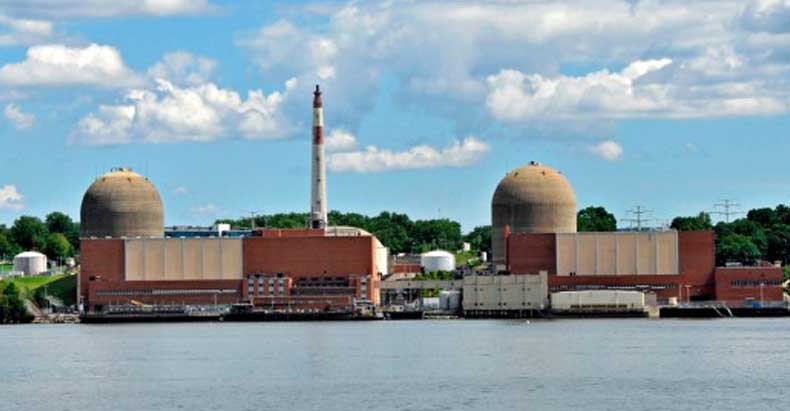
The radiation effects of the Fukushima Daiichi Nuclear Power
Plant triple meltdowns are felt worldwide, whether lodged in sea life or
in humans, it cumulates over time. The impact is now slowly grinding
away only to show its true colors at some unpredictable date in the
future. That’s how radiation works, slow but assuredly destructive,
which serves to identify its risks, meaning, one nuke meltdown has the
impact, over decades, of 1,000 regular industrial accidents, maybe more.
It’s been six years since the triple 100% nuke meltdowns occurred at
Fukushima Daiichi d/d March 11th, 2011, nowadays referred to as “311”.
Over time, it’s easy for the world at large to lose track of the serious
implications of the world’s largest-ever industrial disaster; out of
sight out of mind works that way.
Military brought in to hide true radiation levels — Experts: Officials covering up dire consequences of crisis… Worry over high number of cancers being detected — Public suffering radioactive-related diseases (VIDEO)
El País Semanal (Spanish newspaper), May 2, 2016 (emphasis added): Fukushima: Contaminated lives… Spanish media investigates how the 2011 Japanese tsunami changed the course of the country’s history… the Fukushima nuclear plant started to leak radiation that seeped insidiously into the atmosphere, the soil and the Pacific Ocean… Mr Toru Anzai, 63, wanders around the house he abandoned five years ago [in] Litate… Two years ago, he had a heart attack and a stroke… in the hospital they found a hole in the frontal lobe of his brain that was producing paralysis down the left side of his body. The doctor said it could have been caused by absorbing cesium over a period of time… [After the reactor explosion on] March 14, he heard a thunderous noise… It didn’t take long for the wind to bring the penetrating smell of melted iron mixed with sulfur to Litate as a massive toxic cloud blew towards his home. In spite of the mayor of Litate’s assurance that there was no risk of radiation, Mr Anzai bought his first dosimeter on April 18… the radiation in the room where he and his brothers had been sleeping for the past month was at six microSieverts an hour – 20 times higher than the level stipulated by the government for relocating residents…
Xinhua, May 23, 2016: Five years on, Fukushima remains shrouded in untold stories… Some of them suffer from radioactive-related diseases, and some are seeking help but having nobody to turn to. [Since] the Chernobyl nuclear disaster… various investigations and commemorations have never ceased… Yet on the Fukushima nuclear disaster, probes have always been wrapped in an ominous cloak for the past five years… However, concealing the truth will not lead people’s memory to oblivion, but arouse anger… One focal point is thelocal children’s poor health, especially thyroid cancer… The International Society for Environmental Epidemiology, a global organization, sent a message to the Japanese government this January expressing worry over the high incidence of thyroid cancer…
Xinhua, May 23, 2016: A 2015 research found that children living near the Fukushima nuclear facilities are significantly up to 50 times more likely to develop thyroid cancer compared to those children living elsewhere in Japan. Data on radiation levels collected by Japanese volunteers near the Daiichi nuclear power plant is 8 to 10 times higher than the official number… Questions over the Fukushima aftermath have never ceased to pop up… Japan is concerned with its national image, food security, tourism, nuclear policy, medical compensation and possibility of public lawsuits… [none] of them should be the country’s excuse for preventing the post-disaster situation from being known to the public…
Xinhua, May 23, 2016: Children near Fukushima more likely to suffer from thyroid cancer… More than 160 teenagers in Fukushima Prefecture had been diagnosed with thyroid cancer, including suspect cases… The Fukushima prefectural government doubted the cases were related to the nuclear disaster… Somenuclear experts were surprised by the Japanese government’s irresponsible and indifferent attitude.
Xinhua, May 23, 2016: Truths deliberately covered about Fukushima surface over five years — Facts about the Fukushima nuclear disaster… kept emerging over the past five years after the mishap took place, revealing the real face of the disaster. In front of the local government of Iidate Village in Japan’s Fukushima Prefecture [a device reads] 0.38 microsieverts/hour… However, volunteer Yoichi Tao who majored in physics said the figure of radiation on their own device is 8 to 10 times of the official one. According to Tao, the government dispatched the military to wipe out the nearby nuclear radiation on the ground in advance, so the official figure looks very low. “That’s how the government did it,” he said…
Xinhua, May 24, 2016: The improper handling of the Fukushima aftermath by the Japanese government has had grave consequences… a Russian radiation expert has said… Japan followed the suit of the former Soviet Union in playing down the disastrous consequences, said Valery Stepanenko, a leading specialist in medical and environmental dosimetry and radiation safety… the Japanese government attempted to hide the truth… After the disaster, lies and contradictive information emerged, making it impossible to decide the level of exposure… ”data of internal exposure were still left out,” he said… The consequence is dire…more than 160 teenagers in Fukushima Prefecture have been diagnosed with thyroid cancer, including suspect cases…(source)
What is happening at Fukushima? It’s almost as if there is a mainstream media blackout on information about its status. It has not gone away. It has not subsided. In fact, the situation at Fukushima is far worse than what anyone thought. And, the media is collusion with the government to cover up the severity. The reason why is fairly simple. This is the worst nuclear plant disaster in global history and there was never a plan in place to deal with this severe of a nuclear power plant disaster. As it stands, the clean-up and “fixing” of Fukushima is almost impossible.
Immediately after the incident, news reports were plentiful despite the lack of accurate data and updates from the government of Japan. As time went by, the media stories focused on the clean-up efforts, keeping reactor four from meltdown and downplaying concerns of aging nuclear plants that could suffer a similar fate, meltdown, here in the united States. Experts on everything related to nuclear power plants, reactor cores, and the dangers of radiation released by the accident weighed in with their opinion. Then, as if someone turned a switch, the media took Fukushima off the front burner and threw it out the window producing an illusion the crisis was over and the danger gone. Occasionally, news reports surface about the containment efforts of irradiated water, radiation contaminated fish, unusual diseases found in marine life, and the safety of food sources gleaned from the Pacific Ocean due to Japan’s TEPCO releasing tons of irradiated water into the ocean.
However, hiding in plain sight early on was information indicating the disaster was far worse than the mainstream media, the federal government and the government of Japan had reported. While the news reports focused primarily on the reactor fuel cores, the media ignored the danger of the spent fuel pools. In a report housed at Infowars.com, the true nature of the disaster was exposed on March 15, 2011.
To start, the Fukushima Daiichi nuclear plant has six nuclear reactors that use a design by General Electric known as the Mark I. The Fukushima site was also a repository to store spent nuclear fuel, where 40 years of spent fuel rods have accumulated. Each reactor has a spent fuel pool and an additional spent fuel pool on the ground in a separate building; that means, the Fukushima Daiichi plant had seven spent fuel pools (SFP). Critical to understanding the severity of the problem and the danger Fukushima poses, the design by General Electric, the Mark I, places the spent fuel pools on top of the reactors.
Each reactor building pool holds 3,450 fuel rod assemblies and the common pool holds 6,291 fuel rod assemblies. Each assembly holds sixty-three fuel rods. In short, the Fukushima Daiichi plant contains over 600,000 spent fuel rods – a massive amount of radiation that will soon be released into the atmosphere.
That day, a report by the LA Times indicated that 70% of the spent fuel rods were damaged, meaning radiation is being emitted by the rods or will be soon.
As the world would learn, Fukushima reactors 1, 2, and 3 suffered a complete meltdown, reactor 4 riddled with fires, and reactors 5 and 6 were damaged. Worse still, there were explosions at reactors 1 and 3 blowing “apart the respective containment buildings but left the vessels intact. Or so we think,” and an additional explosion at reactor 2. Remember, the spent fuel pool on the Fukushima reactors were stored on top of the reactors, with one SFP being separate, on ground level, which received damage during the tsunami. So, if explosions happened at reactors 1 and 3 blowing apart the containment buildings and later reactor 2, where did the spent fuel rods go that were stored above the reactors?
Unlike the reactors, spent fuel pools are not—repeat not—housed in any sort of hardened or sealed containment structures. Rather, the fuel rods are packed tightly together in pools of water that are often several stories above ground.
According to Robert Alvarez, “a former senior policy advisor at the Energy Department under Clinton and now a senior scholar at the Institute for Policy Studies,” spent fuel pools have never been considered a credible threat. However, it is these spent fuel rods that posed considerable danger. Alvarez described why just a few days after the disaster.
“The steel wall of the pool seems to show damage. All the surrounding equipment, including the two cranes, has been destroyed. There is smoke coming from reactor No. 3, and steam coming from the spent fuel pool next to it. That indicates that the water in the pool is boiling. And that means the spent fuel rods are getting hot and could start burning.”
According to thenation.com, “If the spent rods start to burn, huge amounts of radioactive material would be released into the atmosphere and would disperse across the Northern Hemisphere.”
The fuel rods must be kept submerged in water. Why? Outside of the water bath, the radioactivity in the used rods can cause them to become so hot they begin to catch fire. These fires can burn so hot the radioactive rod contents are carried into the atmosphere as vaporized material or as very small particles. Reactor no 3 burns MOX fuel that contains a mix of plutonium and uranium. Plutonium generates more heat than uranium, which means these rods have the greatest risk of burning. That’s bad news, because plutonium scattered into the atmosphere is even more dangerous that the combustion products of rods without plutonium.
Murphy called this situation, “Chernobyl on steroids,” first coined by Arnie Gundersen, “a nuclear engineer at Fairewinds Associates and a member of the public oversight panel for the Vermont Yankee nuclear plant, which is identical to the Fukushima Daiichi unit 1.”
Murphy even poses the question, “And where are the up to 20 years of reactor no 1 spent fuel rods that could cause such a problem, and the spent fuel rods held – until the building exploded – in the spent fuel rod pool atop reactor no 3?”
Most of the bomb exposure was from a direct flash that was over in seconds. There wasn’t a significant amount of contamination on the ground because the bomb went off 1,000 feet in the air. So there was not a lot of radiation residual left on the ground for hot particles to get into people’s lungs… That’s not what we’re seeing at Fukushima Daiichi. Everything I’m finding here is millions and billions of very, very small particles that are spread pretty much everywhere. We’ll know a little bit more about that in the future… There’s no comparison between a bomb and what happened at Fukushima. A bomb obliterated maybe a pound of uranium and it was a thousand feet in the air, so most of it went up almost immediately; whereas each of the nuclear reactors at Fukushima had 100 tons of uranium in them so that the quantity of radiation that’s spread out throughout the countryside is orders of magnitude higher at Fukushima than it was at Nagasaki. [emphasis ENEnews.com]
Along with the rest of the planet, Washington’s looking at the risk of a potential catastrophe. At least when it comes to finding the fuel rods from reactor 1, Washington possesses some unique assets. One asset – the secretive National Reconassiance Office – runs the spy satellites remote sensing devices that enable US national security to spy on planet Earth. The NRO’s slightly less secretive cousin over at the Pentagon is the Defense Intelligence Agency. The DIA, in turn, controls MASINT “measures and signatures technologies”.
…
With assets like the NRO and the DIA’s MASINT capacity, even an Obama administration that couldn’t find out millions of barrels of Corexit and crude oil would poison the Gulf should be able to help Japan’s Fukushima plant locate their missing fuel rods. And do so before the missing rods – or any of the other pools of fuel rods in Japan’s stricken reactors – ignite Chernobyl on steroids.
Once Obama and his generals have found the fuel rods, let’s hope they’ll time out from Gridiron dinners and collateral damage and let the Americans who pay for all the fancy spy technology know what’s happening. Because now that Americans are hearing CNN’s Dr. Gupta talking about potassium iodide (KI) to prevent radiation toxicity, they’re going to be wondering if they need to take KI. As long as we don’t see massive uncontrolled radiation releases from the stricken reactors, they probably won’t. Should we see Chernobyl on steroids, Americans may need a whole lot more than KI. And until the spent fuel rods are located, there won’t be enough information to let Americans plan how to protect their loved ones. Unless we all learn the fuel rods have caught fire.
As stated earlier, Fukushima reactor 4 was riddled with fires. The ejection of spent fuel rod assemblies and reactor explosions resulting in “missing” tons of fuel means the meltdown is more than likely burning, since outside of the water needed to cool it. This disaster has resulted in the occurrence of uncontrollable nuclear fission. More than likely, the world is witnessing “Chernobyl on steroids” as the media and world leaders maintain their silence on the severity of this disaster.
To keep abreast of the Fukushima disaster, the following sites are recommended.
The YouTube channel featuring Conrad Miller, MD, provided an update on Fukushima on April 24, 2016. Dr. Miller has over the years since the Fukushima disaster produced videos to update the public.
To view other excellent videos and receive information on Fukushima, access YouTube.com and enter “Fukushima” in the search section.
Below are interesting Fukushima documentation to review.
Fukushima, The Story No One is Talking About with Joseph Montgomery, 4/19/2016
With the lamestream enemedia news interested in “reality TV” and dog and pony shows to spread propaganda to support the Hussein Soetoro administration’s agenda, it is up to citizens to inform themselves. It becomes a difficult task when a foreign nation withholds information valuable to other nations and populations. With the discovery of increasing severity with Fukushima, this will be a lifetime generational disaster affecting the globe.
Suzanne Hamner (pen name) is a registered nurse, grandmother of 4, and a political independent residing in the state of Georgia, who is trying to mobilize the Christian community in her area to stand up and speak out against tyrannical government, invasion by totalitarian political systems masquerading as religion and get back to the basics of education.
Don't forget to follow the D.C. Clothesline on Facebook and Twitter. PLEASE help spread the word by sharing our articles on your favorite social networks.
With the lamestream enemedia news interested in “reality TV” and dog and pony shows to spread propaganda to support the Hussein Soetoro administration’s agenda, it is up to citizens to inform themselves. It becomes a difficult task when a foreign nation withholds information valuable to other nations and populations. With the discovery of increasing severity with Fukushima, this will be a lifetime generational disaster affecting the globe.
Suzanne Hamner (pen name) is a registered nurse, grandmother of 4, and a political independent residing in the state of Georgia, who is trying to mobilize the Christian community in her area to stand up and speak out against tyrannical government, invasion by totalitarian political systems masquerading as religion and get back to the basics of education.
Don't forget to follow the D.C. Clothesline on Facebook and Twitter. PLEASE help spread the word by sharing our articles on your favorite social networks.
It’s been five years since an earthquake with a magnitude of 9.0 – the biggest in the nation’s recorded history and one of the five most powerful recorded ever around the world – and subsequent tsunami destroyed large parts of the Fukushima Daiichi Nuclear Power Plant, eventually killing more than 20,000 men, women and children; displaced over 200,000; and brought untold horror and misery to many survivors.
The Fukushima nuclear disaster on March 11, 2011, resulted in massive radioactive contamination of the Japanese mainland, as well as brought to the forefront the dangers of worldwide nuclear radiation. Five years later, after-effects of the catastrophic event continue to plague the world, making it the greatest environmental disaster of all time.
#1300 tons (272,152 liters) of radioactive water – enough to fill an Olympic-size swimming pool every eight days – enters the Pacific Ocean each day. Harvey Wasserman, journalist and advocate for renewable energy, told RT:
“This is an apocalyptic event. This is something that could contaminate the entire Pacific Ocean. It is extremely serious. The reality is that Tokyo Electric does not know what is happening and does not know how to control what is going on. Our entire planet is at risk here.”
#2 The Fukushima Daiichi Nuclear Plant holds 11,400 fuel rods – Fukushima reactor No. 4 alone has 1300 fuel rods stored in a leaking pool. These fuel rods need to be manually removed, along with 6,300 fuel rods stored nearby. Since the fuel rods, which contain radiation equivalent to 14,000 times the amount released when the US dropped an atomic bomb on Hiroshima at the end of World War II, have to be extracted manually to avoid a worse disaster than the March 2011 nuclear crisis, even the tiniest mistake could lead to a nuclear chain reaction.
#3 In 2013, TEPCO, the Japanese power company responsible for the Fukushima reactor, admitted that radiation levels in its groundwater observation hole on the east side of the turbine buildings had reached 310 Becquerels per liter for cesium-134 and 650 Becquerels per liter for cesium-137. According to the World Health Organization, drinking water at 300 Becquerels per liter is equivalent to one year exposure to natural background radiation, or 10 to 15 chest X-rays.
#4 In the immediate aftermath of the disaster, the plant was spewing an estimated 5,000 to 15,000 terabecquerels (trillion Becquerels) of cesium-137 a month. According to Jota Kanda, an oceanographer at Tokyo University of Marine Science and Technology, the plant continues to leak 10 billion Becquerels of cesium-137 per dayinto the Pacific Ocean.
#5 Within two years of the catastrophe, TEPCO admitted that they had detected the highly toxic strontium-90, a byproduct of nuclear fission that can cause bone cancer if ingested, at levels 30 times the permitted rate. It also publicly admitted that a cumulative 20 trillion to 40 trillion Becquerels of radioactive tritium had leaked into the sea since the disaster.
#6 Apart from Cesium-137 and Strontium-90, the plant continues to leak large amounts of Iodine-131 into the air. Because the thyroid quickly absorbs Iodine-131 in a radioactive event, the resultant internal contamination damages the thyroid, leading to hypothyroidism, cancer and death. Harvey Wasserman writes:
“Iodine-131 can be ingested into the thyroid, where it emits beta particles (electrons) that damage tissue. A plague of damaged thyroids has already been reported among as many as 40% of the children in the Fukushima area. That percentage can only go higher. In developing youngsters, it can stunt both physical and mental growth. Among adults it causes a very wide range of ancillary ailments, including cancer.”
#7 Experts call it the biggest release of radiation to a body of water in the history of the world, much worse than Chernobyl. They project that the entire Pacific Ocean will have Cesium levels 5 to 10 times higher than what they were at the peak of atomic bomb testing decades ago.
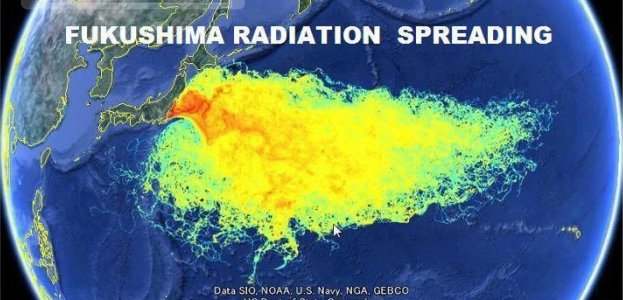
#8 Radiation from the Fukushima disaster has already spread across the globe. Last December, scientists found a spike of cesium-134 off the coast of California — about 11 Becquerels per cubic meter of water. They also found about 10 Becquerels per cubic meter of water 1,500 miles north of Hawaii — a level around twice as high as levels they found on previous missions.
#9 According to Japan’s Ministry of Economy, Trade and Industry (METI), more than 1,100 square kilometers of villages, mountains and forests remain uninhabitable; fully cleaning the site will require half a century.
#10 We have endless releases into the Pacific Ocean that will be ongoing for not only our lifetimes, but our children’s lifetimes, concludes researcher Christina Consolo. She tells RT:
“…The worst case scenario could play out in death to billions of people.A true apocalypse… A weather event, power outage, earthquake, tsunami, cooling system failure, or explosion and fire in any way, shape, or form, at any location on the Fukushima site, could cascade into an event of that magnitude as well.”
Nuclear Engineer: “Alarm bells” are going off over Fukushima plume
coming to US West Coast — People will be dying from radiation that’s flowing
across Pacific — Massive amounts of nuclear waste are flowing into ocean every
day, and will for more than a century — “We’ve contaminated the biggest source
of water on planet, and there’s no way to stop it” (VIDEO)
Nuclear engineer Arnie Gundersen on Fukushima@5, Mar
7, 2016 (emphasis added): Massive amounts of
radiation continue to enter Japan’s water and air, and the Pacific Ocean,
daily… Due to its triple meltdowns and the unmitigable
radioactive releases, Fukushima Daiichi will continue
to bleed radiation into the Pacific Ocean for more than a century…
There is no road map to follow with directions to stop the ongoing debacle…
Nuclear engineer Arnie Gundersen on KPFA, Mar 30,
2016: [Univ. of California] Berkeley’s nuclear program has been in the forefront
of the pro-nuclear propaganda for decades, and since Fukushima has been
aggressively downplaying the significance of it. So, whatever comes out of
Berkeley, I just attribute to a very pro-nuclear faculty… [Woods Hole
Oceanographic Institution is] measuring 1,000 miles offshore [of the US West
Coast] and… picking up 10 becquerels per cubic meter [Bq/m3]. At my point,
that’s when my alarm bells go off is 10 [Bq/m3]… That
plume is still coming, the Pacific is a huge place
and to think that a disaster on the opposite side of the world
can be detected and begin to contaminate
California, I think that the monumental shattering
conclusion [is] radiation knows no borders… So this ‘dilution is the
solution to pollution’ is what I think Berkeley believes in. What you can be sure of is that somebody’s going to die from the
radiation that’s in the Pacific, but you just won’t know who it is –
and they’re counting on that. The nuclear establishment is saying, ‘Well, we can
smear that out in a broader epidemiological study.’
Nuclear engineer Arnie Gundersen on CCTV, Apr 5,
2016: We’re looking at newspaper coverage from the last couple of weeks and it’s
clear that the plant continues to hemorrhage.
Nuclear engineer Arnie Gundersen: [T]he
Fukushima power plants… continues to bleed into the Pacific every day. But what
no one is paying any attention to is that the entire mountain range that runs
100 miles up and down this coast is also contaminated. And as
much radiation is pouring out… into the Pacific from the mountain range
because it’s so contaminated, as from the Fukushima
site… in fact, they’ve got an entire state pouring
radiation into the Pacific. So what’s in the Pacific? Off of California, they’re finding radiation at what I would consider
significant levels… in a cubic meter of ocean water, they’re finding 10
radioactive decays every second… So a cubic meter of water, if you’re in a dark
room, would have 10 flashes of light every second, and that’s going to
go on for 300 years. So we have contaminated
the biggest source of water on the planet, and there’s no way to stop
it.
Maggie Gundersen, founder of Fairewinds: So are
you saying that the contaminated water problem is hopeless? Is there nothing we can do to slow it down?
Arnie Gundersen: It used to be that scientists
believed dilution is the solution to pollution. But I think we’re finding with the biggest body of water on the planet, that you
can’t dilute this stuff. And we’re going to begin to see this
bio-accumulation, which is all the fish that are in the ocean
are going to uptake the cesium and the strontium and become more and more and
more radioactive…
Buchanan, NY — An uncontrollable radioactive flow from the Indian Point nuclear power plant continues leaking into groundwater, which leads to the Hudson River, raising the specter of a Fukushima-like disaster only 25 miles from New York City.
The Indian Point nuclear plant is located on the Hudson River, approximately 25 miles North of NYC, and serves the electrical needs of an estimated 2 million people. Last month, while preparing a reactor for refueling, workers accidentally spilled some contaminated water, containing the radioactive hydrogen isotope tritium, causing a massive radiation spike in groundwater monitoring wells, with one well’s radioactivity increasing by as much as 65,000 percent.
Entergy, the Louisiana-based company that owns the plant, chalked up the readings to “fluctuations that can be expected as the material migrates.” According to Entergy, the tritium contaminated water spill was contained within the plant, and never reached the Hudson or any other water source.
“There is no impact to public health or safety,” Entergy spokeswoman Patricia Kakridas told RT.
Of course, the tritium leak is the ninth in just the past year, four of which were serious enough to shut down the reactors. But the most recent leak, however, according to an assessment by the New York Department of State as part of its Coastal Zone Management Assessment, contains a variety of radioactive elements such as strontium-90, cesium-137, cobalt-60, and nickel-63, and isn’t limited to tritium contamination.
Despite the assurances from Entergy, the area around Indian Point is a “cancer cluster,” with the local rate of thyroid cancer rates registering at 66 percent higher than the national average, according to Joseph Mangano, Executive Director of the Radiation and Public Health Project (RPHP).
RPHP researchers compared the state and national cancer data from 1988-92 with three other five-year periods (1993-97, 1998-02, and 2003-07). The results, published in 2009, show the cancer rates going from 11 percent below the national average to 7 percent above in that timespan. Unexpected increases were detected in 19 out of 20 major types of cancer. Thyroid cancer registered the biggest increase, going from 13 percent below the national average to 51 percent above.
Incredibly, Entergy completely rejects the notion that their plant’s operations have caused an increase in cancer rates.
“There is no relation whatsoever,” Kakridas claimed.
When the study was conducted by RPHP, over 20 million people lived within a 50-mile radius of the nuclear plant.
“Everybody who lives near a nuclear plant is exposed to radiation. Some plants are worse than others,” Mangano told RT. In the case of Indian Point, it is a very old plant, and “there is a greater danger because of a large population living close by.”
Numerous environmental groups call the latest problems just a symptom of a much larger issue and Gov. Andrew Cuomo is partnering with organizations The Sierra Club, Riverkeepers, Hudson River Sloop Clearwater, the Indian Point Safe Energy Coalition, Scenic Hudson and Physicians for Social responsibility in seeking the permanent closure of the plant.
The U.S. Nuclear Regulatory Commission sent a representative to the Indian Point plant, Neil Sheehan, who told CBS News that the NRC is continuing to review the recent tritium leakage at Indian Point.
“We recently sent a radiation protection specialist to the plant to assess the situation and learn more about what happened. He was assisted by our three Resident Inspectors assigned to the plant on a full-time basis,” he wrote in an email to CBS.
NRC is also currently reviewing Indian Point’s renewal license, which would authorize it to continue operating for another 20 years.
“It’s a disaster waiting to happen and it should be shut down,” Paul Gallay, president of Riverkeeper, a watchdog organization dedicated to protecting the Hudson River, told CBS News.
“The good news is, advances in alternate power sources, grid management and energy conservation have brought us to the day when the aging, unsafe Indian Point can close,” Gallay said.
He pointed out numerous sources of energy for the region, including 600 megawatts in transmission system upgrades and another 500 megawatts available through energy savings achieved through efficiency and renewable energy.
“There will be enough power to keep the lights on in our homes and hospitals, our businesses and schools — in every place that makes our communities healthy and vibrant,” Gallay said.
U.S. Senator Chuck Schumer has rejected calls for the immediate closure of the nuclear power plant by Cuomo and environmental groups, saying they should first demonstrate how to replace the energy produced at the power plant, which supplies 25 percent of the power to the New York City area.
“I have told some of the environmental people, if you can show me a plan to figure out a way to replace that electricity, fine, but if you can’t, it’s going to raise electricity rates 30 or 40 percent, which are high enough on average people and that’s not the way to go. In the meantime, I have emphasized very strong safety,” Schumer said.
While Schumer’s sentiments are understandable, the reality is that the sheer economic health costs of this plant’s operation far exceed the savings in energy bills. With so many alternative sources of producing clean energy, the reasoning for keeping such a toxic plant operational is baffling. One can safely assume that there is some vested financial interest in keeping this plant running; as always, simply follow the money.
Jay Syrmopoulos is a political analyst, free thinker, researcher, and ardent opponent of authoritarianism. He is currently a graduate student at University of Denver pursuing a masters in Global Affairs. Jay’s work has been published on Ben Swann’s Truth in Media, Truth-Out, Raw Story, MintPress News, as well as many other sites. You can follow him on Twitter @sirmetropolis, on Facebook at Sir Metropolis and now on tsu.
America being bathed in radiation from Fukushima… alarming levels now 1,000 times above normal for alpha particles
Submitted by IWB, on January 29th, 2016
by: Sarah Landers
(NaturalNews) Official data reported at the National Conference on Radiation Control shows that the U.S. has been experiencing a huge spike in radiation from Fukushima. Levels are considered to be far exceeding the federal regulatory limit, with nearly 1,000 times the normal amount of alpha particles recorded, including plutonium.(1)
Data analysis of Californian air samples, taken seven weeks after Fukushima began to release radiation in 2011, shows gross alpha activity of 200 femtocuries per cubic meter, which is 790 times the normal levels experienced in the state.
The radiation is not just limited to air pollution, and there are thought to be 110 sites off the American Pacific Coast that have been contaminated by leaks of radiation into water systems.
The dangers of alpha radiation
Alpha radiation is thought to be the least dangerous form of radiation when compared with beta and gamma rays – with even simple clothing stopping the alpha particles from reaching the body. However, alpha particles become extremely dangerous when ingested or inhaled. If you’re fortunate and only consume small doses, you may not show any symptoms. However, many people who are exposed suffer radiation sickness including nausea, vomiting, headaches and fatigue.
If you ingest large quantities of alpha particles by either drinking contaminated water or breathing polluted air, you are at high risk of developing cancerous cells, with many lung cancer cases being directly related to radioactive air pollution.(2)
The Fukushima disaster
Following a major earthquake in March 2011, a 15-meter-high tsunami hit Japan, disabling the power supply of the Fukushima plant and damaging the reactors. This caused a nuclear catastrophe, with all three cores melting in the first three days after the tsunami.(3)
This accident rated 7 on the INES scale due to the extremely high levels of radioactive releases, and four reactors were totally written off due to the damage. The main concern at the time was stabilizing the remaining three reactors with water – which took approximately two weeks.
Apart from the cooling, the other very important ongoing task was to prevent the release of radioactive materials – particularly from contaminated water which leaked from the units. The plant went into an official “cold shutdown condition” in December 2011.
But just how far did the radiation travel and could the U.S. be in danger, despite being so far from the source?
How far can radiation travel?
The distance that radiation can travel depends entirely upon the type of the radiation and its ability to penetrate other materials. According to the United States Nuclear Regulatory Commission, alpha and beta particles aren’t able to travel particularly far, whereas gamma rays, X-rays and neutrons travel a significant distance and are difficult to block.(4)
According to the U.S. Nuclear Regulatory Commission, if you live within 50 miles of a normal, functioning nuclear power plant you, will receive an average radiation dose of approximately 0.01 millirem per year, although much of that actually comes in just a fewmassive doses throughout the year. However, the huge spikes seen in the U.S. caused by Fukushima show that nuclear waste spreads fast and far through the air and ocean currents.(5)
The spike reported at the National Conference for Radiation Control is very concerning, showing that time and distance do nothing to stop the spread of radiation from nuclear disasters. Scientists need to closely monitor contamination levels across the Pacific, with the amount of radioactive material appearing on the Pacific Coast on the rise.(6)
It is likely that we will see a variety of health problems emerging over the coming years that can be related to this radiation spike from Fukushima.
A massive gas leak in Southern California is ongoing, and it is unknown when it will be able to be fixed. Pundits are comparing it to the BP oil spill in the Gulf of Mexico and even Fukushima. A recently declassified US gov report revealed that Fukushima is way more dangerous than has been revealed. But do people care?
The colorless miasma slowly crept over the land, engulfing everything in its path. Living creatures that could move, attempted to do so, or faced the ultimate ending in a most gruesome way. Unfortunately and eventually, the animals tired, and were forced to rest, closing their eyes for one final time. The end had come. Now, if you thought this was another story describing the BP spill in the Mexican Gulf or even Fukushima, you would be wrong. Our story involves a natural gas leak in California that is taking place right now, as we speak.
Wired described the situation further when it wrote — “Methane, a greenhouse gas 70 times more potent than carbon dioxide, has been leaking out of a natural gas storage site in southern California for nearly two months, and a fix won’t arrive until spring”. That’s right. The authorities don’t have any idea when it will be fixed, or when this horror will come to an end. The article went on to say that — “According to the California Air Resources Board, the site is leaking up to 145,000 pounds per hour. In just the first month, that’s added up to 80,000 tons, or about a quarter of the state’s ordinary methane emissions over the same period.” In fact, the problem is so bad that — “The Federal Aviation Administration recently banned low-flying planes from flying over the site, since engines plus combustible gas equals kaboom”. Kaboom, as in, a massive explosion. That’s right. A low-flying airplane could set this thing off.
The situation was further described — “Families living downwind of the site have also noticed the leak. Methane itself is odorless, but the mercaptan added to natural gas gives it a characteristic sulfurous smell. Over 700 households have at least temporarily relocated.” It continued by saying — “Given both the local and global effects of the gas leak, why is it taking so long to stop? The answer has to do with the site at Aliso Canyon, an abandoned oil field. Yes, that’s right; natural gas is stored underground in old oil fields. It’s a common practice in the US, but largely unique to America. The idea goes that geological sites that were good at keeping in oil for millions of years would also be good at keeping in gas.”
Zerohedge noted that — “Across the US, over 300 depleted oil fields, of which a dozen are in California, are now natural gas storage sites.” Chris McGill, a vice president of the American Gas Association said — “We have the largest natural gas storage system in the world”. And the site at Aliso Canyon is one of the largest in America, with a capacity of 86 billion cubic feet. Aliso became a natural gas storage site in the 1970s. Each summer, SoCalGas pumps natural gas into the field, and each winter, it pumps it out. The sites are basically giant underground reserves for winter heating.”
The authorities put out a statement that read — “SoCalGas began drilling a relief well on December 4. The relief well will intercept the steel pipe of the original well—all of seven inches in diameter—thousands of feet below ground. Then crews will pour in cement to seal the wells off permanently.” So, that is it. They apparently have a plan, although Zerohedge noted once again- “As if finding a skinny pipe hundreds of feet below ground weren’t hard enough, the presence of all that explosive natural gas adds an extra layer of complication. A tiny spark and everything can go boom. So at the leaking well site, work is restricted to daylight, as lighting equipment could produce stray sparks. (The relief well is far enough away that drilling there can proceed 24/7.) Back in 1975, a well at Aliso Canyon caught fire because of sparks from sand flying up the well…..And crews can’t set a deliberate fire, also known as flaring, which they often do at other remote areas with excess gas. The leak is so big and the flare would be so hot that it could make the mess even harder to contain.”
A pundit commenting on the situation noted — “that means that natural gas leak is putting out 17.5 times the amount of greenhouse gas (effectively) as all the cars in California (combined) per unit of time!… that means (probably) that that single well is putting out as much greenhouse gas as probably half of the country…and it is ongoing. It is like Fukushima down there.” And speaking of Fukushima, which also isn’t in the mainstream news, InvestmentWatch noted that — “Following the March 2011 meltdown at Japan’s Fukushima Daiichi nuclear power plant, reactors have sprayed immeasurable amounts of radioactive material into the air, most of which settled into the Pacific Ocean. A study by the American Geophysical Union has found that radiation levels from Alaska to California have increased and continue to increase since they were last taken.”
In fact, although the US government has played down any and all claims that Fukushima is something to worry about, a recently declassified report written by the U.S. Nuclear Regulatory Commission dated March 18, 2011 was released to the public. In that report, and remember this was ONE week after the tidal wave hit Fukushima, they wrote — “The source term provided to NARAC was: (1) 25% of the total fuel in unit 2 released to the atmosphere, (2) 50% of the total spent fuel from unit 3 was released to the atmosphere, and (3) 100% of the total spent fuel was released to the atmosphere from unit 4.” Now, for most of us, those numbers don’t mean anything. However, Arnold "Arnie" Gundersen, a former nuclear industry executive, and engineer with more than 44 years of nuclear industry experience, explained it in layman’s terms when he said bluntly — “The fuel pools at Units 3 and 4 contained enormous amounts of radiation.” He continued by saying — “There’s more cesium in that [Unit 4] fuel pool than in all 800 nuclear bombs exploded above ground…”. That’s right. More than 800 nuclear bombs and that was just one unit.
So, what do you think dear listeners — “Regarding Fukushima, what did the US gov know, and when did it know it?
Huge Fukushima Cover-Up Exposed, Government Scientists In Meltdown
Submitted by Tyler Durden on 12/19/2015 17:05 -0500
Submitted by Sean Adl-Tabatabai via InvestmentWatchBlog.com, Fukushima radiation just off the North American coast is higher now than it has ever been, and government scientists and mainstream press are scrambling to cover-up and downplay the ever-increasing deadly threat that looms for millions of Americans.
Following the March 2011 meltdown at Japan’s Fukushima Daiichi nuclear power plant, reactors have sprayed immeasurable amounts of radioactive material into the air, most of which settled into the Pacific Ocean. A study by the American Geophysical Union has found that radiation levels from Alaska to California have increased and continue to increase since they were last taken.
The highest levels yet of radiation from the disaster were found in a sample taken 2,500 kilometers (approx. 1,550 miles) west of San Francisco.
“Safe” according to whom?
Lead researcher Ken Buesseler of Woods Hole Oceanographic Institution was one of the first people to begin monitoring Fukushima radiation in the Pacific Ocean, with his first samples taken three months after the disaster started. In 2014, he launched a citizen monitoring effort – Our Radioactive Ocean – to help collect more data on ocean-borne radioactivity.
The researchers track Fukushima radiation by focusing on the isotope Cesium-134, which has a half-life of only two years. All Cesium-134 in the ocean likely comes from the Fukushima disaster. In contrast, Cesium-137 – also released in huge quantities from Fukushima – has a half-life of 30 years, and persists in the ocean, not just from Fukushima, but also from nuclear tests conducted as far back as the 1950s.
The most recent study added 110 new Cesium-134 samples to the ongoing studies. These samples were an average of 11 Becquerels per cubic meter of sea water, a level 50 percent higher than other samples taken so far.
Instead of presenting the findings as an alarming sign of growing radiation, however, Buesseler emphasizes that the Cesium-134 levels detected are still 500 times lower than the drinking water limits set by the U.S. government. The news site The Big Wobble questions whether Buesseler and Woods Hole’s heavy financial reliance on the U.S. government – Woods Hole has received nearly $8 million in research funding from several government agencies – plays any role in this emphasis.
Situation still worsening
The reality, however, is that radiation along the West Coast is expected to keep getting worse. According to a 2013 study by the Nansen Environmental and Remote Sensing Center in Norway, the oceanic radiation plume released by Fukushima is likely to hit the North American West Coast in force in 2017, with levels peaking in 2018. Most of the radioactive material from the disaster is likely to stay concentrated on the western coast through at least 2026.
According to professor Michio Aoyama of Japan’s Fukushima University Institute of Environmental Radioactivity, the amount of radiation from Fukushima that has now reached North America is probably nearly as much as was spread over Japan during the initial disaster.
The recent Woods Hole study also confirmed that radioactive material is still leaking into the Pacific Ocean from the crippled Fukushima plant. Cesium-134 levels off the Japanese coast are between 10 and 100 times higher than those detected off the coast of California.
Without directly challenging the U.S. government’s “safe” radiation limits, Buesseler obliquely references the fact that any radioactive contamination of the ocean is cause for concern.
“Despite the fact that the levels of contamination off our shores remain well below government-established safety limits for human health or to marine life,” he said, “the changing values underscore the need to more closely monitor contamination levels across the Pacific.”
* * *
Don't worry though Olympians, everything will be fine in a few billion or so years.
Wednesday, November 11, 2015
Inside The Fukushima Radioactive Wasteland: A Trip Through The "Exclusion Zone"
Submitted by Tyler Durden on 11/10/2015 21:42 -0500
One month ago, we showed an eerie, drone's-eye-view of the radioactive wasteland that is Fukushima, courtesy of the following video clip showcasing the toxic area located just 200 miles away from the venue of the 2020 summer Olympics.
But while the scenery from above was dramatic, what about life on the actual ground? Because just like with Chernobyl, the world may have been eager to move on and leave the wasteland on its own, the empty ghost towns that neighbor ground zero remain stuck in time. This is the "exclusion zone," and it’s one of the most radioactive places on Earth.
Inside the zone, chunks are ripped out of buildings, totaled cars lie on the street, and clocks are stopped at the moment the tsunami struck. Nature is slowly taking over the houses and possessions of those who once called this place home.
"I feel like I’m in a parallel world," says Norikatsu Nakazato, who is only rarely allowed to visit his family’s 110-year-old house. "I don’t think I’ll be able to live here again in this lifetime." Fusion’s Tim Pool took a trip to the heart of the exclusion zone in October to talk with Nakazato and other survivors who refuse to leave, one of whom gives the following poignant answer when asked why he won't leave and whether he is scared. He answer is no, because "I just gave up."
Sunday, October 25, 2015
“The Pacific Is In Terminal Decline. The Fukushima Legacy Is Terrifying!”
Dana Durnford, oceanic research expert, talks with Richie Allen about the hidden cataclysm that is being unleashed by the continued Fukushima disaster fallout.
Today we are witnessing the continuation of a soft coup against not only President Trump, but of our Republic. The Democrats must be highly compromised, i.e. lots of skeletons in their closets. This was the most blatantly biased investigation of Democrats looking for a crime. Yet not that some Republicans are not compromised. Donald Trump did not erase 33,000 e-mail, did not accept 145,000,000 from a Russian Bank, did not hammer his Blackberries, did not bleach bit his computers, did not threaten Ukraine with withholding $1 Billion dollars from Ukraine unless they stopped the investigation of his drug addicted son Hunter, did not sell out the United States of America like Obama, Biden, Pelosi, Schiff, Nadler, and the compromised Democrats have. If the impeachment does not work this time they will try again, and again any means necessary to end the Presidency of Donald Trump, for they do not want their swamp drained.
Gun Safety, ala Governor Murphy
The NWO puppet that is the currently selected Governor of New Jersey constantly calls for "common sense gun control" should step back, and look at what "common sense gun control did for a group of Mormons in Mexico. In Mexico it is illegal to own a gun. Hey Murphy, what criminal obeys the law? He is in reality working for the disarmament of the American people and their subsequent enslavement.
Coup d'etat
Halloween a day when the demons come back to haunt us. It is the day of the devil. Nancy Pelosi, and Adam Schiff are perfect examples of the personification of evil. Nancy is an extremely devious person, and Adam continues to bite the apple over and over again. He tries to cover his loins just a Adam did as described in the Book of Genesis. The Star Chamber events that only the corrupt and compromised Democrats can call witnesses, and the accused has no right to confront his detractors. Only what lying little Adam Schiff see what will help his narrative gets out.
So now they will bring the charade out in the open, but with Nancy and liddle Schiff's caveats. Republican can only call witnesses if liddle Schiff approves them.
This is a Deep State operation in high gear. If the treasonous Democrats succeed in this impeachment it will be the END OF AMERICA as we know it.
Damn the Democrats, and I am a registered Democrat. I will vote in 2020 for President Trump!
Bought and Paid For
Jerry Nadler claims that there is NO evidence that Google censors conservatives. Either he is a liar, a fool or both. Well he pocketed $26, 000 from Google. It does not take much to buy this clown. My own blog went from 3000 hits-per day to between 50 to 100. It happened from one day to the next. It is called shadow banning. When I googled a story that was a rare story my blog DID NOT appear.
What else does the Deep State have on Nadler? Could it be pedophilia?
Death of Bush a Distraction
Hey did they pull the plug on daddy Bush to delay the Trump's release of classified information? This was to be the week of revelation about Hillary, Bill and the Deep State. Monday the Whistle blower on the Uranium One deal was to speak, but instead we have receive lies about a very evil man. The FBI raided the home of the whistle blower instead. Folks if you cannot see the current war that is going on inside our borders they you are either blind of dumber than a box of rocks. WTFU!!!
With the consummate liar, Netanyahu, claiming that there is a secret nuclear program in Iran is beyond hypocrisy. This criminal lives in a glass house, and should not throw stones. If Israel has the right to nuclear weapons so does Iran. What I would be looking for is Israel pulling a false flag on the US Navy.
Stein Hillary's Shill 120216
On Wednesday I listened to "Democracy Now", and later the Tucker Carlson Show. Each host was interviewing Jill Sellout Stein, but neither asked the key question. The key question for me would have been the following: "Jill, a hand recount of the votes in Wisconsin, Michigan, and Pennsylvania would probably not be completed by the December 19th deadline for the electoral votes. That would deny Trump the necessary votes to be elected President. That seems to be the Hillary strategy to steal the election, so why would the Green Party candidate shill for Hillary's election. Has Hillary, Bill, the Clinton Campaign, the DNC or others that are connected to the Clinton's approached you, and what were you offered?"
That would have been my question, but then again that is why I only operate in the "Fake News" section of journalism.
Egg Timer 06/14/16
The shooting at the Pulse night club in Orlando, which is just another false flag to promote a not so hidden agenda if failing to convince America that the gun did it. At the gym last night no body believed the government's story.
Just think of the 2.5 to 3 million UNCOUNTED votes in California. Had to get that off the front page. Just think that yesterday Trump was going to give a speech on the crimes of the Clintons. Well that had to be postponed. Cui bono? Hillary of course, and the Indonesian male prostitute that resides in the White House, and vacations around the world. He is determined to disarm law abiding Americans before he leaves the White House.
Iowa Caucus
How about Hillary's luck with her winning 6 coin tosses? Maybe she should play the horses, blackjack, etc. as they all can be fixed too. In six coin tosses you would have a 1 in 64 chance of winning all six. What that tells me is that the Iowa democrats have more allegiance to The Wicked Witch of the West than they do to their own country.
How about Sen. Cruz? He was not natural born, and there is doubt that his mother was born in the US. He is ineligible to run for President, but hey Obama did it why not him?
As for Rubio he was born in the US, but not of US citizens, so he too is not eligible to run for President. He has quite a few skeletons in his closet, and that is why they like him.
So much for representative government. It is a joke, but it is not funny.
Pearl Harbor
Today one should remember a day of "infamay". Yes today December 7th, 1941 the Japanese attacked Pearl Harbor, as Roosevelt hoped that they would. He made sure that the aircraft carriers were out to sea, and the dinosaur battleships were in port.
He needed an attack, where the US would lose military personnel, so that he could take the side of Churchill against Hitler. You see there were many like the Bush family that backed Hitler. So this necessitated the sacrifice of Americans to further Roosevelt's agenda.
And the beat goes on. We are still expendable to further hidden agendas.
December 7th, 2015
Halloween brings people in strange costumes, and strange people without costumes. So to does it sometimes bring strange events, in costumes. A Russian jet crashes in the Sinai. Well who was, and still is looking for their candy? Who would be willing and able to inflict such damage to the Russians? Looks to me that it would be Israel, the US, with the most means to do it. With ISIS a distant third.
Who does the security at the airport that the plane took off from?
Listening to the House Hearings on Benghazi was maddening.
The question not asked of the Wicked Witch of the West was "Why were we in Libya, and under what Congressional authorization justified it?"
What Hillary said at one point was that "We had to stop Quadafi from oppressing his people." Well he could ride standing up in an open top car without armed protection, and hear the "oppressed" cheer him. Quadafi had turned his country around, and he ran it for the benefit of the people.
The "oppressed" that the Witch referred to were the hired mercenaries out of Benghazi that Quadafi was fighting, and fighting successfully.
The Democrats were not interested in a thorough investigation of what happened, and why, but only in "Lets cover Hillary's ass mode." They accused the Republicans of turning it into a political circus. Well Hillary and Barry (aka Barack) immediately turned in into a political fairy tale while the dead Americans bodies were still warm. Obama thinking of 2012 election and Hillary thinking about 2016.
What Stevens was in on was the knowledge that Hillary and Obama were shipping weapons such as Stinger Missiles to the enemy. The enemy was fighting a US, Israeli, Saudi proxy war to overthrow Assad. My fellow Americans that is TREASON.
Was Hillary using here State Department Office to enhance the Clinton Foundation with money from people and countries that made generous "contributions" to it? In essence these were bribes to pay for her 2016 Presidential run
Hello all,
The technical support that I signed up for in 5 minutes has resolved the problem. So we will be back up and flying soon.
Obama will hate that fact.
October 3, 2015
The problem is back.
October 2, 2015
Finally, the problem has been fixed. Will be posting again soon, but first I have to take care of personal business.
October 2, 2015
Campus was a gun free zone, and vet with concealed carry was prevented to stop the carnage.
Also the World's most notorious killer, Barack Obama, referred to himself 28 times in his feigned attempt to turn the still warm victims as sacrificial lambs in his desire to disarm all Americans. This is a sick man that the rest of the World suffers from him NPD. Did you notice his pursed lips during his reading of his "sympathy" speech? That is a true sign of NPD. He knows NO empathy whatsoever.
Every Tuesday this asshole sits down with a kill list, and picks out who to execute with drones. Many men, women and children dies as collateral damage with the actions of this beast.
October 1, 2015
Still cannot post.
Will keep trying to right the situation.
September 30, 2015
Could not get into the blog today, and now that that has been addressed, we now cannot post.
Bear with us as we try and right the situation.
I guess that we must have annoyed someone.
Stock Trading 07/08/15
Stock trading has been suspended!!!
Christie Waddles for the Presidency
Just this past week the big fat bully governor of New Jersey announced that he was running for the Republican nomination for the Presidency. We here in New Jersey knew that he was waddling for the job ever since he was elected governor.
He has been a disaster for New Jersey, and he would be worse for the US.
JUST A COINCIDENCE
This past Friday I received a survey from "Everytown for Gun Safety", and of course it was about gun control. Or should I say the disarming of the citizens of America before their total enslavement and death.
It was also just a coincidence that the DHS ran an "active shooter" drill at the time of the Charleston shooting.
DISTRACTION
April 30, 2015
They have been trying to divide and conquer for quite some time, and Baltimore is just another attempt. Do not fall for it. Yes the murder of Freddie Gray was terrible, but it does not justify violence. Beware of agent provocateurs.
Yes there were peaceful protests, but looking at MSM you would not know it. What are they hiding while the Baltimore Riots takes front page, while a Treaty disguised as an agreement is being thrust upon our Nation. Discussed in secret, and with transnational corporate input. No Congressional input. They cannot even discuss what they have been told with their constituents.
Fast Track began with the Nixon administration for tariff rate, and only tariff rates. Treaties required 2/3 of the Senate to pass. Along comes The Great Communicator, the straight man for a chimp, and he declares treaties nothing more than agreements. So Ronnie only needed a simple majority of both houses.
Then came coke snorting, womanizing, money laundering Bill Clinton to get Fast Track on NAFTA, GATT, etc.
The TPP will grant sovereignty to corporations, and subject the citizens to their greedy whims and fancies. The poverty in this country and in others will explode, and violence will begin. That is why you are being subjected to another drill for Martial Law in Baltimore.
Just wait for Jade Helm, and again a psyops to get the masses used to Martial Law.
My friends any one who pushes the TPP is a TRAITOR.
FORCLOSURES
April 17, 2015
In the local paper every Friday has what appears in the classified section is a listing of Sherrif's Sales. Every Friday the list was 3, 4 or 5 pages. Today while we are in "recovery" the pages number 7, and the Republican Congress is pushing the TPP, which will destroy not only the soveringty of the US and any other signatories, but it will further bring down the middle class (what is left of it). Do not worry though, the vultures will peck at the bones of the national, state, county, and local government's assets, and they will get them for pennies on the dollar. The bastards of banking will devour the houses, and turn them into rentals.
WTFU America.
January 20, 2015
Just listenedd to Obama's Chief of Staff say that Obama with his State of the Union will continue his struggle for the middle class. "Continue his struggle for the middle class...", is that sarcasm. Obama, if that is his real name, has been attacking the middle class, and in so doing is destroying the United States of America.
His speech will be nothing more than rhetoric. He is going to demand increased taxes on the rich. Well how will that happen with a GOP House and Senate? It cannot happen and he knows it. It is all for show, and he continues his life in lies.
January 12, 2015
There is outrage on the outcome of the Dallas Cowboys versus the Green Bay Packers. Why is their outrage on this total distraction? Fans here belong to one of two tribes that support the circus of the "bread and circus".
It has become a game of less and less interest as commercials, reviews, more reviews, pregame shows of several well paid ex-jocks to tell us what must be done by each team to win. Then after the game the same go over and over the game and why one team won and one lost. The media has more covering a meaningless event than the do covering all of Africa.
It is done to take you mind off the reality of the day. It is the blue pill to keep you from seeing that you are accepting a police state as you are groped and searched when you enter the stadium.
Then there is more money to be made in the betting on the game than in the TV and commercials. So would it be any surprise to you that the games might be fixed? It isn't to me. Have you ever seen the pro football game where one team plays and the other merely shows up? Maybe the team that only showed up knew who the winner would be.
There is also a globalist plan to destroy national sports such as US football, and replace it with soccer. Could this be a step in that direction?
I remember the day well. A Customer Service Representative was promoted to Outside Sales, and he left just before lunch. His new job was to begin on the following Monday. He came back in at about an hour or two later. His face was white as a ghosts. He took a deep breath and said "President Kennedy has been killed."
It was a quiet at the bus stop in Newark that night, and the bus was dead silent. Just like today people are silent on the coup d'etat that happened that day in Dallas. It angers me that people can forget that at that day and time on the 11th month and the 22nd day our country was changed forever, and not for the better.
Many still believe that it is us versus them, and Democrat versus Republican when there is not a dime's worth of difference. The US and the world are run by a SSG (Secret Shadow Government).
Here is the audio of President Kennedy speaking about the danger to American in Secret Societies.
When will they ever learn, when will they ever learn? It takes more than flying a flag and closing your eyes to the senseless slaughterr of men, women, and children to be patriotic. The "Great Satan" has struck again, and killed children in Ahrar Ash-Sham, Syria. It is to stop our own creation ISIS, or so they say. It is really to wage war against the Syrian government, and his majesty want Congress to expand his war making powers. So get off of your patriotic ass and call your Congressman and Senator and say, "I am mad as hell and I am not going to take it anymore. End the wars, stop the bombing."
November 5, 2014
Today is the day after, and many of us know what a day after can be like. We promise never to do it again when we recover, but we forget about it and do it again. Well we did it again. We traded one bunch of traitors for another. It is like getting drunk on a different beverage. What will change? Nothing much will change. It will be the continued destruction of the United States, and the impoverishment of millions more. When will we ever learn, when will we ever learn?
May 28, 2008. MEDICARE PREMIUMS HAVE DOUBLED SINCE 2000? I did not know that. Can you help get the ad on the air? May 26, 2008: Vet Burials Nonstop At National Cemeteries Average Of 1,800 Veterans Die Each Day
RITTMAN, Ohio -- The cracking of rifle fire silenced the twittering blue jays, blackbirds and killdeer. (read entire article)
May 8, 2008: Hey, at least the OIL surge is working! This is happening on such a regular basis, it's not even shocking anymore, but that (to me) is the outrage! May 5, 2008: Another Taser incident. Just the facts: Number of Google hits for "Taser 20007" = 3,650,000. Number of hits for "Taser 2008" = 4,260,000. And it's only the beginning of May. May 1, 2008: CBS-2 HDTV reports that House members are leasing expensive cars on taxpayers' money. LINK April 30, 2008: Don't let anyone tell you that the U.S. "liberated' the women of Afghanistan. Shine the light on stories like this. April 29, 2008:I know, technically this qualifies as an "Outrage of the Last 7 Years," but it could also be an ACTION ITEM (read to the end of the column). Thank you, Ted Rall. April 28, 2008: Preventing Voter Fraud by Burdening the Poor and Elderly? Only in Bush World April 27, 2008: Doctors to kill transplant patient for using medical pot