Our War On Terrorism Continues - We Will Liberate Every Inch Of Syria
By President Bashar al-Assad
June 07, 2016 "Information Clearing House" - "SANA" - Damascus, SANA – President Bashar al-Assad said that the Syrian people surprised the world with their unprecedented participation in the People’s Assembly elections, sending a clear message to the world that the greater the pressure gets, the more the Syrians commit to their sovereignty.
In a speech addressing the People’s Assembly of the 2nd legislative term on Tuesday, the President started with congratulating the Syrian people on the advent of the holy month of Ramadan, hoping that in next Ramadan Syria will have recovered.
His Excellency said that while this is not the first time he stands at the Assembly after a new parliament was elected, but this time is greatly different from the previous ones as these elections came amid great international and regional and political events and amid harsh internal circumstances that led some to expect the elections to fail or not be accomplished, or if accomplished, they would be boycotted completely by the citizens, or at best they would be met with indifference.
“But what happened was the opposite, as the Syrian people surprised the world once again with their wide participation in one of the important national and constitutional events,” President al-Assad said, adding “the unprecedented level of participation by voters to elect their representatives at the People’s Assembly was a clear message to the world that the greater the pressure gets, the stronger the Syrian people’s commitment to their independence becomes, and that the further others attempt to interfere in their affairs, they more they prove to be committed to the constitution as the defender of independence and the pillar of stability.
“This national stance was not represented by the level of participation only, but also by the unprecedented number of candidates, who also showed a high sense of patriotism and awareness.
“All of that is a big and important message to you, the representatives of this people, as this unprecedented participation, despite all the circumstances, challenges and dangers, places on you an extraordinary responsibility towards the citizens who entrusted their hopes in your hands to maintain and preserve them through hard, sincere, and honest work that should rise up to the gravity of the challenges imposed on Syria and up to this turnout and this trust the people gave you.”
President al-Assad noted that just as these elections were not ordinary and the level of participation was unprecedented, this Assembly also came different from the previous ones, as the voters who are used to electing representatives showed much responsibility and awareness and a high level of understanding of the changes in the situation and the value of sacrifices.
He pointed out that in addition to the people electing representatives of their social groups, they chose and voted for candidates who lived the suffering and are willing to give, adding “your Assembly this time, and for the first time, includes the injured who sacrificed a piece of their body so that the homeland can be complete, the martyr’s mother or father or sister whose children sacrificed their lives in order for Syria to persist, the doctor who kept the sublime character of the profession and was considerate of the people and their economic and living conditions and so treated the citizens for free, the artist who carried a gun and defended his land and honor.”
His Excellency noted that this time, the number of women, youths, and holders of higher university degrees is much greater than before.
President al-Assad said that the world is currently witnessing unusual conditions with the West seeking to preserve its grip on the world at any cost, resulting in international clashes than in turn created regional clashes between states that seek to preserve their sovereignty and independence and states that do others’ bidding, and this reflected on the region in general and on Syria in particular.
He elaborated by saying that these conflicts reflect on the political process in Geneva, with international, regional, and local sides, along with some who have Syrian nationalities but chose to become puppets of either the most backwards states in the world or states that dream of returning to the days of colonialism, adding “but facing those traitors are another group of patriotic Syrians that are entrusted with the sacrifices of the martyrs and the wounded, and who are endeavoring through political work to preserve their land, country, and its independent decision.”
The President said “It is no longer secret that the essence of the political process for the regional and international countries supporting terrorism has been, since the beginning and throughout the various initiatives, aimed at undermining the presence of any concept of the homeland through hitting its core, which is the constitution, and through continuous pressure to consider it null and stop it and freeze it under different names and terms, mainly the so-called transitional stage.
“And of course, through hitting the constitution, two main pillars of any state get hit: the first is the institutions, on top being the institution of the army that is the defender of the state and the guarantor of the people’s security, as they started focusing on that greatly since the start and during any talk about Syria’s future and institutions. The other pillar is the diverse national, pan-Arab, and religious identity of Syria, which they started to focus on when they realized that it was the underpinning of the homeland’s steadfastness at the beginning of the events.
“They believed that the core of their political scheme, after their plot of terrorism failed, was to hit the constitution… the scheme was for terrorism to come and fully take over and be given the quality of moderation and later be given the legitimate cover, of course from the outside and not the inside. Their scheme was to undermine the constitution, and consequently create absolute chaos from which the only exit would be a sectarian, ethnic constitution that turns us from people committed to their homeland into conflicting groups that cling to their sects and seek help from strangers against their own.”
The President stressed that the sectarian experiences prove that sectarian regimes turn the people of one homeland into adversaries, and when there are enemies and adversaries anywhere, then in that case each party looks for allies, and the allies in such cases wouldn’t be inside Syria, or inside the homeland, and since relationships would be based on doubt, grudge, and hatred in the sectarian model, then the ally would be found in the outside.
“Here is when the imperialist states come and put themselves forward as protectors of those groups, and their interference in the affairs of that homeland becomes justified and legitimate, and then they move at some point to partitioning when the partitioning scheme is ready. Therefore, and in order to consolidate their scheme, we all notice that the sectarian terms occupy a significant space in the political discourse of the terrorism-sponsoring countries, the regional and the international ones,” he added, stressing that all this seeks to consecrate this concept and make it seem unquestionable or even indispensable, at which point pressure would begin on Syria to accept this logic.
His Excellency explained that just like unity starts with the unity of the people and not with geography, division also begins in the same way by dividing the people, adding “since we never have and never will allow them to take Syria down that way into the abyss, we proposed at the start of Geneva 3 a paper of principles that form basis for talks with other sides.”
President al-Assad said that after reaching agreement over the principles proposed by Syria, then it’s possible to discuss other issues like the national unity government which would draft a new constitution via a specialized committee then put it to referendum, with parliamentary elections coming after that.
He said that everyone today asks repeatedly “what is your vision for the solution,” explaining that the solution has two aspects: the political side and fighting terrorism.
Returning to the issue of principles, the President said principles are necessary in negotiations or talks because they need reference points, and in the case of Syria they try to say that the reference point is decision 2254, but decisions contradict themselves, like the 2012 Geneva statement that speaks of Syria’s sovereignty and at the same time tries to impose a transitional body on the Syrian people.
He said that when one sets principles, they prevent sides from proposing whatever they want and define limits, and any proposition outside these principles would be considered obstruction and lack of seriousness.
“I will quickly mention the basic principles proposed in the paper: Syria’s sovereignty and unity, rejection of foreign interference, rejection of terrorism, supporting reconciliations, preserving establishments, lifting the siege, reconstruction, and controlling borders. There are also other points that are mentioned in the current constitution and other constitutions like cultural diversity, citizens’ liberties, and independence of the judiciary, and other principles. We didn’t agree to any proposition outside these principles, quite simply, and this is why they refused. We didn’t hear anyone saying no but there was evasion.
President al-Assad said these principles would form basis for the success of talks if there was credibility and seriousness, in addition to showing a clear vision of the mechanism of political work that would lead to a Syrian-Syrian solution, adding “but actual talks, up to this moment, haven’t started; rather we were holding dialogue during the rounds with the international facilitator, which as I said isn’t a side to negotiate with. They didn’t respond to the paper of principles. Our delegation would ask about other sides’ reactions, and we never got an answer, which shows that those sides are reliant on their masters and it became clear that they came unwillingly and submissively to Geneva, with them beginning since the first day with making preconditions. And when they failed, they declared clearly in the last round their support of terrorism and of undermining the cessation of hostilities.”
His Excellency said that the principles paper was ignored by the other sides, and instead there was a suggestion from international sides to engage in indirect talks in different rooms with the facilitator playing the mediator, which also didn’t happen, adding that what was proposed was merely a number of questions under the tagline of “common denominators” when in fact all these questions were traps that contained terms that would harm Syria’s sovereignty, safety, its establishments, or its society.
President al-Assad said that the states involved in this issue won’t let the mediators or envoys work in an honest and independent manner, with officials from these states working behind the states and drafting the aforementioned questions under the assumption that the Syrian Arab Republic’s team of negotiators isn’t well-versed in politics, but in fact the Syrian team’s answers were decisive and they couldn’t let any of those suspicious terms slip past them, adding “in truth, for us, whoever came up with these questions, whether they were from the facilitator’s team or from those states, are either amateurs or novices in the world of politics.”
He went on to reiterate that the “other side” came to Geneva against their will after their masters forced them to go, and they came yelling and went and sulked in their hotels, and once in a while their masters would instruct them to make a certain statement, and apart from all of that there were no negotiations or agenda, as the only agenda approved for them by Riyadh is the agenda of when to wake up, sleep, and eat.
“Of course, when they failed to achieve what they wanted in the first time, they wanted to withdraw and hold Syria responsible, but they couldn’t do that in the second time. In the last time, their response was a public declaration of supporting terrorism and stopping the truce or withdrawing from the truce or what was called the cessation of hostilities,” stressing that the aftermath of that was the brutal shelling of Aleppo and the targeting of hospitals, civilians, and children by terrorists.
“Although most Syrian provinces, villages, and towns have suffered and still suffer from terrorism, and they resisted it and still do, Erdogan’s fascist regime has always focused on Aleppo because for him it’s the only hope for its Muslim Brotherhood project after he failed in Syria and after his criminal and extremist nature was exposed to the world, and also because Aleppo’s people refused to be a pawn and a tool in the hand of strangers and they resisted and persevered and remained in Aleppo, defending it and defending the homeland,” adding that Aleppo will be the graveyard where the dreams and hopes of the butcher Erodgan will be buried.
The President went on to note that in addition to what happened in Aleppo, terrorism continued to strike, with massacres in al-Zara and barbaric bombings in Tartous and Jableh, with terrorists trying in vain to incite strife in Syria, because all Syrians are brothers in life and in martyrdom who cling to life, steadfastness, and victory.
“In this context, the issue that was proposed constantly during the past few months was the issue of truce. Many of us hold the truce responsible for all that is happening. Let’s talk objectively here; nothing in this world is absolute except divine ability, and for us humans everything is relative. The truce, like anything else, if is positive then it has negative points, and if it’s negative it has positive points. In all cases, this truce doesn’t cover all areas in Syria in order for us to burden it with the negativities,” he said, adding that the truce resulted in many reconciliations that prevented a lot of bloodshed of Syrian civilians and armed forces, in addition to having benefits on the international levels that won’t be discussed now.
“On the military level, it allowed for concentrating military efforts in specific directions and realize achievements, and the first proof is liberating Palmyra shortly after the beginning of this truce and after it al-Qaryatain, and in the Ghouta of Damascus several areas were liberated of course,” the President said, adding that some of those areas were liberated in these months in much less than it would have taken to liberate them otherwise.
He explained that the problem with the truce is that it was reached with international consensus and with the agreement of the State, but there was no commitment by the US side in particular to the terms of this truce, and the US turned a blind eye to the actions of its Saudi and Turkish agents in the region.
President al-Assad noted that the Saudis openly declared their support for terrorism more than once, and Turkey openly sends terrorists across the borders to the northern areas in Syria, all while the Americans turn a blind eye to these practices, stressing that Erdogan, who caused chaos by sending forces into Iraq, blackmailed the Europeans with the refugees issue, and sent thousands of terrorists to Aleppo recently, has been reduced to a political bully or hoodlum.
“They weren’t content with the terrorism of explosives and shells; they also backed it with economic terrorism through sanctions against Syria and through pressuring the Syrian Pound with the goal of economic collapse and bringing the people to their knees,” the President said, noting that despite all difficulties the Syrian economy is still withstanding, with recent monetary steps proving the possibility of standing up to pressure and reducing the damage its caused and stabilizing the Syrian Pound.
His Excellency said that this will probably be a priority for the Assembly and for the new government that will be formed as per the constitution, explaining that the issue of the Syrian Pound is linked to the effect of terrorism in terms of its attacks on infrastructure and economic facilities, cutting off roads between cities, scaring off capitals, and the people’s reaction in general to terrorism.
President al-Assad pointed out that addressing with the Syrian Pound is a short-term issue, while the long-term issue is economy which was affected by the crisis in various ways, with some investors suspending their projects at the beginning in hopes of things returning to normal, while others continued with their work.
He stressed that what is needed for the sustainability of support the Syrian Pound and the economy is for investors to carry out projects regardless of their scales and for the government to look into laws and legislations to strengthen the economy, noting that after five years of the crisis, Syrians now have experience in how to deal with the current situation and don’t have to start from the beginning.
“The terrorism of economy and the terrorism of explosives and massacres and shells are one and the same, so I assure you that our war against terrorism continues, not because we like wars, because they imposed war on us, but the bloodshed won’t end until terrorism is uprooted no matter where it is and regardless of the masks it wears.
“Just like we liberated Palmyra and many other areas before it, we will liberate every inch of Syria from their grasp. We have no choice other than victory, or else there won’t be a Syria and out children will not have a present or a future,” President al-Assad affirmed, noting that this doesn’t mean excluding the political track, explaining “we will continue working on the political track no matter how slim the possibilities of realizing and achievement are, and this is based on the strong desire on the popular and official levels to stop bloodshed and destruction and to save the country. However, any political process that doesn’t begin, continue, and end with eliminating terrorism is meaningless and will not produce results.”
His Excellency reiterated his call for everyone who decided to bear arms for any reason to join reconciliations, because the path of terrorism only leads to destroying Syria and the loss of its people without exception.
The President addressed the Army and Armed Forces and the supporting forces, saying that no words can do them justice as they are the reasons why Syria persists, saluting them and their families and their comrades who were martyred or injured.
“The defeat of terrorism must be realized as long as there are states like Iran, Russia, and China that support the Syrian people and stand by righteousness and assist the wronged in the face of the wrongdoer,” President al-Assad said, thanking these states for their firm positions and for respecting their principles and supporting peoples’ right to self-determination.
“Here I hope that we don’t pay any heed to what is proposed in media about disputes and clashes and divisions. Things are much more firm than before and the vision is much clearer. Don’t worry; things are good in this track,” he added.
The President also thanked the Lebanese resistance for the help it provided in fighting terrorism in Syria and saluted its fallen heroes.
Addressing the Assembly members, His Excellency said that they are faced with serious tasks and major challenges, and while the sacrifices of Syrian heroes who gave their lives for their country is part the price of restoring security, triumphing over terrorism, reclaiming land, and rebuilding Syria, then the other part of that price is fighting corruption, chaos, and unlawful actions.
“These heroes gave their lives in defense of the land and the people and of the country with its constitution, establishments, and law. The price we have to pay is preserving the constitution, preserving establishments and developing them, consecrating justice and equal opportunities. These heroes gave their lives to restore the homeland whole and intact. The homeland whole is made up of all these elements together, so live up to their sacrifices, be as the people hope you to be. Your mission isn’t just a duty entrusted to you by the voters; it is also a duty entrusted to you by the martyrs and the wounded and bereaved mothers and all those who offered their blood, money, intellect, and position to protect their homeland. It is a great and serious duty, so let us all bear it together and live up to it.”
Source: http://www.informationclearinghouse.info/article44823.htm
Showing posts with label Liberation. Show all posts
Showing posts with label Liberation. Show all posts
Wednesday, June 8, 2016
President al-Assad:
Thursday, March 24, 2016

A Cleaving Blow: Palmyra's Liberation Spells Doom for Daesh
© Sputnik/ Mikhail Voskresenskiy
The liberation of Palmyra will effectively cut Daesh forces in half, opening the road to Raqqa and Deir ez-Zor, according to the commander of the Russian taskforce in Syria.

Retaking the city of Palmyra, a place of considerable historical and geographical importance, will allow the Syrian forces to effectively bisect their Daesh enemies and present an opportunity to establish control over the border with Iraq, according to Col. Gen. Alexander Dvornikov, commander of the Russian military taskforce that has been deployed to Syria.
"The city of Palmyra, located in the eastern part of Syria, is blocked and the fight to liberate it continues. Securing this city – a place of special historical and geographical significance to Syria – will effectively split the Daesh forces in two. It will also open the road to Raqqa and Deir ez-Zor, not to mention [provide us with] the opportunity to establish control over the border with Iraq,| Dvornikov said, according to RIA Novosti.
Meanwhile, the Syrian Arab Army forces, aided by militia units, have already liberated the historical part of the ancient city and continue to hammer the Islamist forces that remain entrenched in an attempt to hold the location.
Palmyra has been under Daesh control since May 2015. The terrorist group, which has been blacklisted in many countries including Russia and the United States, has already destroyed part of the ancient city, which is a UNESCO World Heritage site.
Monday, October 19, 2015
Vietnam: From National Liberation to Trans-Pacific Vassal (1975-2015)
Global Research, October 18, 2015
In 1975 the people of Vietnam successfully ended one of the longest and bloodiest anti-colonial wars in world-history – defeating the US, the world’s biggest imperial power, after 20 years of struggle.
Barely forty years later the Vietnamese regime signed off on the US-Japanese dominated Trans-Pacific Free Trade Agreement (TPFTA), which essentially converted Vietnam into a vassal state.
Vietnam has gone full circle: From a neo-colony ruled by puppet dictators backed by an American occupation army involving 500,000 troops from 1955-1975, to its current ‘Communist’ rulers who have turned-over its markets, industries, ports, resources and labor to the 500 largest Western and Asian multi-national corporations.
Contrasting Historical Moments: 1975 and 2015
In 1975, the revolutionary government closed all US military bases and expelled all US military personnel. Today the Vietnam ‘vassal regime’ allows US naval visits and signs military agreements to tighten the imperialist military encirclement of China.
In 1975, the revolutionary leaders promised to end imperial exploitation of plantation and factory labor; today the vassal rulers offer the imperial states cheap labor, at wages less than half that paid to Chinese workers to ‘entice’ multi-nationals.
In 1975, the government intervened in favor of workers, taking over plantations and factories; today the vassal state savagely represses striking workers and outlaws class-based unions.
In 1975, the revolutionary government declared its solidarity with workers’ and peasants’ struggles around the world; today the vassals declare their unconditional support of all of the major imperial organizations – from the World Trade Organization to the Trans-Pacific Treaty organization.
What explains this total reversal of politics and allegiances? What accounts for the transformation from revolutionary vanguard to submissive vassal of imperial powers? What factors led to the degeneration and decay of a revolutionary movement of millions and the ascendancy of a corrupt and servile political and socio-economic elite? Why did this counter-revolution occur without any major mass popular upheaval?
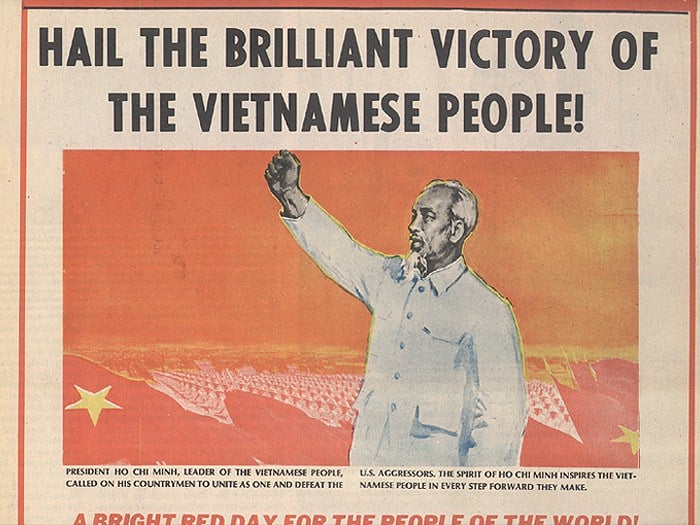
Stages and Circumstances of Vietnam’s Degeneration
Liberated Vietnam facing Military Siege
Internal and external events and forces played a major role in undermining the promise of social transformation proclaimed by the Vietnamese revolutionaries.
Beginning with the US destruction of the economy and Washington’s subsequent refusal to pay reparations and vindictive policy of post-war boycott and sanctions, the Vietnamese faced monumental tasks with few financial resources.
The US ground and air war devastated the infrastructure and productive enterprises of the country. Napalm and chemical warfare (Agent Orange) devastated villages and poisoned the rice fields, water and soil. Millions of cluster bombs maimed scores of thousands of peasants.
In sum, Vietnam’s external allies were moving in a direction, which favored Vietnamese technocrats and ‘capitalist holdovers’ from the colonial and neo-colonial period.
The ‘new rich’, including privileged sectors of the revolutionary regime, took advantage of the ‘shortage of capital flows’ and the years of shortages and sacrifices to advocate an ‘opening to the market’ and to promote the entry of foreign capital. This was accompanied by the privatization of public enterprises (dubbed ‘joint ventures’) and ‘incentives’ (high profits) to manufacturers, especially from Hong Kong, Japan and Taiwan.
Internal Factions and the Victory of the Capitalist Technocrats
By the late 1980’s, four tendencies competed for influence in the Communist Party:
Many of the corrupt officials embraced the ‘free market’ to legitimate their corrupt appropriation of public goods and the laundering of illicit earning.
The ideology “getting rich is good” pervaded the top and middle echelons of the Party, which was ‘Communist’ in name only.
The party-state lost its legitimacy along with its revolutionary legacy. The former colonial enemies, Japan, the US and their allies were eagerly courted as the Vietnamese elite’s new ‘partners’ and mentors for the upwardly mobile technocrats and economists who served them.
Vietnamese workers and peasants, once heralded as the vanguard of the liberation struggle, will be savagely exploited by the Communist – capitalist ‘partnership’. They are now among the poorest of the poor in all of Asia.
Conclusion
The ascendancy of a pro-imperialist collaborator elite in Vietnam was not inevitable; it was a relatively gradual process, in which the negative external environment gradually eroded the will and capacity of Vietnam’s heroic and historic leaders to combine the revolutionary reconstruction with popular democratic institutions following the defeat of the US military. In a repeat of the Imperial Roman scorched and salted earth policy, the US took revenge for its humiliating defeat by leaving a devastated country, refusing reparations and imposing vindictive economic sanctions on the Vietnamese people and nation. The demise of the USSR and China’s turn to capitalism forced Vietnam to look for alternative sources of external finance.
Solidarity and support for on-going liberation struggles around the world should be the rule. Social practice in everyday life should be combined with individual and collective learning of technical, historical, social and literary subjects, which enrich and deepen understanding of the revolutionary roots of contemporary society.
The state should combat the tendency of organized local ethnic groups to serve as agents loyal to foreign regimes. Material and symbolic rewards for excellence should be combined and lifetime accomplishments recognized. Those guilty of illicit economic and social activities, especially those related to nepotism or kin/clan enrichment, should be marginalized and punished.
The post-liberation defeat and reversal of Vietnam’s revolutionary gains was not inevitable. Negative lessons should be studied and serve as guidelines for future revolutions. There are grounds to believe that the Vietnamese revolutionary legacy is not dead. The revolutionary grandparents in ‘retirement’ can and will transmit their vision and experience of an alternative class struggle to their grandchildren, who are going to suffer savage exploitation, dispossession and de-nationalization following Vietnam’s entry into the imperialist Transpacific Partnership Agreement.
Leaders, who have grown rich from the TPP, will face anger and revolt by the Vietnamese masses who are destined to pay heavily for their leaders’ sell-out.
Copyright © Prof. James Petras, Global Research, 2015
Barely forty years later the Vietnamese regime signed off on the US-Japanese dominated Trans-Pacific Free Trade Agreement (TPFTA), which essentially converted Vietnam into a vassal state.
Vietnam has gone full circle: From a neo-colony ruled by puppet dictators backed by an American occupation army involving 500,000 troops from 1955-1975, to its current ‘Communist’ rulers who have turned-over its markets, industries, ports, resources and labor to the 500 largest Western and Asian multi-national corporations.
Contrasting Historical Moments: 1975 and 2015
In 1975, the revolutionary government closed all US military bases and expelled all US military personnel. Today the Vietnam ‘vassal regime’ allows US naval visits and signs military agreements to tighten the imperialist military encirclement of China.
In 1975, the revolutionary leaders promised to end imperial exploitation of plantation and factory labor; today the vassal rulers offer the imperial states cheap labor, at wages less than half that paid to Chinese workers to ‘entice’ multi-nationals.
In 1975, the government intervened in favor of workers, taking over plantations and factories; today the vassal state savagely represses striking workers and outlaws class-based unions.
In 1975, the revolutionary government declared its solidarity with workers’ and peasants’ struggles around the world; today the vassals declare their unconditional support of all of the major imperial organizations – from the World Trade Organization to the Trans-Pacific Treaty organization.
What explains this total reversal of politics and allegiances? What accounts for the transformation from revolutionary vanguard to submissive vassal of imperial powers? What factors led to the degeneration and decay of a revolutionary movement of millions and the ascendancy of a corrupt and servile political and socio-economic elite? Why did this counter-revolution occur without any major mass popular upheaval?
Stages and Circumstances of Vietnam’s Degeneration
Liberated Vietnam facing Military Siege
Internal and external events and forces played a major role in undermining the promise of social transformation proclaimed by the Vietnamese revolutionaries.
Beginning with the US destruction of the economy and Washington’s subsequent refusal to pay reparations and vindictive policy of post-war boycott and sanctions, the Vietnamese faced monumental tasks with few financial resources.
The US ground and air war devastated the infrastructure and productive enterprises of the country. Napalm and chemical warfare (Agent Orange) devastated villages and poisoned the rice fields, water and soil. Millions of cluster bombs maimed scores of thousands of peasants.
The US secretly supported the Khmer Rouge, the Cambodian terror regime, in its war on liberated Vietnam. This further damaged Vietnam’s shattered economy and diverted scarce resources needed for peacetime reconstruction to military operations.
China launched a border war on Vietnam’s northern frontier, increasing the burden on the depleted resources of the Vietnamese state.
The Difficult Transition
The Vietnamese revolutionary government, during the first decade of its existence, struggled to make the transition from a war to a peace economy.
Given the scarcity of resources, skilled manpower and revenues, and under stress to protect its borders, the Vietnamese government attempted to ‘socialize’ the economy with few personnel and limited external support from the Soviet Union and its allies.
Power was concentrated, political militants and loyalists took command, although many lacked experience or expertise in economic development. Economic recovery was understandably dictated by political and military priorities. Politics was in command – trained orthodox economists were in retreat. The choice was ‘red’ over ‘expert’.
After decades of deprivation and sacrifice, many cadres sought and obtained access to scarce resources. A privileged elite emerged, especially in South Vietnam, where the US military occupation had spawned a huge black-market economy, and a large stratum of wealthy ‘middlemen’ who acted as ‘brokers’ with wealthy overseas Chinese businesspeople, especially in Hong Kong and beyond.
The Vietnamese defeated the Pol Pot terrorist regime at a heavy cost and backed a friendly client regime.
By 1980, China began its transition to capitalism and showed no interest in providing aid or investment to hasten Vietnam’s socialist reconstruction. By the mid 1980’s, with the ascendance of Gorbachev, Russia cut off its economic assistance to Vietnamese state enterprises, denigrated socialist planning and backed ‘market solutions’.
External ‘Allies’ Promote Internal EnemiesIn sum, Vietnam’s external allies were moving in a direction, which favored Vietnamese technocrats and ‘capitalist holdovers’ from the colonial and neo-colonial period.
The ‘new rich’, including privileged sectors of the revolutionary regime, took advantage of the ‘shortage of capital flows’ and the years of shortages and sacrifices to advocate an ‘opening to the market’ and to promote the entry of foreign capital. This was accompanied by the privatization of public enterprises (dubbed ‘joint ventures’) and ‘incentives’ (high profits) to manufacturers, especially from Hong Kong, Japan and Taiwan.
Internal Factions and the Victory of the Capitalist Technocrats
By the late 1980’s, four tendencies competed for influence in the Communist Party:
(1) A revolutionary faction, including some of the historic leaders of the Liberation struggle.
(2) A centrist or reformist faction of privileged officials who sought to protect and promote state enterprises – a source of their own enrichment. They supported the “partnership” with foreign private capital supposedly as a supplement to the so-called “socialist sector”’
(3) A third faction of technocrats, who favored the gradual conversion to a private capitalist economy, except in some ill-defined ‘strategic sectors’.
(4) A fourth faction, composed of Western educated and connected economists, who sought and secured submission to overseas capitalist and international financial institutions. They joined forces with the technocrats and privileged, corrupt Party elite and became the eventual rulers of Vietnam.
The Counter-revolutionary ‘Unholy’ Alliance
In the course of the following decade, an alliance of technocrats, corrupt and enriched officials (with their families), who had become business partners, and pre-revolutionary elites took control of the economy. By the middle of the 1990’s, Vietnam could no longer ‘balance’ between the USSR and China on the one-hand and Western capitalists on the other. The USSR had disappeared. Russia was in chaos. China was in headlong pursuit of capitalist growth at any cost, through any means, especially via the privatization of major enterprises and stripping workers of all labor and welfare rights.
The Vietnam revolutionaries were ‘retired’ or relegated to the historical museum as respected but impotent figureheads. They were trotted out on special ‘national’ occasions.
The ‘statists’-the Party CEOs fought rearguard struggles trying to retain lucrative fiefdoms in public enterprises, but lacked any strategic allies abroad or internally. They had immobilized the working class and had themselves embraced the privileges of power, luxury and corruption – (with few notable exceptions).
By the turn of the millennium, the technocrats and capitalist ideologues had taken full command of economic decision-making. They embraced the politics and economics of ‘globalization’ and the insertion of Vietnam into the World Trade Organization (WTO). They cited Vietnam’s rapid growth, lauding its abundant disciplined, cheap labor, kept in line by the centralized Party. Communist Party leaders exhibited all the features of the authoritarian personality: arrogant and abusive to the workers under them, submissive and servile to the foreign investors above them.
The Party had become the instrument for repressing outbreaks of industrial strikes, rural protests and public disaffection.Many of the corrupt officials embraced the ‘free market’ to legitimate their corrupt appropriation of public goods and the laundering of illicit earning.
The ideology “getting rich is good” pervaded the top and middle echelons of the Party, which was ‘Communist’ in name only.
The party-state lost its legitimacy along with its revolutionary legacy. The former colonial enemies, Japan, the US and their allies were eagerly courted as the Vietnamese elite’s new ‘partners’ and mentors for the upwardly mobile technocrats and economists who served them.
With the signing of the Trans-Pacific Partnership (TPP), US imperialism easily secured in luxury conference rooms what they had failed to achieve in twenty years on the battlefield: Total access to all of Vietnam’s major economic sectors, a captive labor force without rights or protection and a ruling elite willing to serve as an accomplice to its militarist policy of encircling China.
Imperial Dominance by Invitation
The US political-economic conquest of Vietnam was accomplished by the invitation and complicity of the Vietnamese ruling Communist Party and not by the force of arms, not by a puppet ruler or a bought and bound ‘Generalissimo’.
The main beneficiaries of its vassalage are the Vietnamese collaborators, intermediaries, importers, exporters and labor contractors, who receive legal and illicit commissions for selling out the nation’s wealth. This includes a small army of ‘service operators’, embedded in IT start-ups, Chinese-Vietnamese business associates of Hong Kong sweatshop manufacturers, new university graduates turned business consultants and public officials who ‘sign-off’ on tax exemptions,and fabricate compliance with labor and environmental protection laws. These are the ones who grow rich in the new ‘market economy’.
As the major US, Japanese and overseas Chinese corporations take control of Vietnam’s manufacturing, banking, retail and wholesale sectors and local and overseas trade, small-scale local businesspeople will go bankrupt. State enterprise will be sold or closed. Small farmers and peasants will a lose access to credit while cheap imported rice will flood the market and bankrupt local farmers.Vietnamese workers and peasants, once heralded as the vanguard of the liberation struggle, will be savagely exploited by the Communist – capitalist ‘partnership’. They are now among the poorest of the poor in all of Asia.
Conclusion
The ascendancy of a pro-imperialist collaborator elite in Vietnam was not inevitable; it was a relatively gradual process, in which the negative external environment gradually eroded the will and capacity of Vietnam’s heroic and historic leaders to combine the revolutionary reconstruction with popular democratic institutions following the defeat of the US military. In a repeat of the Imperial Roman scorched and salted earth policy, the US took revenge for its humiliating defeat by leaving a devastated country, refusing reparations and imposing vindictive economic sanctions on the Vietnamese people and nation. The demise of the USSR and China’s turn to capitalism forced Vietnam to look for alternative sources of external finance.
Added to these harsh external conditions, difficult internal problems complicated the transition: Vietnam’s revolutionary leaders, who were magnificent and victorious strategists of politico-military struggle, were mediocre economic strategists. They turned to the pre-revolutionary Chinese-Vietnamese business elite, linked to Hong Kong, Taiwan, and mainland business families, to navigate the economy.
The young, educated post-revolutionary generation was drawn heavily from privileged families, especially from Saigon; they inexorably adapted and imposed their neo-liberal ideology on the regime.
The marriage of corrupt repressive statist officials to the traditional privileged clans and classes brought the new post-revolutionary educated technocrats to power.
The authoritarian Party elite ensured the de-radicalization of the workers and peasants, the exclusion and repression of leftwing activists and the unhindered application of neo-liberal, pro-imperial economic policies.
The Vietnam experience provides us with several important historical lessons:
The first lesson is the importance of democratizing and socializing production, distribution and culture following national liberation to check against the post-revolutionary seizure of power by Party and military leaders and to limit the advance of the old privileged classes.
Secondly, the educated classes must serve the interests of the revolutionary masses, and admission to institutes of higher education should favor the sons and daughters of the working class, not the children of the traditional comprador elite.
University students should be integrated into democratic class organization to further and deepen their links to the past and present revolutionary heritage
Public resources should be concentrated on economic and social programs that improve the lives of wage and salaried workers and local producers. The presence of private, local and foreign investors should be rigorously controlled via time- bound agreements.
The administration and decision-making in cooperative, self-managed and local enterprises should be decentralized.
Political education should be based on egalitarian ethics. Anti-corruption, disciplinary committees, elected by workers, peasants, employees, accountants, consumers and environmentalists should be established throughout the economy.
State expenditures on social and private consumption should be balanced with emphasis on public transport, health, education and leisure facilities.Solidarity and support for on-going liberation struggles around the world should be the rule. Social practice in everyday life should be combined with individual and collective learning of technical, historical, social and literary subjects, which enrich and deepen understanding of the revolutionary roots of contemporary society.
The state should combat the tendency of organized local ethnic groups to serve as agents loyal to foreign regimes. Material and symbolic rewards for excellence should be combined and lifetime accomplishments recognized. Those guilty of illicit economic and social activities, especially those related to nepotism or kin/clan enrichment, should be marginalized and punished.
The post-liberation defeat and reversal of Vietnam’s revolutionary gains was not inevitable. Negative lessons should be studied and serve as guidelines for future revolutions. There are grounds to believe that the Vietnamese revolutionary legacy is not dead. The revolutionary grandparents in ‘retirement’ can and will transmit their vision and experience of an alternative class struggle to their grandchildren, who are going to suffer savage exploitation, dispossession and de-nationalization following Vietnam’s entry into the imperialist Transpacific Partnership Agreement.
Leaders, who have grown rich from the TPP, will face anger and revolt by the Vietnamese masses who are destined to pay heavily for their leaders’ sell-out.
The Vietnam’s leaders have embraced the aggressive US-Japanese militarist policy against China; this betrayal of the people’s struggle will have long-lasting negative consequences.
Once against external and domestic developments will converge – hopefully, this time ushering in a new phase of revolutionary change.
Copyright © Prof. James Petras, Global Research, 2015
Subscribe to:
Posts (Atom)