"No videos found" is that persistent message from the "Ministry of Truth". So the Ministry is showing its true colors of pro radical Islam, anti-semitism, and a full suppression of the truth. There is a vast conspiracy to destroy the nation state, and each and every culture of them.
Blogger's note:
subterrnews.blogspot.com does not send cookies, or collect any information on
those using the blog. However, the blogspot is on google, and google may
collect information, and send cookies. Many of the links that we
connect to do not send out cookies or collect information, but some do.
Your keying in to this blog you have agreed to this.
The views expressed in the articles
do not necessarily represent the opinions of this blog.They are the views, and opinions of the
author(s) of the article.
"The attempt in the West to impose a strict set of rules about what one is allowed to think and express in academia and in the media - to the point that anyone who disobeys is discredited, demonized, intimidated and in danger of losing his or her livelihood - is just as toxic and just as reminiscent of Orwell's diseased society."
Today, conflicts arising out of jihadism account for the majority of war casualties, whereas hostilities are increasingly concentrated in the Middle East. However, Daesh itself is no longer the biggest threat to world peace, Swedish researchers say.
More than half of the world's direct casualties of war are now harvested in conflicts linked to militant Islamism and jihadism, a new compilation from the world's leading conflict researchers at Uppsala University showed.
According to the Swedish researchers, almost all great conflicts since 2006 have been classified as jihadism, the Swedish newspaper Dagens Nyheter wrote. Daesh has been the focus of the media coverage of violent Islamism ever since the terrorists spectacular advance in Iraq and Syria a couple of years ago. Although the jihadism category is still largely dominated by the war in Syria, Daesh proper is no longer the biggest player, as a constellation of Islamic groups has been mushrooming worldwide.
Of late, Daesh has opened "subdivisions" in countries such as Libya and Lebanon. At the same time, previously independent jihadists have been joining in, the most infamous being the Nigerian Boko Haram, which last year pledged allegiance to the "caliphate" in the Middle East.
According to Isak Svensson, professor at the Department of Peace and Conflict Research, the increase also depends on several rebel movements having switched their rhetoric from nationalist to outright Islamist. The spread of Islamism has led to a dramatic increase in the proportion of Jihad-related causalities in the statistics, whereas the death rate in other conflicts has decreased.
Despite jihadism bearing clear links to Islam, the connection is not as obvious, as India and Indonesia, the two countries with the world's largest Muslim population, are still strictly-speaking free from the violent manifestations of Islamism. Radical Islam is strangely absent in Southeast Asia, which is home to a number of Muslim groups. In the early 2000s, analysts believed the region would turn into a hotbed of terrorism, yet the hypothesis has since been put to shame.
The survey on the geographical development of conflicts over time also showed that the hostilities are accumulating "towards the middle." Today, the majority of the world's conflicts unfold in the vast stretch of land across the Muslim world from Afghanistan and Pakistan to Northern Africa.
Remarkably, most of the sub-Saharan Africa, which was previously tormented by decade-long liberation wars, is peaceful today, as is East Asia, which between 1946 and 1979 stood for 80 percent of the world's war deaths. Today, the percentage amounts to only 4 percent.
Lastly the survey pointed out a change in the nature of conflicts. Since WWII, civil war became the "normal" form of conflict. Today, the borders between armed conflicts, terrorism or even organized crime have been erased.
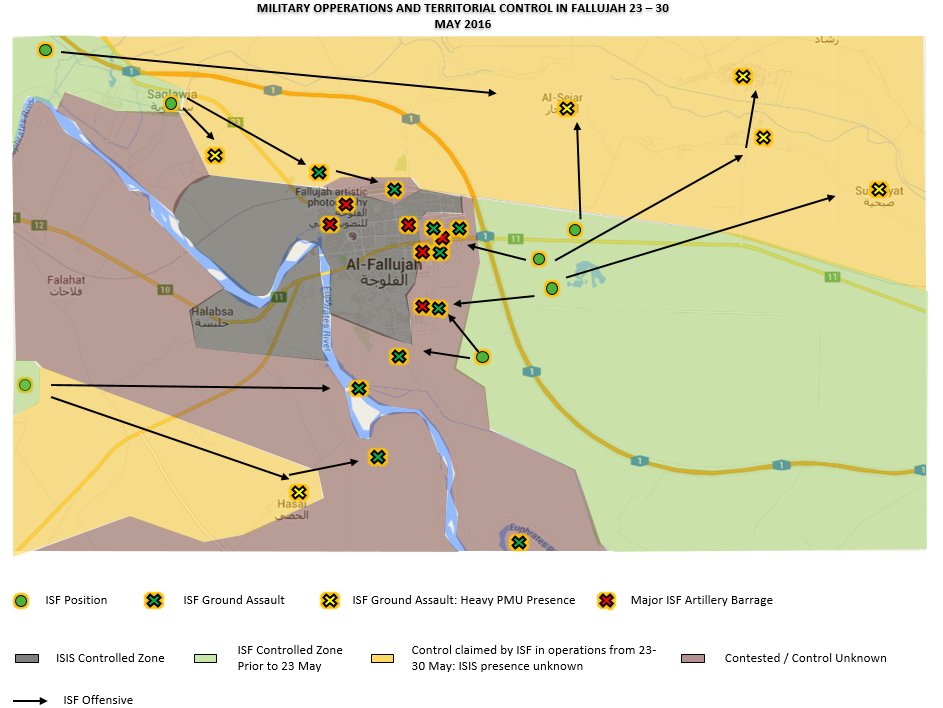
The operation to free the second largest Iraqi city under Daesh control, Fallujah, is currently underway and Baghdad's future both literally and figuratively depends on the outcome. The victory could pave the way for an offensive on Mosul, protect the capital from terrorist attacks and help bolster Prime Minister Haider al-Abadi.
Fallujah, located less than 70 kilometers (43 miles) west of Baghdad, was the first city to fall, when Daesh decided to extends its control from Syria to Iraq in January 2014. It could now become the latest success story for the Iraqi security forces and their allies, who have been on a roll for the last seven months.
Daesh has been steadily retreating both in Iraq and Syria, thanks in no small part to Russia's counterterrorism efforts. Baghdad-led forces and Peshmerga pushed Daesh out of the cities of Sinjar, Ramadi and al-Hit, while the Syrian Arab Army and Kurdish militias drove the militants out of Palmyra and al-Shaddadi.
The victory in Fallujah will reinforce this trend at a time when Daesh's revenues and ranks are shrinking, but it will not come easily.
"Defeat in Fallujah should be inevitable, and if the cordon built up over the past few weeks and months has been even partially effective it should have made [Daesh's] ability to move fighters in or out difficult but not impossible," Associate Professor Rodger Shanahan of the Lowy Institute observed.
The operation meant to liberate the city was announced at a time when Baghdad has experienced the worst wave of violence in a year. More than 150 people were killed in the capital in a series of terrorist attacks earlier this month. Daesh targeted both Shia districts of Shaab and Sadr City, as well as a Sunni neighborhood of Tarmiya.
Supporters of Iraqi cleric Moqtada al-Sadr flee the smoke grenades fired by security forces during clashes after demonstrators broke into Baghdad's fortified "Green Zone" on May 20, 2016
The assaults "likely accelerated the antigovernment protests over corruption and mismanagement that have already been at a boiling point since last summer," making steps aimed at "preventing further mass casualty attacks" in the capital a priority for the government "whose popularity is at a nadir among the Iraqi populace," Daniel R. DePetris of the Raddington Group wrote for the National Interest.
If Iraqi security forces, assisted by US warplanes and the Popular Mobilization Units, push Daesh out of Fallujah, al-Abadi will receive the boost he desperately needs to push through the cabinet reshuffle that he has long advocated and maintain his grip on power. The Iraqi prime minister has tried to appoint technocrats to his government, but the initiative was blocked by main parties.
Surprisingly, regardless of how the offensive on Fallujah goes, it could both speed up and delay the operation to free Mosul, Iraq's second largest city and the key Daesh stronghold in the country.
"If the offensive to clear and hold Fallujah takes longer than anticipated, Baghdad may need to redeploy troops designated for Mosul towards Fallujah to ensure that the city is adequately protected from [Daesh] counterattacks," DePetris explained.
Yet, even if Iraqi army succeeds and even if Fallujah receives enough protection, Daesh is likely to employ its once successful strategy of wreaking havoc in the country through indiscriminate bombing campaigns.
The terrorist group "may well see strategic utility in suffering a defeat while imposing an enormous cost in civilian lives and damaged infrastructure. This could breed ongoing ill-well among the Sunni Iraqi population, laying the groundwork for a sympathetic Sunni environment into which some of its Iraqi members could continue to operate after IS loses its territory," Shanahan explained.
This is precisely the strategy that helped Daesh take large territories in Iraq under control in the first place.
The home country of Osama bin Laden has largely remained secure at a time when al-Qaeda and Daesh have wreaked havoc in the Middle East and beyond, but recent developments indicate that radical groups will become more active in Saudi Arabia, fueling fears that authorities will not be able to contain the terrorist threat.
"Aside from a failed 2006 assault on the Abqaiq oil collection and processing facility, an amateurish attack in 2007 that killed three French citizens, and a foiled assassination attempt against Saudi Prince Mohammed bin Nayef in 2009, Saudi Arabia has been eerily quiet," Texas-based think tank Stratfor detailed.
It all changed in 2015 when terrorists affiliated with Daesh launched a bombing campaign in the kingdom's Eastern Province, mostly populated by the Shia. Since then, attacks have become more frequent and their geography is expanding, with many taking place in the capital and Sunni-populated areas.
The terrorist threat will likely become even worse as Daesh and al-Qaeda's affiliates lose ground in Syria. Seasoned fighters, many of whom hail from Saudi Arabia, could return home.
Like al-Qaeda militants, Daesh "fighters could use their honed skills to conduct more complex and strategic attacks. Both groups have a history of attacking tourist attractions in Egypt and Tunisia to undermine those nations' economies. A more sophisticated Islamic State campaign might echo previous al-Qaeda initiatives, targeting expatriates to impair the Saudi economy," the analysts warned.
Daesh presents a "growing menace" to Saudi Arabia, but there is an additional challenge – al-Qaeda's deadliest offshoot, al-Qaeda in the Arabian Peninsula (AQAP). This is the group that claimed responsibility for the January 2015 attack on the French satirical magazine, Charlie Hebdo.
AQAP and Riyadh declared an unofficial truce when the Saudis launched a campaign against the Houthis in Yemen. The terrorist group "benefited greatly from this arrangement, seizing the opportunity afforded by the chaos to snatch up large quantities of money, weapons and manpower," Stratfor explained.
The truce between Riyadh and AQAP collapsed in late April, fueling concerns that the group that is primarily active in Yemen and Saudi Arabia could launch a terrorist attack in the oil kingdom.
AQAP, according to the analysts, "could draw on its increased might to relaunch efforts to export terrorism to Saudi Arabia. Since Saudis have always constituted an important component of AQAP, the group could try to use its ties in the kingdom to facilitate new attacks."
By The Numbers: Untold Story of Muslim Opinions & Demographics proves radical Islam is a bigger problem most politically correct will admit
Submitted by IWB, on December 17th, 2015
By the Numbers is an honest and open discussion about Muslim opinions and demographics. Narrated by Raheel Raza, president of Muslims Facing Tomorrow, this short film is about the acceptance that radical Islam is a bigger problem than most politically correct governments and individuals are ready to admit. Is ISIS, the Islamic State, trying to penetrate the U.S. with the refugee influx? Are Muslims radicalized on U.S. soil? Are organizations such as CAIR, who purport to represent American Muslims accepting and liberal or radicalized with links to terror organizations?
Clarion Project Exposes CAIRs Terror Links
Published on Nov 5, 2015
Ryan Mauro of the Clarion Project goes head to head with CAIR, and exposes their terror links!
CAIR in Damage Control After Terrorist Designation, Ties to Muslim Brotherhood
Published on Nov 28, 2014
In 2007, the U.S. Justice Department designated CAIR as an unindicted co-conspirator in the trial of the Holy Land Foundation, a charity that financed the terrorist organization Hamas. The Justice Department specifically listed CAIR as an entity of the U.S. Muslim Brotherhood’s Palestine Committee; its section devoted to covertly assisting Hamas.
Homeland Security Advisor Openly Supports the Muslim Brotherhood
Published on Oct 18, 2013
The Clarion Project (formerly Clarion Fund), the Center for Security Policy and the Institute on Religion and Democracy have published a shocking interview with Mohamed Elibiary, a senior Department of Homeland Security adviser. The Daily Caller reported on it yesterday.
Elibiary is a member of the Secretary’s Homeland Security Advisory Committee and founder of Lone Star Intelligence LLC. He served on the DHS Countering Violent Extremism Working Group and the DHS Faith-based Security and Communications Advisory Committee.
On September 12, he announced that he had been reappointed to the Committee and promoted to Senior Fellow. He was also a delegate for Republican presidential nominee John McCain in 2008.
Ted Cruz: Let me go back to the earlier discussion a minute ago. It’s not a lack of competence that is preventing the Obama administration from stopping these attacks. It is political correctness. We didn’t monitor the Facebook posting of the female San Bernardino terrorist because the Obama DHS thought it would be inappropriate she made a public call to Jihad and they didn’t target it. The Tsarnaev brothers, the elder brother made a public call to Jihad and the Obama administration didn’t target it. Nidal Hasan communicated with Anwar al-Awlaki a known, radical cleric asked about waging Jihad against his fellow soldiers. The problem is because of political correctness, the Obama administration, like a lot of folks here, want to search every one’s cell phones and emails and not focus on the bad guys and political correctness is killing people. http://dailycaller.com/2015/12/15/ted-cruz-political-correctness-is-killing-people-video/
Today we are witnessing the continuation of a soft coup against not only President Trump, but of our Republic. The Democrats must be highly compromised, i.e. lots of skeletons in their closets. This was the most blatantly biased investigation of Democrats looking for a crime. Yet not that some Republicans are not compromised. Donald Trump did not erase 33,000 e-mail, did not accept 145,000,000 from a Russian Bank, did not hammer his Blackberries, did not bleach bit his computers, did not threaten Ukraine with withholding $1 Billion dollars from Ukraine unless they stopped the investigation of his drug addicted son Hunter, did not sell out the United States of America like Obama, Biden, Pelosi, Schiff, Nadler, and the compromised Democrats have. If the impeachment does not work this time they will try again, and again any means necessary to end the Presidency of Donald Trump, for they do not want their swamp drained.
Gun Safety, ala Governor Murphy
The NWO puppet that is the currently selected Governor of New Jersey constantly calls for "common sense gun control" should step back, and look at what "common sense gun control did for a group of Mormons in Mexico. In Mexico it is illegal to own a gun. Hey Murphy, what criminal obeys the law? He is in reality working for the disarmament of the American people and their subsequent enslavement.
Coup d'etat
Halloween a day when the demons come back to haunt us. It is the day of the devil. Nancy Pelosi, and Adam Schiff are perfect examples of the personification of evil. Nancy is an extremely devious person, and Adam continues to bite the apple over and over again. He tries to cover his loins just a Adam did as described in the Book of Genesis. The Star Chamber events that only the corrupt and compromised Democrats can call witnesses, and the accused has no right to confront his detractors. Only what lying little Adam Schiff see what will help his narrative gets out.
So now they will bring the charade out in the open, but with Nancy and liddle Schiff's caveats. Republican can only call witnesses if liddle Schiff approves them.
This is a Deep State operation in high gear. If the treasonous Democrats succeed in this impeachment it will be the END OF AMERICA as we know it.
Damn the Democrats, and I am a registered Democrat. I will vote in 2020 for President Trump!
Bought and Paid For
Jerry Nadler claims that there is NO evidence that Google censors conservatives. Either he is a liar, a fool or both. Well he pocketed $26, 000 from Google. It does not take much to buy this clown. My own blog went from 3000 hits-per day to between 50 to 100. It happened from one day to the next. It is called shadow banning. When I googled a story that was a rare story my blog DID NOT appear.
What else does the Deep State have on Nadler? Could it be pedophilia?
Death of Bush a Distraction
Hey did they pull the plug on daddy Bush to delay the Trump's release of classified information? This was to be the week of revelation about Hillary, Bill and the Deep State. Monday the Whistle blower on the Uranium One deal was to speak, but instead we have receive lies about a very evil man. The FBI raided the home of the whistle blower instead. Folks if you cannot see the current war that is going on inside our borders they you are either blind of dumber than a box of rocks. WTFU!!!
With the consummate liar, Netanyahu, claiming that there is a secret nuclear program in Iran is beyond hypocrisy. This criminal lives in a glass house, and should not throw stones. If Israel has the right to nuclear weapons so does Iran. What I would be looking for is Israel pulling a false flag on the US Navy.
Stein Hillary's Shill 120216
On Wednesday I listened to "Democracy Now", and later the Tucker Carlson Show. Each host was interviewing Jill Sellout Stein, but neither asked the key question. The key question for me would have been the following: "Jill, a hand recount of the votes in Wisconsin, Michigan, and Pennsylvania would probably not be completed by the December 19th deadline for the electoral votes. That would deny Trump the necessary votes to be elected President. That seems to be the Hillary strategy to steal the election, so why would the Green Party candidate shill for Hillary's election. Has Hillary, Bill, the Clinton Campaign, the DNC or others that are connected to the Clinton's approached you, and what were you offered?"
That would have been my question, but then again that is why I only operate in the "Fake News" section of journalism.
Egg Timer 06/14/16
The shooting at the Pulse night club in Orlando, which is just another false flag to promote a not so hidden agenda if failing to convince America that the gun did it. At the gym last night no body believed the government's story.
Just think of the 2.5 to 3 million UNCOUNTED votes in California. Had to get that off the front page. Just think that yesterday Trump was going to give a speech on the crimes of the Clintons. Well that had to be postponed. Cui bono? Hillary of course, and the Indonesian male prostitute that resides in the White House, and vacations around the world. He is determined to disarm law abiding Americans before he leaves the White House.
Iowa Caucus
How about Hillary's luck with her winning 6 coin tosses? Maybe she should play the horses, blackjack, etc. as they all can be fixed too. In six coin tosses you would have a 1 in 64 chance of winning all six. What that tells me is that the Iowa democrats have more allegiance to The Wicked Witch of the West than they do to their own country.
How about Sen. Cruz? He was not natural born, and there is doubt that his mother was born in the US. He is ineligible to run for President, but hey Obama did it why not him?
As for Rubio he was born in the US, but not of US citizens, so he too is not eligible to run for President. He has quite a few skeletons in his closet, and that is why they like him.
So much for representative government. It is a joke, but it is not funny.
Pearl Harbor
Today one should remember a day of "infamay". Yes today December 7th, 1941 the Japanese attacked Pearl Harbor, as Roosevelt hoped that they would. He made sure that the aircraft carriers were out to sea, and the dinosaur battleships were in port.
He needed an attack, where the US would lose military personnel, so that he could take the side of Churchill against Hitler. You see there were many like the Bush family that backed Hitler. So this necessitated the sacrifice of Americans to further Roosevelt's agenda.
And the beat goes on. We are still expendable to further hidden agendas.
December 7th, 2015
Halloween brings people in strange costumes, and strange people without costumes. So to does it sometimes bring strange events, in costumes. A Russian jet crashes in the Sinai. Well who was, and still is looking for their candy? Who would be willing and able to inflict such damage to the Russians? Looks to me that it would be Israel, the US, with the most means to do it. With ISIS a distant third.
Who does the security at the airport that the plane took off from?
Listening to the House Hearings on Benghazi was maddening.
The question not asked of the Wicked Witch of the West was "Why were we in Libya, and under what Congressional authorization justified it?"
What Hillary said at one point was that "We had to stop Quadafi from oppressing his people." Well he could ride standing up in an open top car without armed protection, and hear the "oppressed" cheer him. Quadafi had turned his country around, and he ran it for the benefit of the people.
The "oppressed" that the Witch referred to were the hired mercenaries out of Benghazi that Quadafi was fighting, and fighting successfully.
The Democrats were not interested in a thorough investigation of what happened, and why, but only in "Lets cover Hillary's ass mode." They accused the Republicans of turning it into a political circus. Well Hillary and Barry (aka Barack) immediately turned in into a political fairy tale while the dead Americans bodies were still warm. Obama thinking of 2012 election and Hillary thinking about 2016.
What Stevens was in on was the knowledge that Hillary and Obama were shipping weapons such as Stinger Missiles to the enemy. The enemy was fighting a US, Israeli, Saudi proxy war to overthrow Assad. My fellow Americans that is TREASON.
Was Hillary using here State Department Office to enhance the Clinton Foundation with money from people and countries that made generous "contributions" to it? In essence these were bribes to pay for her 2016 Presidential run
Hello all,
The technical support that I signed up for in 5 minutes has resolved the problem. So we will be back up and flying soon.
Obama will hate that fact.
October 3, 2015
The problem is back.
October 2, 2015
Finally, the problem has been fixed. Will be posting again soon, but first I have to take care of personal business.
October 2, 2015
Campus was a gun free zone, and vet with concealed carry was prevented to stop the carnage.
Also the World's most notorious killer, Barack Obama, referred to himself 28 times in his feigned attempt to turn the still warm victims as sacrificial lambs in his desire to disarm all Americans. This is a sick man that the rest of the World suffers from him NPD. Did you notice his pursed lips during his reading of his "sympathy" speech? That is a true sign of NPD. He knows NO empathy whatsoever.
Every Tuesday this asshole sits down with a kill list, and picks out who to execute with drones. Many men, women and children dies as collateral damage with the actions of this beast.
October 1, 2015
Still cannot post.
Will keep trying to right the situation.
September 30, 2015
Could not get into the blog today, and now that that has been addressed, we now cannot post.
Bear with us as we try and right the situation.
I guess that we must have annoyed someone.
Stock Trading 07/08/15
Stock trading has been suspended!!!
Christie Waddles for the Presidency
Just this past week the big fat bully governor of New Jersey announced that he was running for the Republican nomination for the Presidency. We here in New Jersey knew that he was waddling for the job ever since he was elected governor.
He has been a disaster for New Jersey, and he would be worse for the US.
JUST A COINCIDENCE
This past Friday I received a survey from "Everytown for Gun Safety", and of course it was about gun control. Or should I say the disarming of the citizens of America before their total enslavement and death.
It was also just a coincidence that the DHS ran an "active shooter" drill at the time of the Charleston shooting.
DISTRACTION
April 30, 2015
They have been trying to divide and conquer for quite some time, and Baltimore is just another attempt. Do not fall for it. Yes the murder of Freddie Gray was terrible, but it does not justify violence. Beware of agent provocateurs.
Yes there were peaceful protests, but looking at MSM you would not know it. What are they hiding while the Baltimore Riots takes front page, while a Treaty disguised as an agreement is being thrust upon our Nation. Discussed in secret, and with transnational corporate input. No Congressional input. They cannot even discuss what they have been told with their constituents.
Fast Track began with the Nixon administration for tariff rate, and only tariff rates. Treaties required 2/3 of the Senate to pass. Along comes The Great Communicator, the straight man for a chimp, and he declares treaties nothing more than agreements. So Ronnie only needed a simple majority of both houses.
Then came coke snorting, womanizing, money laundering Bill Clinton to get Fast Track on NAFTA, GATT, etc.
The TPP will grant sovereignty to corporations, and subject the citizens to their greedy whims and fancies. The poverty in this country and in others will explode, and violence will begin. That is why you are being subjected to another drill for Martial Law in Baltimore.
Just wait for Jade Helm, and again a psyops to get the masses used to Martial Law.
My friends any one who pushes the TPP is a TRAITOR.
FORCLOSURES
April 17, 2015
In the local paper every Friday has what appears in the classified section is a listing of Sherrif's Sales. Every Friday the list was 3, 4 or 5 pages. Today while we are in "recovery" the pages number 7, and the Republican Congress is pushing the TPP, which will destroy not only the soveringty of the US and any other signatories, but it will further bring down the middle class (what is left of it). Do not worry though, the vultures will peck at the bones of the national, state, county, and local government's assets, and they will get them for pennies on the dollar. The bastards of banking will devour the houses, and turn them into rentals.
WTFU America.
January 20, 2015
Just listenedd to Obama's Chief of Staff say that Obama with his State of the Union will continue his struggle for the middle class. "Continue his struggle for the middle class...", is that sarcasm. Obama, if that is his real name, has been attacking the middle class, and in so doing is destroying the United States of America.
His speech will be nothing more than rhetoric. He is going to demand increased taxes on the rich. Well how will that happen with a GOP House and Senate? It cannot happen and he knows it. It is all for show, and he continues his life in lies.
January 12, 2015
There is outrage on the outcome of the Dallas Cowboys versus the Green Bay Packers. Why is their outrage on this total distraction? Fans here belong to one of two tribes that support the circus of the "bread and circus".
It has become a game of less and less interest as commercials, reviews, more reviews, pregame shows of several well paid ex-jocks to tell us what must be done by each team to win. Then after the game the same go over and over the game and why one team won and one lost. The media has more covering a meaningless event than the do covering all of Africa.
It is done to take you mind off the reality of the day. It is the blue pill to keep you from seeing that you are accepting a police state as you are groped and searched when you enter the stadium.
Then there is more money to be made in the betting on the game than in the TV and commercials. So would it be any surprise to you that the games might be fixed? It isn't to me. Have you ever seen the pro football game where one team plays and the other merely shows up? Maybe the team that only showed up knew who the winner would be.
There is also a globalist plan to destroy national sports such as US football, and replace it with soccer. Could this be a step in that direction?
I remember the day well. A Customer Service Representative was promoted to Outside Sales, and he left just before lunch. His new job was to begin on the following Monday. He came back in at about an hour or two later. His face was white as a ghosts. He took a deep breath and said "President Kennedy has been killed."
It was a quiet at the bus stop in Newark that night, and the bus was dead silent. Just like today people are silent on the coup d'etat that happened that day in Dallas. It angers me that people can forget that at that day and time on the 11th month and the 22nd day our country was changed forever, and not for the better.
Many still believe that it is us versus them, and Democrat versus Republican when there is not a dime's worth of difference. The US and the world are run by a SSG (Secret Shadow Government).
Here is the audio of President Kennedy speaking about the danger to American in Secret Societies.
When will they ever learn, when will they ever learn? It takes more than flying a flag and closing your eyes to the senseless slaughterr of men, women, and children to be patriotic. The "Great Satan" has struck again, and killed children in Ahrar Ash-Sham, Syria. It is to stop our own creation ISIS, or so they say. It is really to wage war against the Syrian government, and his majesty want Congress to expand his war making powers. So get off of your patriotic ass and call your Congressman and Senator and say, "I am mad as hell and I am not going to take it anymore. End the wars, stop the bombing."
November 5, 2014
Today is the day after, and many of us know what a day after can be like. We promise never to do it again when we recover, but we forget about it and do it again. Well we did it again. We traded one bunch of traitors for another. It is like getting drunk on a different beverage. What will change? Nothing much will change. It will be the continued destruction of the United States, and the impoverishment of millions more. When will we ever learn, when will we ever learn?
May 28, 2008. MEDICARE PREMIUMS HAVE DOUBLED SINCE 2000? I did not know that. Can you help get the ad on the air? May 26, 2008: Vet Burials Nonstop At National Cemeteries Average Of 1,800 Veterans Die Each Day
RITTMAN, Ohio -- The cracking of rifle fire silenced the twittering blue jays, blackbirds and killdeer. (read entire article)
May 8, 2008: Hey, at least the OIL surge is working! This is happening on such a regular basis, it's not even shocking anymore, but that (to me) is the outrage! May 5, 2008: Another Taser incident. Just the facts: Number of Google hits for "Taser 20007" = 3,650,000. Number of hits for "Taser 2008" = 4,260,000. And it's only the beginning of May. May 1, 2008: CBS-2 HDTV reports that House members are leasing expensive cars on taxpayers' money. LINK April 30, 2008: Don't let anyone tell you that the U.S. "liberated' the women of Afghanistan. Shine the light on stories like this. April 29, 2008:I know, technically this qualifies as an "Outrage of the Last 7 Years," but it could also be an ACTION ITEM (read to the end of the column). Thank you, Ted Rall. April 28, 2008: Preventing Voter Fraud by Burdening the Poor and Elderly? Only in Bush World April 27, 2008: Doctors to kill transplant patient for using medical pot