Imagine
standing at a TSA security checkpoint on your way home for the
holidays. You’re getting ready to go through the awkward travel
procedures instituted almost immediately after 9/11 when the
Transportation and Security Administration (TSA) was created and
air travel in the United States morphed into a search and seizure
operation with the implied possibility of your detention and
interrogation.
The initial outrage such expressions of implicit state violence
caused early on eventually gave way to begrudging acceptance. But now, a
new layer of “security,” that could restrict freedom of movement even
further, is being rolled out at several ports of entry in partnership
with health technology industry leaders, academic institutions, and
government health entities in more than three dozen countries.
A new digital certificate called CommonPass, designed to serve as a
clearance mechanism for passengers based on a health diagnosis underwent
its first transatlantic
test on October 21 under the watchful eye of the Centers for Disease
Control (CDC) and U.S. Customs and Border Protection (CBP) at Heathrow
Airport in London. There, a group of select participants embarked on United
flight 15 to Newark, New Jersey after being screened and tested for
COVID-19 at the point of departure in a largely ceremonial exercise that
included initiative co-founders, Paul Meyer and Bradley Perkins.
The app’s first trial run took place with much less media fanfare
last month on a Cathay Pacific Airways flight from Hong Kong to
Singapore and marked the beginning of the CommonPass pilot project
launched by The Commons Project non-profit organization in-tandem with the World Economic Forum.
Travel industry insiders claim that CommonPass will allow
international travel to resume before a COVID-19 vaccine is made widely
available by applying standard methods for certification of lab results
and vaccination records of travelers through the CommonPass Framework, based on criteria set by the governments of each port of entry.
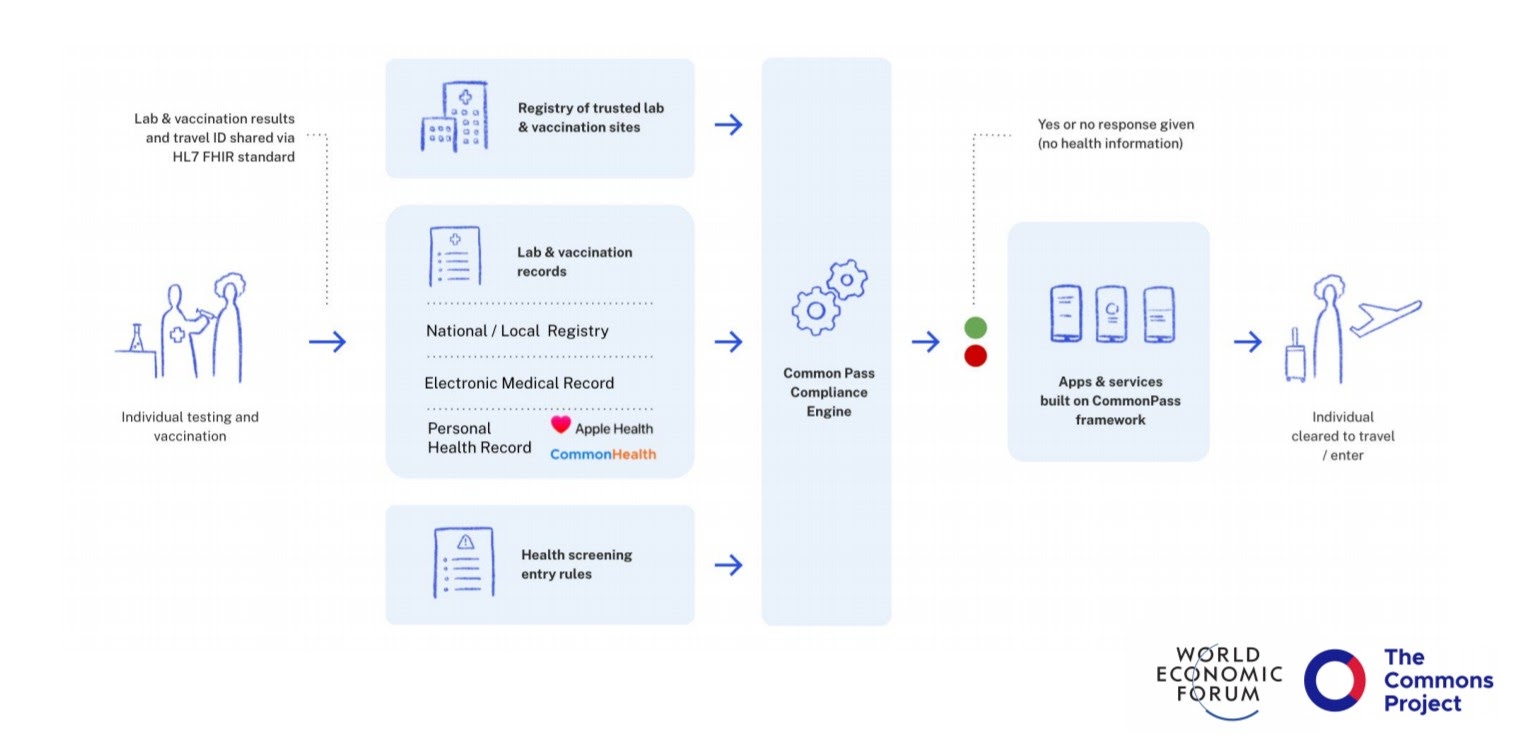
A graphic from a Commons Project presser lays out the basics of the CommonPass
J.D. O’Hara, CEO of one of the world’s largest travel services
companies and one of the participants at Wednesday’s CommonPass trial
run, hailed the app’s ability to “verify health
information in a secure, verified manner,” while Roger Dow of the U.S. Travel Association released a statement praising it for paving a “way forward” for the global economy in the wake of the pandemic.
As the multi-sector, global response to the coronavirus tightens the
noose around civil liberties, CommonPass stands out as one of the most
appalling and dangerous attacks on basic human rights in the name of
public health and is rife with a potential for abuse so great, that it
behooves us to find out more about the people and interests behind it.
Feudal revivalists
In medieval times, the ‘commons’ denoted the de facto and collective
ownership of land, which peasants used to plow, sow and harvest or raise
sheep and cattle. The rise of the land-owning classes in post-Magna
Carta Europe, and England in particular, slowly eviscerated this form of
communal privilege through the enclosure system, which redistributed
the commons to the proto-capitalist class in partnership with the
monarchies and create the system of oppressive labor exploitation known
as feudalism.
Starting in 1604, the Enclosure Acts of England created legal
property rights for land that had belonged to the farmers and shepherds,
forming the basis of modern-day capitalism. Today, that scene is being
repeated as the Internet, an information ‘commons’ is being carved out
by Big Tech and led by organizations like The Commons Project, which
avails itself of a name that connotes the total opposite of its purpose.
Co-founders Paul Meyer and Bradley Perkins are the non-profit’s CEO and Chief Medical Officer, respectively. Perkins began his career over
thirty years ago at the Center for Disease Control and, for nearly a
decade, worked at the RAND corporation’s health care policy division, RAND Health Advisory Board.
Meyer, for his part, is a Yale law school graduate, who was writing
President Clinton’s speeches years before receiving his graduation
diploma from the storied institution. Both have extensive career
histories in the fields of health and technology, though in very
different areas and with strange bedfellows along the way.
In 2009, Perkins became
the Chief Technology Officer for a publicly-traded cross-national
operator of hospitals and clinics called Vanguard Health Systems.
Vanguard had been established with
funding from Morgan Stanley and controlled by the Blackstone Group
since 2004, maintaining control all though the company’s IPO in 2011. Two years later, Vanguard was acquired by Tenet Healthcare, creating the third-largest
investor-owned hospital company in the United States with a total of 65
hospitals nationwide and over 500 healthcare facilities.
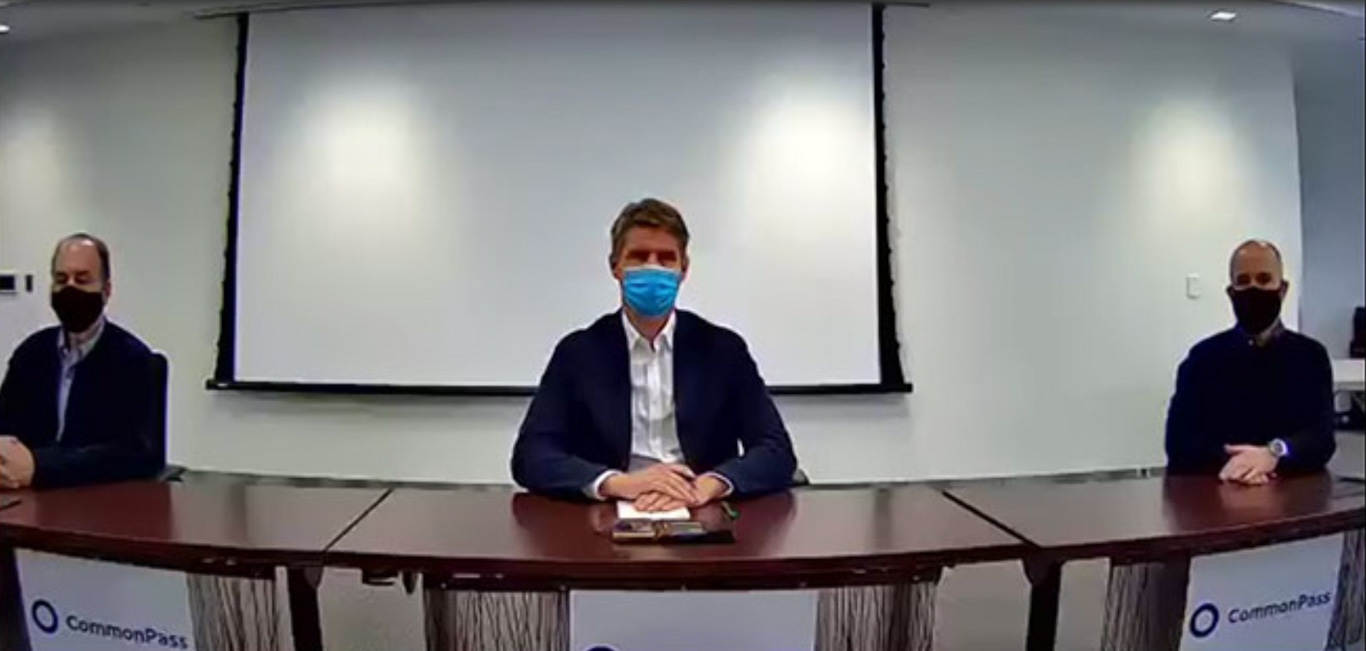
Paul Meyer, center, is pictured in a screenshot of a media briefing touting CommonPass
Besides being one of the biggest healthcare companies in the United
States, Tenet is also one of the most notoriously corrupt. The same year
it bought Vanguard, it was slapped with a major whistleblower complaint that disclosed the company’s fraudulent practices. That lawsuit resulted
in a $514 million settlement. A more recent case involving a conspiracy
between Oklahoma orthopedic surgeons at one of its facilities was settled for
$66 million in 2019. But, Tenet’s problems go back even further to the
early 2000s when fraud and performing unneeded surgeries led to a
multitude of lawsuits and even a Senate investigation.
The Vanguard deal marked the end of Perkins’ tenure there, who chose to take a
$1.9 million package instead of joining the newly merged conglomerate
like its CEO and much of its staff did. He would move on to create a company
of his own called Sapiens Data Science; a health tech platform that
provides access to “credible scientifically validated data algorithms”
and looks to create a “new revolutionary health ecosystem.”
Meyer’s background is more complicated, and his arrival on the
healthcare scene runs through different channels linked to American
intelligence cover operations dating back to NATO’s war in Kosovo and
the former Yugoslavia during the early Clinton years. It is his
involvement with an infamous human-trafficking outfit known as the
International Rescue Committee or IRC, that should be cause for concern
given his role in The Commons Project and flagship CommonPass app.
The Meyer of Kosovo
Before he was named Young
Global Leader by the World Economic Forum or Henry Crown Fellow at the
Aspen Institute, and even before becoming a Term Member of the Council
on Foreign Relations and receiving MIT’s 2003 Humanitarian of the Year
award, Paul Meyer found himself in war-torn Kosovo installing a new
Internet infrastructure system to replace the one destroyed in the war, only days after NATO bombs had stopped shelling the Serbian people.
Barely out of law school and having spent two years writing President
Clinton’s speeches as the conflict in the former Yugoslavia was
transpiring, Meyer was tapped by the IRC to lead a UN and private relief effort called
the Internet Projekti Kosova (IPKO) or Kosovo Internet Project, with
tech-savvy local Akan Ismaili to handle the complex technical issues and
Teresa Crawford from the Advocacy Project to “uplink” satellites in the
region with the stated purpose of reuniting displaced Albanian
families. The system was set up atop
a building used by the British KFOR Civil-Military Cooperation CIMIC
and British Royal Engineers were also brought onto the project, among
others.
Eventually, the IRC gave the project to a non-profit organization
“dedicated to providing wide access to the Internet in Kosovo.” IPKO is
today the largest telecom, internet, and cable TV company in Kosovo.
Meyer remains involved through the IPKO Foundation, which he co-founded
to provide “free technology education” to Kosovar students.
By the 1950s, the IRC was known to be an “integral link”
in the CIA’s covert network led by Tony Blair protégé and former
British Foreign Minister, David Miliband since 2013. In 2018, the IRC
was embroiled in a child-sex trafficking scandal dubbed the
“sex-for-food scandal” covered extensively by Whitney Webb in a recent article.
The organization’s cover-up of dozens of sex abuse, bribery and fraud
allegations resulted in the U.K. government withdrawing its funding from
the organizations. However, no IRC employees were prosecuted over the
37 incidents detailed in the report.
Currently, the IRC is very involved in the implementation of a
biometric ID system for refugees of the ongoing conflict in Myanmar, a
project funded by
the Rockefeller Foundation-backed ID2020 Alliance, which also funds The
Commons Project. IRC’s Mae La initiative, however, receives most of its
funding through the notorious CIA-cutout USAID and intends to create a
“blockchain-based digital identification” system using iris recognition
technology to give refugees access to IRC’s services in Thailand. Long
term goals include rolling health, work and financial data together into
a single ID system, that will determine access to food, healthcare and
mobility.
We want your DNA
The difference between IRC’s Mae La project and The Commons Project
is a question of class. Class status, to be specific. But, it is
essentially the same idea and covers the same interests of the groups
and individuals who form part of the Commons Project’s board of
trustees; many of whom have been part of the digital tracking and
healthcare technology space for years.
People like Linda Dillman,
who ran Wal-Mart’s implementation of RFID employee tracking technology
as the retail giant’s CIO or the former Chief Technology Officer for the
U.S. Department of Health and Human Services, Bryan Sivak,
who is now a Managing Director at Managing Director at Kaiser
Permanente, one of the largest healthcare insurance plan providers in
the nation. Other trustee affiliations stand out, as well, such as Will
Fitzpatrick, General Counsel to the Omidyar Network and George W. Bush’s
Assistant Secretary of Defense, Health Affairs, Dr. William
Winkenwerder, Jr.
At the core of these efforts is the desire to create a DNA-based
population screening agenda, which people like Perkins and Meyer are
forcefully pushing forward. Perkins worked as the CMO at a company
called Human Longevity, Inc., which “combines state-of-the-art DNA
sequencing and expert analysis with machine learning, to help change
medicine to a more data-driven science.”
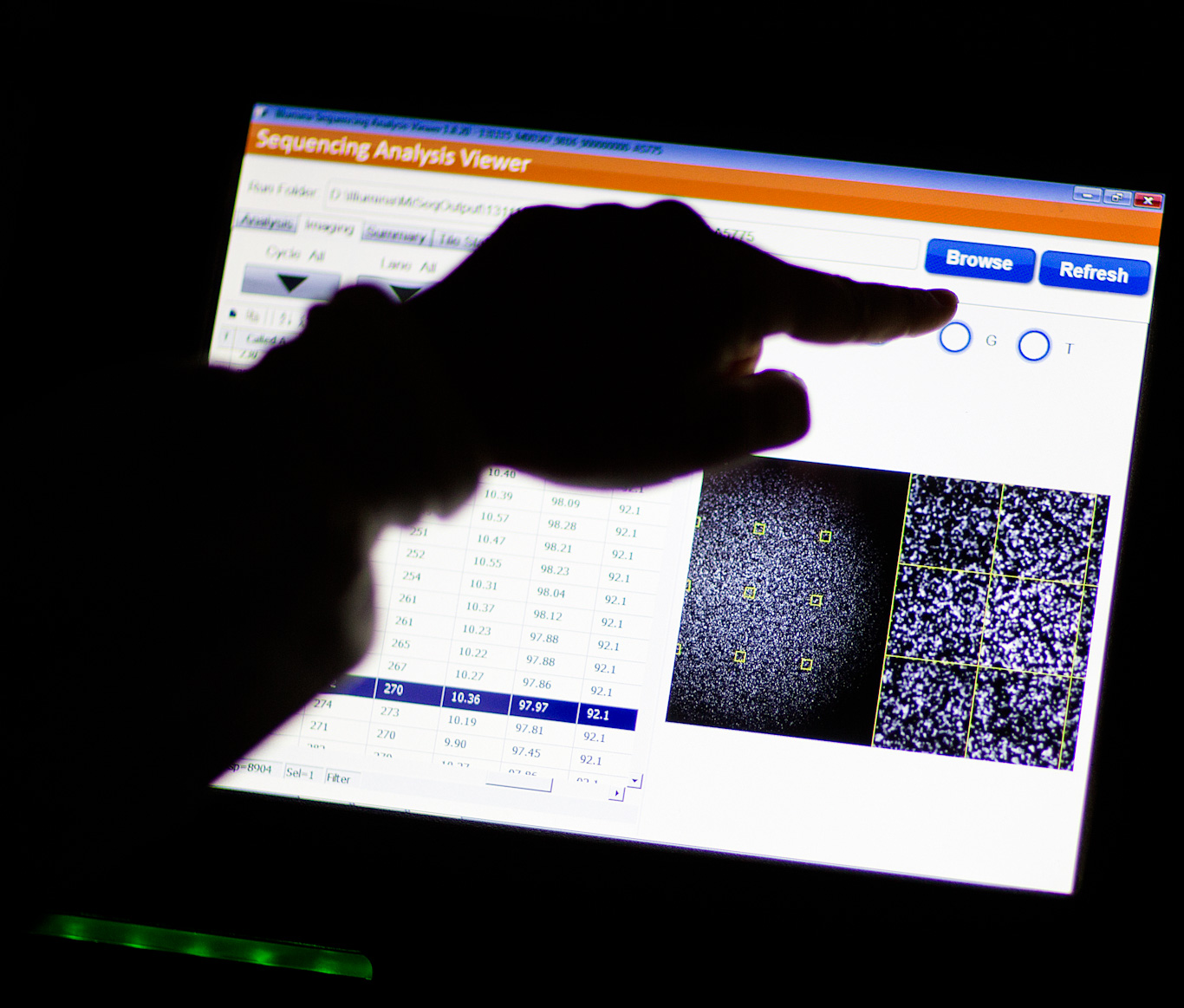
A microbiologist demonstrates a whole-genome DNA sequencing machine called a MiSeq at CDC HQ in Atlanta. David Goldman | AP
Meyer developed a precursor to CommonPass in 2016, when he merged his mobile health services company, Voxiva, which implemented the
“first nationwide digital disease surveillance systems in Peru and
Rwanda” in partnership with the CDC, the National Institutes of Health
(NIH), with Sense Health to form a health messaging service called Wellpass Meyer
described as “an integrated platform… [that] helps overcome the
challenges of deploying fragmented engagement and population health
solutions.”
Dubious technology
The reliability of the DNA-based, algorithmically-deduced health
diagnoses used for the CommonPass trial run must also be called into
question given the history of the company furnishing the technology.
Prenetics, Ltd is the Hong Kong-based, Alibaba-funded company that also performed the COVID-19 testing for the UK’s Premier League’s Project Restart, which used a similar health status app called Covi-Pass, covered by this author in June.
Prenetics’ COVID tests rely on DNA-based technology it acquired in
2018, when it purchased DNAFit; a company founded by South African
businessman Avrom “Avi” Lasarow, who came on board after the merger as
Prenetics’ Chief Executive Officer for Europe, Middle East and Africa.
Lasarow, who also heads the Premier League’s coronavirus testing
program, just settled a civil case against him in the U.S. last May for nearly $60,000 surrounding allegations of “deceptive health claims”.
“Lifestyle genetics pioneer” Lasarow has a long track record of settling out of court over such issues, including a lawsuit brought
by the U.S. Federal Trade Commission in 2015, which accused Lasarow
Healthcare Technologies Ltd., aka L Health Ltd., and two other
defendants of making false or unsubstantiated claims regarding a
“melanoma detection” app. As part of that settlement,
Lasarow was “prohibited from making any misleading or unsubstantiated
claims about the health benefits or efficacy of any product or service.”
Prenetics has been reportedly working on establishing a partnership with VSTE Enterprises,
the same company that developed the V-Code technology that underpins
Covi-Pass, since May. Nevertheless, such red flags pale in comparison to
the individuals and organizations that are behind CommonPass, itself,
who have plans for a much vaster digital enclosure based on DNA
population screening technologies through initiatives like the The
Commons Project, which aims to fundamentally transform medicine and
impose new limits on our freedom of movement as the CommonPass rollout
is slated to quickly expand to other routes across Asia, Africa, the
Americas, Europe and the Middle East.
A common thread
Just as Bush’s Aviation and Transportation Security Act opened the
doors for certain technology and security sectors to flourish in the
wake of 9/11, this novel health-focused expansion of the national
security state has bypassed all levers of democratic power to allow for
the entrenchment of a far larger and more dangerous group of entities,
within the health, technology and life sciences industries together with
an increasingly more powerful clique of federal health agencies and
officials, like Robert Kadlec, who are pushing for a full spectrum
surveillance society.
Taking your shoes off at the airport and exposing your body to
radiation has become routine now at every airport in the nation and most
‘temporary’ laws passed through emergency legislation remain
on the books nearly two decades later. Precedent demands that we assume
the same will occur with the majority of the new restrictions on our
freedom of movement and quality of life currently being implemented
throughout the country and the world.
Rolling back these draconian measures is not in any of their plans,
as promised by the president of the U.S. Travel Association, Roger Dow,
who confidently asserted after Wednesday’s successful CommonPass trail
run, that the app will let us “navigate out of the crippling economic
fallout of COVID-related travel restrictions and quarantine
requirements,” adding that it will “pay further dividends for more
seamless and convenient travel even once the pandemic has subsided.”
Feature photo | The CommonPass generated QR code is shown. Original image sourced from the Common Project
Raul Diego is a MintPress News Staff Writer, independent photojournalist, researcher, writer and documentary filmmaker.