European ‘Green Deal’ Is As Bad As It Gets
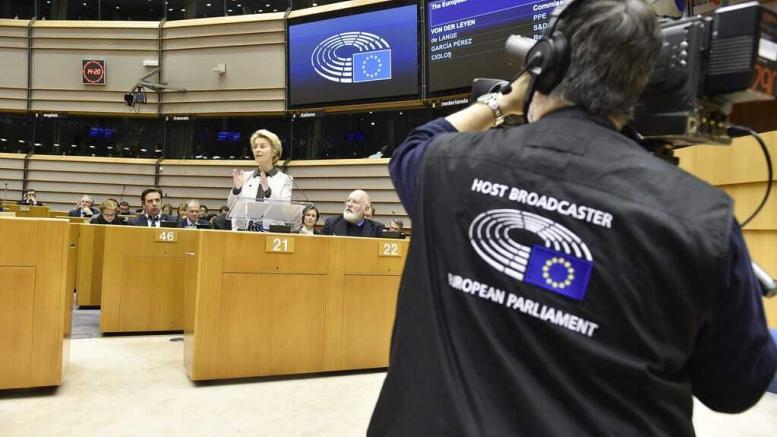 Extraordinary
Plenary session - The European Green Deal- Resumption of session and
order of business- Commission statement - The European Green Deal.
Photographer: Jean-Christophe VERHAEGEN; © European Union 2019 - Source :
EP
Extraordinary
Plenary session - The European Green Deal- Resumption of session and
order of business- Commission statement - The European Green Deal.
Photographer: Jean-Christophe VERHAEGEN; © European Union 2019 - Source :
EP
Europe
is creating and ingesting its own poison pill that will divert massive
investments down an economic rabbit hole. The social fallout will never
be attached to the root cause of their demise: mal-investment tied to
baseless and anti-human policies. ⁃ TN Editor
Back in May, I had the pleasure to be a guest at an Austrian Economic Center event in Vienna, in which we discussed the policy outlook prior to the European elections. My prediction back then: more greens, more ecstatic green policies to come. The newly elected Commission President Ursula von der Leyen has attempted to appease green forces in the European Parliament by dedicating herself to the environmentalist agenda, and as a result, is now pursuing ambitious policy goals that she laid out in her candidature speech in Strasbourg.
The New Green Deal contains major implications for industry and consumers, including higher energy taxation, higher levies on shipping and aviation, higher road emissions duties, forcing companies to rethink recycling and repairing electronics, and pursuing free trade deals more difficult to conclude. These measures all deserve op-eds o their own, but for the sake of this one, let’s narrow it down.
Three takeaways are important from the proposed package of executive and legislative measures:
- The Commission wants to introduce a carbon-border tax
- The Commission updates the emissions targets for 2030
- The Commission spends more money in an effort to “reinvest” (or to buy off member states)
The Carbon Border Tax
The main objective of this “border adjustment” is to prevent the relocation of carbon-intensive production to non-EU countries, a problem known as “carbon leakage.” When companies outsource production to avoid carbon costs, they shift their emissions abroad. That, claims the EU, reduces the effectiveness of EU climate policy objectives. This is of exceptional concern to Brussels, as non-EU countries, such as those in the Balkans, as well as Moldova, Belarus, and Ukraine, could come to rival EU producers as a result. The logic is very European: first we curb our own business efficiency through regulation, then we call other countries unfair competitors.This is hardly the first time that European leaders have restricted trade due to environmental concerns. It was the most notable reason why the Obama-era free trade agreement, the Transatlantic Trade and Investment Partnership (TTIP), was laid on ice, or why the bloc still does not have a free trade relationship with China. French President Emmanuel Macron is even threatening to block a trade arrangement with South American countries (called Mercosur) in case Brazil leaves the 2015 Paris Climate Accord.
Worse than politicizing its trade deals, von der Leyen will now extend its climate policy to non-EU members, effectively bullying the entire continent into zealous emissions targets. Especially for Eastern European countries such as Ukraine, this is a true nightmare.
As expected, Europe’s journalists are sticking with the Commission’s rhetoric by calling it a carbon border tax. I for myself call it politicized European protectionism.
Target Update
Brussels is reportedly looking at a climate law setting a target to achieve net-zero emissions by 2050, and a plan to boost the bloc’s 2030 target for emissions cuts from at least 40 percent reduction to between 50 percent and 55 percent compared to 1990 levels. The Commission plans to present it by March 2020. The target update is only an argument for legitimizing harsher legislative measures. Once passed, you’ll hear in the European Parliament that new and costly emissions restrictions are “in line with EU climate targets.”The good news for the Commission is that its climate law will not require unanimity voting in the European Council, but only qualified majority. That said, Poland, Hungary, and the Czech Republic are currently withholding their consent.
Increasing ambition to a 55 percent cut will likely find a majority in the Parliament, and in the Council eight countries have said they support that target. The question is whether opponents can rally a workable opposition.
That leads us to the crux of the issue.
The Climate Cash Grab
Commission president Von der Leyen has already proposed a financial package called the Just Transition Fund, which will support regions in their transition away from fossil fuels. However, the current climate targets already necessitate 260 billion euros of additional annual investment, meaning that the updated targets will need even more funding. At the moment, the Just Transition Fund is rumored to be included in the EU budget for 2021-2027 and raise investments of 100 billion euros. It remains a mystery who exactly will privately invest (at their own risk) into inefficient windmills and solar panels.One thing is certain: a cash grab of this size can certainly attract the interests of Central European nations that are currently hesitant to join in. That said, Germany and the Netherlands are favoring limited budgetary ambitions.
It is the ultimate mix of climate ideology and spending extravaganza. Since Brussels has a tendency to get the answer wrong every time, I am confident that we’ll get the worst of both.
Read full story here…
Source: technocracy.news
Blogger's note:
subterrnews.blogspot.com does not send cookies, or collect any information on
those using the blog. However, the blogspot is on google, and google may
collect information, and send cookies. Many of the links that we
connect to do not send out cookies or collect information, but some do.
You are keying in to this blog, and you have agreed to this.
The views expressed in the articles
do not necessarily represent the opinions of this blog. They are the views, and opinions of the
author(s) of the article.
0 comments:
Post a Comment