

On 13 July
an international newscast reported that the European Commission will
discuss as a priority on how the EU should react to China’s national
security law for Hong Kong, a sovereign decision taken by Beijing to
protect the citizens of the Chinese territory, Hong Kong, from western
instigated riots and acts of terror. This is apparently an issue close
to the heart of the German Foreign Minister, Heiko Maas, as he raised the issue as a priority for the EC to be discussed.
Can you
imagine! The audacity of the EC to even suggest debating on what should
be the reaction of Europe on an entirely internal affair of Sovereign
China?
What would
Europe, Germany, France, or any other EU member state say if China would
comment on their EU-collective or individual sovereign internal
affairs? – It’s not difficult to see the hypocrisy of the west,
vis-à-vis the east, especially China and Russia.
Or, in the words of RT:The economic sanctions imposed on China in the Huawei affair will be returned several-fold by Beijing. If the Queen Elizabeth goes too far, the Chinese Navy has more than what it takes to sink her.
And if the three million Chinese arrive from Hong Kong, it is not immediately clear where they will be housed or where they will work in Britain’s broken economy. In fact, perhaps the most cunning plan would be for China to open the Hong Kong floodgates now and force London to own up to its words.
Why is the
west so much interested in Hong Kong? – Could it be that Hong Kong has
been serving mostly western oligarchs and corporate and financial giants
for illegal fiscal transactions, like money laundering and tax evasion?
Why not shifting dubious financial transactions simply to Singapore? –
Hong Kong is much closer still to the British Crown (until 1997), than
Singapore which was dissolved as Crown colony in 1963, when it became a
state of Malaysia, ending 144 years of British rule. In August 1965,
Singapore became officially the independent Republic of Singapore. Since
then Singapore has built up a strictly controlled financial and fiscal
regime.
This – just as
an introduction to the Big Picture that China may want to keep in mind
for their future economic policy and planning vision. The west cannot be
counted on. The west, under the leadership of the dying Anglo-American
empire is in its last breath hell-bent to stop, to destroy China’s
economic advances – if it could. But it can’t.
Mind you,
China’s are fully legitimate economic advances that do no harm anybody,
to the contrary, China keeps seeking peaceful cooperation with the west.
A prime example is President Xi’s Belt and Road Initiative (BRI), the
New Silk Road – designed as bridge that spans the world with projects
and initiatives intended to bring humanity closer together, developing
jointly her economic potential, attempting to respect and better
understand cultural differences and learn from the variety of their
richness. A “win-win” for all.
In the words of famous Russian economist, Mikhail Khazin, While
the world economy is collapsing as it never did in the history we can
remember – maybe by as much as 50%, the Chinese economy is growing.
When
SARS-2-Cov, later renamed by WHO to COVID-19 – was first discovered in
Wuhan, China, Wuhan and Chinese authorities reacted immediately with a
total lockdown, extending from Wuhan (11 million population) to the
entire Hubei Province (60 million) – and subsequently beyond, covering
the whole country. China’s reaction was decisive, immediate and with
full discipline of the population.
The origin of
the “new” corona virus, is still debated, but all substantiated evidence
leads to conclude that the virus originated outside of China and was
transported to China in one way or another. Patient zero was with high
probability somewhere in the United States and emerged likely sometime
between August and October 2019.
We also know
about the 2010 Rockefeller Report that predicted a pandemic outbreak at
the beginning of 2020 – with what the report calls “The Lockstep
Scenario” – precisely what the world is living now and has been going
through since the beginning of 2020, especially since the worldwide
lockdown of everything in mid-March 2020. This already looks like a
meticulously planned global “pandemic”. Something that has never
happened since the existence of mankind- that a pandemic virus hits the
world population at the very same time, at once. This in itself is
already too much of a coincidence to be a natural occurrence.
Now, add to
this, Event 201 of 18 October 2019, sponsored by the Johns Hopkins
University School of Health, the Bill and Melinda Gates Foundation
(BMGF) and the cream of the elite, the WEF (World Economic Forum), an
event, whose key purpose was to computer simulate – yes, you guessed it –
a corona pandemic that not only killed (by computer simulation) over a
period of 18 months, 65 million people, but also destroyed the stock
market and by and large the world economy, leaving behind uncountable
bankruptcies, untold misery, poverty, famine and desperation – a way of
transferring wealth from the “grassroots” to the top.
Doesn’t the
current global economic annihilation that is uprooting the world as we
know it, look very similar? From mid-March to mid-May 2020 – two intense
Covid-months – US billionaires have added US$ 434 billion to their
wealth, according to an CNBC report. And we haven’t even seen the tip of
the iceberg yet in terms of bankruptcies, unemployment, misery and
famine, nor in terms of asset transfers from the bottom to the top. Let
alone what’s to follow over the coming one to three years.
Whoever
directs this “coincidental” covid-scenario, may have a multi-purpose in
mind. For example, creating a new world economic paradigm of a
fear-infested broken society of poverty and slavehood, led by a
corporate financial elite – and, perhaps equally or more important –
eliminating the perceived Chinese competition for world hegemony.
Western perceived and propagated, of course. Devoid of reality. As China
doesn’t have hegemonic ambitions. Never had such ambitions, as
thousands of years of Chinese history indicate. It’s not part of her Tao
philosophy. With the endless bashing of China, who could expect the
west having the slightest idea of Chinese history and Taoism?
China’s
disciplinary lockdown wiped out – temporarily – more than two thirds of
her production apparatus. Yet, this very lockdown and discipline was
also what saved China from total disaster, as has happened in other
countries, notably the US.
As of 13 July
2020, China had 83,602 cases of infection and 4,634 deaths, out of a
total population of 1.4 billion. Compare this to the US, with 3.4
million infections and 137,000 deaths, by 13 July and according to
official US statistics. The US has a population of about 330 million,
less than a fourth of the Chinese population.
The
consequential halt to the Chinese economy – a vital supply chain to
western economies, especially the US but also Europe – plus the western
border and harbor closings due to Covid, had a disastrous impact on the
world economy. Once the corona peak was reached in China and the disease
slowly abated, around May / June 2020, China gradually re-opened her
borders and restarted her economy. Today, the Chinese economy has
basically fully recovered. The outlook for China is good.
The IMF
initially predicted an unrealistic global GDP contraction of 3%, later
adjusted to 5.5%, for 2020 with a slight growth for 2021. This is far
from reality. In truth, nobody can predict the full global calamity at
this point. But the social dimension of global misery, poverty, famine
and the related death toll is a human disaster way outranking the
1929-33 Great Depression; a socioeconomic blow unheard of in human
history.
Outlook and Forward Strategy
Realizing
China’s rapid recovery, but also taking into account the western trade
war against China, the IMF predicted a 1% growth for 2020 and rising in
2021 to maybe 3%. Given China’s preparedness for western aggressions,
economic and otherwise, China estimates a 2020 growth of around 3.5% and
reaching 5% to 6% in 2021.
Western
propaganda media would like the world to believe that the decline of
China’s phenomenal growth of 12% and higher, to a “mere” 5% to 6% is an
indication for China’s big economic problems. Never mind that an
expansion of 5% to 6% is still more than double that of the west. China
has decided to convert vertical growth – based on production and
consumption and the use of natural resources – to horizontal or “quality
growth”, meaning using her extensive network of public banking and
other public financial institutions to address territorial and sectorial
weak spots and inequalities in the country.
This approach
allows dealing specifically with local (mostly western China)
infrastructure shortcomings which have sustained inequalities of living
standards between the eastern Pacific Rim and the country’s interior,
notably the western and north-western provinces. Many of these local
investments, by local public banks may be based on long-term financing
at highly favorable conditions. What the west would call “subsidies”, a
derogatory term in western neoliberal economies which function on the
concept of ‘instant profit’.
China sees
this differently. A long-term financial instrument at favorable
conditions is a contribution to the communal, regional and national
economy. It increases the general welfare and productivity of people,
the “happiness factor” – which is an indicator of the overall
improvement of a country’s equilibrium and wellbeing.
China is
currently confronted with western aggressions of several kinds – all led
by Washington and supported by its subservient allies. One is the
on-and-off but seemingly never-ending trade war by the Trump
Administration against China. The US knows, of course, that the trade
war in reality has nothing to do with trade, but rather with launching
bad publicity against China, and bashing China’s currency – meaning,
attempting to destroy world confidence in the yuan. This will not
happen.
Most of the
United States’ still functioning industries (those not yet outsourced)
and the biggest contributor to US GDP – consumption – depend largely on
the Chinese supply chains. They all need Chinese goods and inputs to
survive, in particular, the medical industry which depends to 80% on
imports from China. This refers especially to pharmaceuticals and inputs
to pharmaceutical products, manufactured in the US or Europe. In the
case of antibiotics, the percentage is a s high as 90%. This is only one
sector. Imagine, China would stop selling iPads and iPhones – or other
computer parts to the US, what that would mean for the US economy, let
alone for the US consumer’s wellbeing and comfort.
China knows
the threat of trade war and of cutting off China’s supply chains, is a
bluff, but China is ready to call the bluff, by reorienting and
enhancing her trade relations with Asia and the members of the Shanghai
Cooperation Organization (SCO), which include, in addition to China and
Russia, most Central Asian countries, and also India, Pakistan, with
Iran, Malaysia and Mongolia in observer status, preparing to be fully
incorporated.
China is also
boosting trade among the ASEAN+3 countries (Association of
Southeast Asian Nations – Brunei, Cambodia, Indonesia, Laos, Malaysia,
Myanmar, the Philippines, Singapore, Thailand, and Vietnam; plus 3 =
Japan, South Korea and China). Monetary transactions will take place
mostly in yuan and local currencies, not the US dollar.
In the first three months of 2020, China’s trade with ASEAN countries surpassed both the EU and the United States.
During this period, ASEAN-China trade increased by 6 percent
year-on-year to US$140 billion and accounting for 15 percent of China’s
total trade volume, expected to increase to 30% or higher by 2025. Some
of this shift may be due to the EU’s almost total covid-lockdown during
this period. However, the reoriented and intensified trade with ASEAN+3,
away from the western aggression, is sustainable with a visible
tendency to grow.
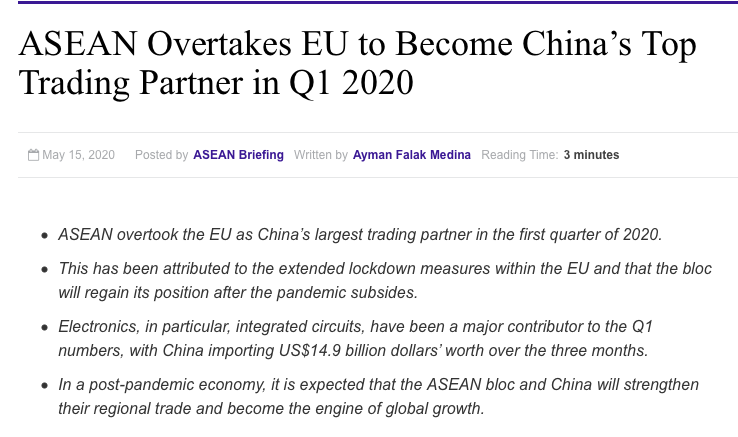
Screenshot from ASEAN Briefing
Trading with
ASEAN and SCO countries, monetary transfers will be carried out in yuan
or local currencies, outside the dollar domain and avoiding the SWIFT
payment scheme. Instead, monetary transfers will use the Chinese CIPS
(Cross-Border Interbank Payment System), or, alternatively, the
Russian MIR (meaning ‘peace’), at present mostly used for Russian
internal transactions, but gradually being internationalized. In
addition, the Chinese People’s Bank of China controlled crypto yuan is
just about ready to be launched internationally – see below for more
details.
SCO and ASEAN+3 account for about half the world population and for one third of the globes economic output. While
continuing offering partnerships with the west, as China
non-belligerently does, China is no longer dependent on the west’s good
will. Far from it.
China may also expand its concentration onto the
super-continent of Eurasia which is connected to Africa and includes
the Middle East. To serve this enormous landmass no seas have to be
crossed. Its easy trading, friendly relations, no conflicts, because
equal partners strive for the real meaning of trade, no losers, only
win-win.
Not to forget,
Eurasia has been for the past century a thorn in Anglo-American
empire’s eye. It is a huge market, covering about 55 million square
kilometers (21 million sq. mi), or around 36.2% of the Earth’s total
land area; with a population of about 5 billion people (2020 est.),
about 65% of the world population. In addition, the supercontinent
harbors enormous riches of natural resources. An estimated at least two
thirds of still available natural resources are located in Eurasia. This
is a formidable resource and market.
Dominating Eurasia is part of the self-declared Anglo-American hegemon’s objective
– and it is a key reason for Washington’s relentless aggression against
China and Russia. One of the strategies Washington applies is the
thousands of years-old “divide to conquer” – separating Western Europe
from Russia and China. For hundreds of years before the ascent of the
Anglo-American empire, western European countries and territories were
natural trading partners of Russia, as well as of China, the latter
largely thanks to the old (2100-year-old) Silk Road.
WWII and the
subsequent Cold War with its “Iron Curtain” was supposed to “finish” the
socialist Soviet Union and at the same time sever western Europe from
her traditional alliance with the Eurasian Continent, notably with
Russia, but also with more distant China. The elaborate construct of
building a post WWII united Europe with eventually a unique currency, an
idea initiated by the CIA with European Atlantists of the Club of Rome
in the 1950s – was supposed to finally make Western Europe a US ally and
to separate Europe definitely from the concept of socialism, notably
from the Soviet Union.
The plan
almost succeeded. But dynamics sometime seek out justice and
equilibrium. The Soviet Union was finally destroyed by the west,
starting in the mid-1980s with the final collapse in 1991, helped by
such traitors as Mikhail Gorbachev (1985-1991) and Boris Yeltsin
(1991-1999). Yeltsin sold out much of the riches of the Soviet Union to
the western-allied Russian elite and through them, to the west.
However, in 2000 Vladimir Putin
was elected as Russia’s new President. He saw through this western
fraud – and changed it all. He took firm control over Russia and
successfully ended western usurpation of Russia. Today, under President
Putin, and despite endless western sanctions, Russia has regained full
sovereignty and has become self-sufficient in the three life-pillars,
food, education and health. Russia has also become one of the world’s
foremost food grain exporters, like wheat, as well as a military power
with technologically the most advanced defense systems in the world. In
alliance with China, a solid pact between the two countries – the East,
the Eurasian Continent is unbeatable by the west.
This
politico-socioeconomic success of Mr. Putin’s, away from western
exploitation and for the benefit of the Russian people, has unleashed a
firestorm of wrath by the Occident against Putin and Russia. There is
hardly a day when Putin or Russia bashing – and also China bashing, for
that matter – is not on the western news menu.
Europe, still
oscillating somewhere in between west and east, may eventually join (or
re-join) her natural partners in the east. Indications to that end are
the clearest in Germany, where the corporate world is already allied
with Russia and by extension, with China – and this despite Madame
Merkel, whose official position has until recently been fully
pro-Washington. However, more recently she has also been propagating
independence from Washington.
Without much ado, pioneered by Greece and Italy, and against protests
from Washington, Europe is gradually also becoming part of China’s BRI.
Predictably, new alliances will emerge and that with the idea of a
multi-polar world. Both Beijing and Moscow have been propagating moving
away from a unipolar hegemonic system towards a multi-polar world,
favoring peace and cooperation.Away from the sanction-prone west, a priority for China is also developing her own internal market and infrastructure.This has already begun, addressing primarily China’s western and north-western provinces. It is the conversion from China’s traditional vertical growth, reaching in the past at times 12% or more per year, to what is called “quality growth”, bringing about socioeconomic development to the Chinese “hinterland” – people’s wellbeing and more equilibrium of the Chinese economy, comparing the country’s eastern and western regions.
Another territorial area of contention is the South China Sea. This is nothing new. Already under Obama’s infamous “Pivot to Asia” (2012 onward) – a political disaster – he “occupied” the South China Sea with about 60% of the US navy fleet, yes, almost two thirds of US war ships were menacingly circulating and watching over Chinese movements and activities – in what is China’s historically sovereign territory. Under President Trump, the aggression has become even fiercer.
On 14 July RT reports China’s Foreign Ministry Spokesperson Zhao Lijian as saying to reporters that the US has been “the troublemaker and the disruptor of peace and stability in the region”. He added,
“China enjoys indisputable sovereignty over the South China Sea and the islands. China’s stand is based on historical facts and international law. China’s sovereign rights and positions are formed in the course of history and this position has been held by Chinese Government for long.” And further, “Beijing has never sought to establish “an empire” in the region. However, he argued that China’s territorial claims and interests “have sufficient historical and legal basis,” and are legal under international law.”What are the real bones of contention of China’s rightful territorial claims to much of the South China Sea? – There are between 42 and 70 billion barrels of oil under the South China Sea, possibly more – and close to 300 trillion cubic feet (tcf) of gas.
China is less wary about her territorial partners in the South China Sea (Brunei, Taiwan, Indonesia, Malaysia, the Philippines, and Vietnam.), than about western / NATO interference and bullying of these partners into conflicts and belligerence with China. The non-confrontational approach of China is bound to find resources sharing arrangements with these regional partners.
***
A key issue for the US is China’s strong currency, the yuan. The yuan is poised to gradually replace the US-dollar as a major world reserve currency. The international strength of the yuan is being enhanced by a blockchain-based and gold-backed People’s Bank of China (PBC) controlled crypto-yuan.
China’s central bank (PBC) has launched a trial run in a number of cities, including Shenzhen, Suzhou, Chengdu, and Xiong’an, of her new crypto-currency, the e-RMB (Ren Min Bi, meaning People’s Money), or Yuan. So far it has been fully accepted by the people and is used virtually for everything, from salary deposits, to on-line purchases, to rent payments, street shopping and more.
Eventually the new cyber money will be rolled out internationally for trade, commodity pricing – and even to be used as a safe and stable reserve currency. The digital blockchain money assures the users total security, no interference from outside. It is a protection from ”sanctions” and arbitrary confiscation of financial assets. As such, the new cyber yuan may become an attractive international trading / transfer alternative to the US-dollar. This will add a new dimension to China’s economic strength. Not only will her economy soon outrank that of the United States, the yuan may also gradually become one of the main reserve currencies of the world.
With sanctions and threats of war – from trade, to biological, to cyber, to hard warfare by missiles and bombs – China is once again on her way to a new autonomy, a trustworthy Asian market – even including Australia and Japan – as well as a large potential internal market. The west, the US and Europe, may continue to depend on China’s supply chains, but these can no longer be used as instruments for sanctions and coercion.
China is
embedded in a solid alliance with Russia and in a strategic coalition
with the SCO. In addition, President Xi’s Belt and Road Initiative –
BRI, or also called the New Silk Road – is about to become the world’s
economic development revolution of the 21st Century. In this
sense, China will continue to relentlessly work in a non-aggression
style forward, towards a world community with a shared future for
mankind.
*
Note to readers: please click the share
buttons above or below. Forward this article to your email lists.
Crosspost on your blog site, internet forums. etc.
This article was originally published on New Eastern Outlook.
Peter Koenig is an
economist and geopolitical analyst. He is also a water resources and
environmental specialist. He worked for over 30 years with the World
Bank and the World Health Organization around the world in the fields of
environment and water. He lectures at universities in the US, Europe
and South America. He writes regularly for Global Research; ICH; New
Eastern Outlook (NEO); RT; Countercurrents, Sputnik; PressTV; The 21st
Century; Greanville Post; Defend Democracy Press; The Saker Blog, the
and other internet sites. He is the author of Implosion – An Economic Thriller about War, Environmental Destruction and Corporate Greed – fiction based on facts and on 30 years of World Bank experience around the globe. He is also a co-author of The World Order and Revolution! – Essays from the Resistance. He is a Research Associate of the Centre for Research on Globalization.
The original source of this article is Global Research
Copyright © Peter Koenig, Global Research, 2020
Posted with the permission of the author.
Blogger's note:
subterrnews.blogspot.com does not send cookies, or collect any information on
those using the blog. However, the blogspot is on google, and google may
collect information, and send cookies. Many of the links that we
connect to do not send out cookies or collect information, but some do.
You are keying in to this blog, and you have agreed to this.
The views expressed in the articles
do not necessarily represent the opinions of this blog. They are the views, and opinions of the
author(s) of the article.
0 comments:
Post a Comment