China’s vision for the future is “Give Peace a Chance”. It
is also the title of one of John Lennon’s most prominent songs. It
became the anthem for the anti-war movement, at the time of the US-waged
war against Vietnam. John Lennon was a peace activist. No wonder he was
ostracized, considered enemy number one by the US establishment, was
followed and surveyed by the FBI – and was eventually assassinated.
October 9, 1940 is his birthday.
“Give Peace a Chance” is the key motto for China’s peace philosophy
throughout her 70-years Revolution, often against challenging
situations, especially in the last decade with almost permanent
aggressions of one kind or another by the United States and their
coopted allies in Europe. China is a tremendous challenge for the west,
not only because of her sheer size and economic and technological
advances, but also because China seeks peaceful cooperation and
development around the globe.
The West does not seek Peace. Peace is bad for business. War is good
and profitable, as such renown mainstream journals as the Washington
Post have openly propagated in their op-ed columns time and again.
Anecdotally, both world wars were initiated in the west. This is the
premise under which the permanent western aggressions against the east,
especially the leadership of the east, China and Russia, are being
waged.
The motto of non-aggression and Peace – a Tao doctrine – prevails in
China’s foreign policy as the top principle, as of this date. And there
is no indication that China will depart from this Peace dogma which has
brought her internal stability, international recognition – and has made
China over the last decades to one of the world’s foremost economies,
as well as a leader in technological and environmental advances. This,
despite constant western castigating for pirating western technology and
destroying the environment. The demonization is like a propaganda tool
to deviate the world’s attention from western capitalist disasters
around the world. But China moves on, undisturbed, generously, with a
vision for a
common future for mankind all mankind, not just China.
On 1 October, China celebrated the 70
th Anniversary of her Revolution.
China’s vision began with the Chinese Revolution,when China’s leader of the Communist Party,
Mao Zedong,
declared the Independent People’s Republic of China on 1 October 1949,
succeeding the Republic of China (1912). In fact, China’s Revolution
already began just after the Second Sino-Japanese War (1937-1945), at
the end of WWII, with the Chinese Civil war (1945 – 1949), also called
the War of Liberation.
The International Forum on
“China’s 70-Year Development and the Construction of the Community with a Shared Future for Mankind”– 5-6 November in Shanghai, is part of the celebration. It is a forward-looking event with a
Chinese vision for the future. To better grasp that vision for the future, here is a quick look at the past.
History with Foresight
Visionary Chairman Mao Zedong wanted to finally free
the people of China from hundreds of years of western colonization and
oppression, from the calamities of Opium Wars I and II (British imposed
1839-1842, and 1856-1860) and engaged the Chinese Communist Party (CPC –
Communist Party of China) in an all-out confrontation with the
Kuomintang (KMT), or the second phase of the Civil War (1945 – 1949).
The KMT, also called the Nationalist Party, was led by General Chiang
Kai-shek, who succeeded KMT’s founder, Sun Yat-sen, after his death in
1925.
Chiang Kai-shek had the support of the United
States, whose main objectives were stopping the “spread” of communism
and maintaining continuous access to China’s riches, mostly in the form
of natural resources, but also by exploiting the Chinese labor force.
Washington ordered Chiang to break all relations with the Soviet Union –
and to eliminate the threat of a communist leadership in China. This
led to a lingering on and off conflict from the 1920s onwards between
KMT and the CPC (also considered the first phase of the Civil War).
Hostilities began shortly after the foundation of the KMT in 1919
which was ‘helped’ by the United States. While Mao and his Communist
Party emerged as the winner of the Civil War in 1949, Chiang Kai-shek
and his followers took over the Chinese Province of Taiwan, where
Kuomintang is still the ruling party. China’s non-aggression against the
occupation of Taiwan is one of the many demonstrations of China’s
peaceful diplomatic approach to conflict.
The current President of the Republic of China, as Taiwan calls
itself, although it is a part of China, is Tsai Ing-wen, a politician
and professor, in office since 2016. He caters entirely to the interests
of Washington and the west in general, even vying to buy independently –
and totally illegally – weapons from the US. While part of the PRC,
Taiwan enjoys a certain autonomy, again compliments of China’s
non-belligerent approach to conflicts.
Today, Taiwan is still recognized by 14 countries out of 193
UN members as the official representative of China. This, despite the
fact that the UN declared the People’s Republic of China already in 1971
as the official representative of China with one of the five permanent
seats in the UN Security Council (UNSC). Countries recognizing Taiwan as
official China, still bending over to please Washington, are becoming
fewer and fewer, as China is emerging as the number one economy of the
world; call it
socioeconomy, because China’s advancements are
not just measured by the western standards of linear economic growth,
but promote distributive growth, encompassing also vast improvements of
people’s quality of life.
Mao’s victory brought a new era to the Chinese people. With what he called the
Great Leap Forward (1958
– 1962), Mao and the CPC led a social and economic campaign converting
the rural agrarian areas into a socialist industrialized economy through
communal farming or agricultural cooperatives. This 4-year effort was
constantly attacked and disrupted by infiltrated anticommunist saboteurs
at a high social and monetary cost for China. But it served as a
learning phase. China’s flamboyant rise to the second (by some accounts
the first) world economy, proved that the lessons helped defeat US
interference then and today.
The ten-year
Cultural Revolution (1966 –
1976) was Mao’s sociopolitical movement aiming at cleaning socialist
China from infiltrated capitalist elements and influences. Then, and to
some extent still today, China was full with so-called Fifth Columnists,
a term coined during the Spanish Civil war, when General Franco’s
Nazi-party, the “Falange”, were able to defeat the legitimately elected
Republicans, because the “Falange” had what they called a “Fifth Column”
clandestinely embedded among the Republican defense forces in Madrid.
Today Fifth Columnists are everywhere. They come in all shapes and
forms, including disguised as western NGOs, in every country that
Washington and its western allies want to dominate and provoke ‘regime
change’. It was clear that the west, predominantly the emerging US
empire, wanted to disrupt Mao’s revolution; they would not let China
flourish under her own political, communist values and believes.
Foreign meddling in China’s Revolution came at a huge cost for China.
As a consequence, Mao’s revolutions are often portrayed by the west as
failures, the usual western tarnishing the success of other nations, of
other socioeconomic systems, in order to hide the west’s own disastrous
failures. From a Chinese and humanitarian perspective, Mao’s Revolutions
have drastically improved the public education and health system, have
eradicated endemic deadly diseases inherited from the western dominated
colonial and KMT times – and, foremost, poverty was largely eradicated.
As of these days, about 750 million people have been lifted out poverty.
Alleviation of poverty was an emphasis under both of Mao’s Revolutions.
These Revolutions also taught valuable lessons to Chinese scholars and
future leaders – and have drastically advanced China towards food
self-sufficiency which she reached by 2018.
It is thanks to these lessons that, after Mao’s death in 1976, his
successor, Deng Xiaoping, led China through a far-reaching economic
reform, including elements of a market economy, however always under
central government control – a principle that is maintained as of today.
Deng called the new Chinese economic model “socialism with Chinese
characteristics”, a principal that continues today. He helped develop
China into the world’s fastest-growing economy, improving the lives of
hundreds of millions of citizens. Deng also masterminded the return of
Hong Kong from a UK colony to China in 1997, and Macau from Portugal in
1999. The transition was completed by Deng’s successor,
Jian Zemin.
Deng retired in 1992. His successor, Jian Zemin, had several
high-ranking positions in previous governments and was President of the
PRC from 1993 – 2003. Jian opened China further for foreign investments
and trade. He visited the US in 1997, where he met with President
Clinton. Jian followed a non-confrontational foreign policy, like his
predecessors, strengthened relations with western partners, especially
the United States – and maintained at home an economic annual growth of
at least 8%. This led to an explosion of wealth, but also initially to a
less than optimal distribution of wealth, most of which concentrated
along China’s eastern shores, risking conflicts with the lesser
developed Chinese “hinterland”.
Hu Jintao followed Juan Zemin as China’s Paramount Leader from 2002 to 2012. Hu, as a rather modest leader, along with his Premier,
Wen Jiabao, and his Vice-President,
Xi Jinping,
continued the policy of economic growth and development, achieving more
than a decade of double-digit growth, however shifting the economy
gradually more to non-consumption growth, fostering, instead,
socioeconomic equality, aiming at building a “Harmonious Socialist
Society”.
Hu was seeking a prosperous China, free of internal social conflicts
and pursued internally and externally a “peaceful development policy” –
with ‘soft power’ meaning a diplomatic approach to foreign policy
issues, that was never confrontational. During Hu’s rule China increased
its influence in Africa and Latin America, laying the groundwork for
future closer relationships with these regions. Hu was also known for
shared and consensus-based leadership. Hu was succeeded in 2013 by Xi
Jinping.
The Vision
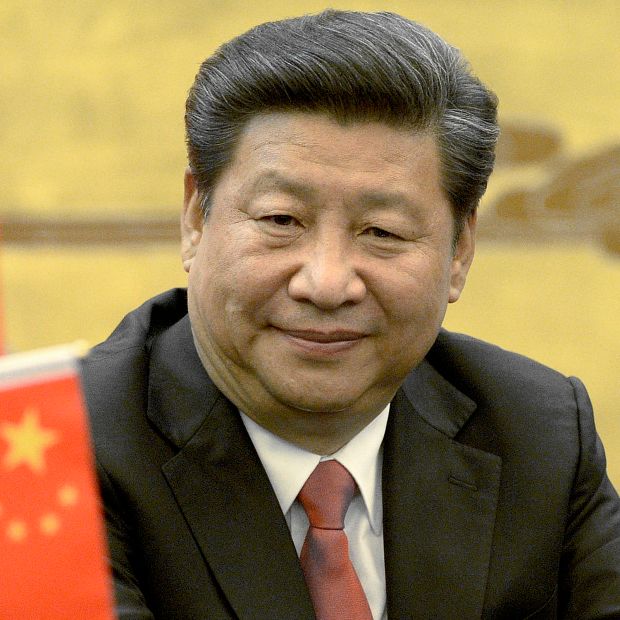
 Enter the era of President Xi Jinping
. He is a
lawyer, chemical engineer, philosopher – and visionary. On 7 September
2013, President Xi Jinping gave a speech at Kazakhstan’s Nazarbayev
University, in which he spoke about ‘People-to-People Friendship and
Creating a better Future”. He referred to the Ancient Silk Road of more
than 2,100 years ago, that flourished during China’s Western Han Dynasty
(206 BC-AD 24).
Referring to this epoch of more than 2,000 years back, Xi Jinping
pointed to the history of exchanges under the Ancient Silk Road, saying,
“they had proven that countries with differences in
race, belief and cultural background can absolutely share peace and
development as long as they persist in unity and mutual trust, equality
and mutual benefit, mutual tolerance and learning from each other, as
well as cooperation and win-win outcomes.”
Xi’s vision may be shaping the world of the 21
st Century.
He designed and engineered the Belt and Road Initiative, loosely modeled
according to the Ancient Silk Road, soon after assuming the Presidency
in 2013. He launched this ground-breaking “project”, a fabulous idea to
connect the world with transport routes, infrastructure, industrial
joint ventures, teaching and research institutions, cultural exchange
and much more. Enshrined in China’s Constitution,
BRI has become the flagship for China’s foreign policy.
BRI is literally building bridges and connecting people of different
continents and nations. The purpose of the New Silk Road is
“to
construct a unified large market and make full use of both
international and domestic markets, through cultural exchange and
integration, to enhance mutual understanding and trust of member
nations, ending up in an innovative pattern with capital inflows, talent
pool, and technology database”.
During the 19
th National Congress in 2017, BRI was
included in the Chinese (CPC) Constitution as an amendment to promote
the BRI’s objective of “shared interests” and “shared growth” which are
major political objectives for China. This amendment to the Constitution
for raising international cooperation through a multifaceted
socioeconomic development endeavor is unique in China’s history. It fits
precisely the theme of the present Forum,
“The Construction of the Community with a shared Future for Mankind”.
The BRI is a global development strategy adopted by the Chinese
Government, eventually with investments in more than 150 countries and
international organizations – and growing – in Asia, Africa, Europe, the
Middle East and the Americas. BRI is a multi-trillion investment
scheme, for transport routes on land and sea, as well as construction of
industrial and energy infrastructure, energy exploration, cultural
exchange and integration facilities, education and research institutions
– as well as trade among connected countries; and, unlike WTO (World
Trade Organization), BRI is allowing nations to benefit from their
comparative advantages, creating win-win situation. In essence, BRI is
to develop mutual understanding and trust among member nations, allowing
for free capital flows, a pool of experts and access to a BRI-based
technology data base.
At present, BRI’s closing date is foreseen for 2049 which coincides with new China’s 100
th Anniversary.
The size and probable success of the program indicates, however,
already today that it will most likely be extended way beyond that date.
It is worth noting, though, that only in 2019, six years after its
inception, BRI has become a news item in the West. Remarkably, for six
years BRI was denied, or ignored by the western media, in the hope it
may go away. But away it didn’t go. To the contrary, many European Union
members have already subscribed to BRI, including Greece, Italy,
France, Portugal – and more will follow, as the temptation to
participate in this projected socioeconomic boom is overwhelming.
Germany is mulling over the benefits and contras of participating in
BRI. The German business community, like business throughout Europe, is
strongly in favor of lifting US-imposed sanctions and reconnecting with
the East, in particular with China and Russia. But the official Berlin
is still with one foot in the White House – and with the other trying to
appease the German – and European – world of business. This balancing
act is in the long run not sustainable and certainly not desirable. At
present BRI is already actively involved in over 80 countries, of which
at least half of the EU membership.
To counteract the pressure to join BRI, the European Union, basically
run by NATO and intimately linked to Washington, has initiated their
own ‘Silk Road’, to connect Asia with Europe through Japan. In that
sense, the EU and Japan have signed a “free trade agreement” which
includes a compact to build infrastructure, in sectors such as energy,
transport and digital devices. The purpose is to strengthen economic and
cultural ties between the two regions, boosting business relations
between Asia and Europa. It is an obvious attempt to compete with or
even sideline China’s BRI. But it is equally obvious that this response
will fail. Usually initiatives taken in ill-fate are not successful. And
China, non-belligerent China, is unlikely to challenge this EU-Japan
competitive approach.
China’s New Silk Road is creating a multipolar world, where all
participants will benefit. The idea is to encourage economic growth,
distributed in a balanced way, so as to prioritize development
opportunities for those most in need. That means the under-developed
areas of western China, eastern Russia, Central Asia, Central Europe –
reaching out to Africa and the Middle East, Latin America, as well as to
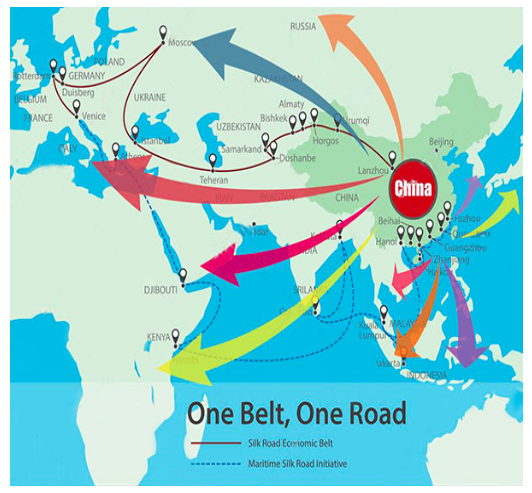
South East Asia and the Pacific. BRI is already actively building and
planning some six to ten land and maritime routes, connecting Africa,
the Middle East, Europe and South America (see map, above).
The expected multi-trillion-dollar equivalent dynamic budget is
expected to be funded by China, largely, but not exclusively, by the
Asian Infrastructure and Investment Bank (AIIB), by Russia – and by all
the countries that are part of BRI and involved in singular or
multi-country projects.
Implementing BRI, or the New Silk Road, is itself the realization of a
vision of nations: Peaceful interconnectivity, joint infrastructure and
industrial development, as well as joint management of natural
resources. For example, BRI may help with infrastructure and management
advice resolving or preventing conflicts on
transboundary water resources.
There are some 263 transboundary lake and river basins, covering almost
half the earth’s surface and involving some 150 countries. In addition,
there are about 300 transboundary aquifers serving about 2 billion
people who depend on groundwater.
Water resources, life depends on them. If these
resources are not properly managed, by, say, one or several parties
taking advantage of the other users, a conflict is born. Often such
conflicts can become violent. BRI may turn this source of potential
hostilities around into a source for peace. Water is among the most
shared resources on earth, and as such it may serve as an instrument for
peaceful connectivity.
The Chinese government calls the Silk Road Initiative
“a bid to enhance regional connectivity and embrace a brighter future”.
With freshwater resources rapidly diminishing for ready use in the
public domain, because of industrial and human pollution and
privatization, management of water resources and transboundary water in
particular, may be constructed into a “Shared Future for Mankind.” The
Belt and Road Initiative may provide the guiding principles for this
shared future of life’s essential resource – water.
Today, “Give Peace a Chance” is more relevant than ever. And China is
a vanguard in promoting peaceful development across the globe. During
the Cuban Conference “For a World in Equilibrium” of January 2019, one
of the Chinese representatives said very unequivocally in his
presentation, “we are building bridges between people and nations to
connect the world peacefully”. Undoubtedly, he is right and was
referring to President Xi Jinping’s Belt and Road Initiative, or the New
Silk Road.
The same can unfortunately not be said about the West which is,
instead, building walls, predominantly the US, followed by her European
vassals, either physical walls, or walls by conflicts, wars and – walls
by “economic sanction”, by which they strangle and kill people
en masse.
Whenever a government does not share the US neoliberal doctrines, or
refuses to bend to their dictate and efforts to plunder a country of
natural resources, it is first subject to atrocious sanctions, then to
military intervention with the goal of regime change. All that is
possible, because the western world is run by the fiat dollar system,
under which all international transactions have to transit through an
American bank, foremost a Wall Street bank. That’s how they block
transfers, confiscate and steal money in banks all over the world.
In Venezuela sanctions started soon after
President Hugo Chavez
was elected as President in 1998. They were severely enhanced under
Obama in 2014, and President Trump squeezed the country even more in
2017. In August 2019 Trump tightened the noose of economic strangulation
to the maximum, “the most that any country has been sanctioned”, he
proudly proclaimed, blocking and confiscating government accounts,
including national reserve accounts and gold all around the western
world. They are seizing Venezuelan assets in the US and internationally,
intercepting ships and otherwise interrupting trade, for example
blocking crucial medication and food stock from entering the country,
while also threatening sanctions on countries that are trading with
Venezuela.
According to Venezuelan officials, the financial losses since 2017
amount to at least 130 billion dollars. These funds represent goods and
services, the absence of which compromises not only wellbeing but real
lives of Venezuelans. The 130 billion dollars could amply supply food
and medication for Venezuelans to live well and for hospitals to
function with the necessary medication and equipment. In addition, the
US was directing mercenaries and members of the government opposition to
sabotage the countries electric system, which caused days, in some
regions weeks of black-outs, a disaster for hospitals depending on
electricity for refrigeration and lighting of operating theaters.
Indeed, a recent study by the Center for Economic Policy Research
(CEPR), in Washington, concluded that sanctions of the US and their
European allies may have cost the lives of up to 40,000 Venezuelans. But
Venezuela will not cave in and will survive, largely thanks to the
support from China and Russia.
At this time could also be mentioned the 60 years blockade of Cuba,
the US instigated wars on Iraq, Syria, Afghanistan, Vietnam, the civil
wars in Central America, Central Africa, the hostilities towards North
Korea – and of course the constant aggressions vis-à-vis China and
Russia – and much more. All for eradicating any “threat” of socialism
that might spread as a positive alternative to boundless
turbo-capitalism which is currently running the western world.
But enough about the west and its drive for world hegemony in
flagrant disrespect of international law and Human Rights. It just goes
to illustrate a few examples to juxtapose the west and the east,
foremost China in alliance with Russia, whose approach is a multipolar
socioeconomic development scheme, generous and peaceful, connecting
people through trade and through BRI.
“The future is in the East” – so goes a
progressive axiom. It is also my strong believe. By the East is meant
China, Russia, most of Central Asia; now all represented by the Shanghai
Cooperation Organization (SCO), or the
Shanghai Pact. SCO is a Eurasian political, economic, and security alliance, the creation of which was announced on 15 June 2001 in
Shanghai,
China by the leaders of China, Kazakhstan, Kyrgyzstan, Russia,
Tajikistan, and Uzbekistan. The Pact was signed in June 2002 and entered
into force in September 2013. SCO’s headquarters are in Beijing
Today, the SCO counts 8 members, including the member India and
Pakistan. Iran and Mongolia are on a “waiting list”, on the verge of
becoming members. Turkey, already a dialogue partner, is increasingly
vying gaining SCO access, either through association or full membership.
And this, despite the conflict it may create with Turkey’s NATO
partners, mainly the US. Clearly, were Turkey to join the SCO, exit from
NATO would be imminent – and disastrous for NATO, perhaps he stumbling
block that would bring NATO down. Especially, since popular anti-NATO
pressure from Italy to Germany, Greece, Spain and Portugal is steadily
growing. Turkey is also the most strategically located NATO partner
between East and West; between Europe and Asia, controlling the
Bosporus, access to the Black Sea.
The SCO has also several observer and dialogue partners which
eventually, it is assumed, may become full-fledged SCO members. The SCO
is also called the alliance of the east and is considered a security
pillar in more ways than one: SCO members account for almost half of the
world population and for about one third of the world’s economic
output. In other words, this eastern alliance is politically and
economically autonomous and to a large extent detached from the western
dollar based “sanction-prone” economy.
The SCO, a visionary Chinese initiative of the early 2000s, was
overlaid and expanded in 2013 by another brilliant Chinese Initiative,
the BRI. May also be added to this powerhouse another association of
countries, the
Eurasian Economic Union (
EAEU),
primarily a trading partnership. The members are located in central and
northern Asia, and include Armenia, Belarus, Kazakhstan, Kyrgyzstan and
Russia. The treaty was formally established in January 2015.
This block of eastern countries and associations is seeking against
all odds, a multi-polar world, a world of Peace and Prosperity for All –
a big challenge given the current socioeconomic disequilibrium – but
feasible with mutual respect and a will to cooperate, to apply the
forces of synergy and solidarity, as is inherent in the Belt and Road
approach. The stakes are high. As Russia’s Foreign Minister, Mr. Lavrov
pointed out during the 74
th UN General Assembly, in September 2019:
“The
West ignores reality by trying to prevent the formation of a
multi-polar world by imposing its narrow “liberal” rules on others.”
But, he added, “Western dominance is on the wane, ‘we’re liberals, so everything’s allowed’ just isn’t working anymore.” These words are the basis for a strong pillar and union of eastern associations.
Outlook and Vision
Economy
China has registered during the past decades a phenomenal economic
growth rate, at times exceeding 12% per year. Today it has been on
purpose reduced to about 6%, so as to allow a better distribution of the
growth benefits, and also spread wealth more horizontally to create
greater equality of wellbeing.
In figures and facts:
China’s GDP measured in US-dollars amounts to $14.2 trillion
(nominal; 2019 est.), which corresponds to $27.3 trillion in Purchasing
Power Parity (PPP; 2019 est.). This corresponds to US$ 10,153 / capita,
in nominal term (2019 est.), to US$ 19,520 / capita measured by PPP.
Compare this with the US GDP of US$ 21.345 trillion in nominal terms
(2019 est.) and $64,767 / per capita (2019 est.) This makes China the
world’s second largest economy in nominal terms, expected to exceed the
US by 2026. However, when comparing the two GDPs by their PPP values,
China is number one; having surpassed the United States in 2016.
Measured by PPP, China is already today de facto the
world’s largest economy, because the only figures that have any
significance in economic production and consumption, are those that
reflect the output’s purchasing power.
Examples of Economic Efficiency
New Airport in Beijing: In only 4
years China built by far the world’s largest airport in Beijing, Daxin
International Airport. It was ready for China’s 70th Birthday
on 1 October 2019, when it was inaugurated by President Xi Jinping. It
has been operational the week after inauguration. This airport, an
architectural wonder, covers some 700,000 m2 (almost 100 football
fields) and carries passengers by fast train in 20 minutes to the center
of Beijing. It is expected to accommodate in 2021 already 45 million
passengers and can easily be expanded to receive and serve 100 million
passengers as the need requires. This airport is a sign that China is
capable of realizing extraordinary achievements – it signals a visionary
future.
China’s Rapid Urbanization: When in 2017, Beijing was
faced with a housing shortage for low-wage migrant workers, they built
100,000 low-rent apartments in twelve months. The speed of China’s
infrastructure development, the rapid urbanization, providing millions
of new subsidized housing for migrant workers, is a model that has
worked and is being replicated throughout China. In fact, pays off
socially and economically. People who do not have to worry about
shelter, are healthier and live and work better. China has been building
homes for a million people–the entire housing stock of San Francisco –
every month since 1950. This policy aims at and creates wellbeing among
the workers, among the people – and is at the same time a solid tool for
China’s economic development – and people’s happiness. China’s
successful and rapid housing development is being closely watched by
Australia, as her major cities, Sydney and Melbourne face similar
problems.
Trade
China has been the
world’s largest exporter of goods
since 2009. Official estimates suggest Chinese exports amounted to
about $2.1 trillion in 2017. The total annual value of the country’s
exports equates to approximately $1,500 for every Chinese resident.
Since 2013,
China has as well become
the world’s largest trading
nation.China is also a significant importer and accounts for about 10%
of total global imports, i.e., about US$ 1.7 trillion, leaving China as a
net exporter with a trade surplus of about US$ 400 billion. –
Trade war with the US– see below.
Monetary Policy
China’s Yuan, is a solid currency, backed by China’s economy and by
gold. In 2017 the Yuan was admitted into the International Monetary
Fund’s (IMF) basket of reserve currencies, which constitute the SDR – or
Special Drawing Rights. The SDR basket consists of five currencies and
their respective weights are: US-Dollar $41.73%, Euro 30.93%, Renminbi
(Chinese Yuan) 10.92%, Japanese Yen 8.33%, British Pound 8.09%. The Yuan
is clearly undervalued in the SDR basket, as it is rapidly replacing
the dollar as reserve currency. Treasurers around the globe realize that
the US-dollar is fiat money, backed by nothing, whereas the Yuan is a
solid currency, based on a solid economy, plus backed by gold.
The decline of the US dollar as a world reserve currency means that
the US dollar hegemony is fading. This is inadmissible for the US.
Therefore, Washington along with the major western allies are
considering to abandon the key reserve role of the dollar and replacing
it with some kind of an SDR, in which the dollar would maintain a
prominent role, but its Ponzi-scheme characteristics would no longer be
openly visible.
The current US debt to GDP ratio is about 105%. However, what the
General Accounting Office calls “unmet obligations” amounts to about
700% of GDP (net present value – total outstanding obligations
discounted to today’s value). According to former Federal Reserve
Chairman, Alan Greenspan, responding to a journalist’s question,
“we will never pay back our debt; we will just print new money”. This
is a dangerous pyramid, or Ponzi-scheme, of which most governments are
aware, and yet many of them hold on to the dollar as key reserve
currency. With the yuan rising, this may change rapidly. In fact, the
conversion from dollar to yuan as reserve currency has already started.
Regarding the western foreseen reserve basket to “save” the dollar,
it is not clear yet what the other currencies and their respective
weight in the new “Reserve SDR” would be, but let’s assume the same five
currencies. The Yuan, if still in the reserve basket would probably
still be under-valued. If so, this might be a good reason for China to
exit the Reserve SDR and continue with the Yuan by its own economic and
monetary value as a reserve currency. The Yuan has made its reputation
of stability and does no longer need the backing of a (western coined)
SDR to prove its strength as a reserve currency.
The War on Tariffs
In June 2018, US President Trump started an unprovoked Trade War with
China, then expanded it to other countries, including his European
allies. But it is most ferocious with China. As usual, China’s response
was not hostile. Retaliation, yes; but still an approach of seeking
negotiations and compromise. In reality, the US market for China may be
important, but not that important to be humiliated as was the case with
the American bulldozer approach to impose not just tariffs, but tariffs
that were nothing but a new form of economic sanctions.
The real meaning and purpose behind these tariffs was not reducing
China’s exports in the first place, but harming the Yuan, as it was
gaining strength and, as mentioned before, gradually taking over the
US-dollar’s role as world reserve currency. Some 20 years ago the US
dollar accounted for more than 90% of all reserve assets in nations’
treasuries around the globe. Today, that percentage has shrunk to less
than 60% and is fading rapidly. Much of the lost territories by the US
dollar was made up by the Chinese Yuan. And as the importance of the
Yuan rises, the US hegemony of the world’s economy, resources and people
will fade. This does not go down in Washington without a fight.
Future Economic Growth
China, in the near future, will most likely keep to a “modest” growth
rate, around 5% to 7%, concentrating on horizontal distributive growth,
with a focus on improved public wellbeing for all, universal access to
affordable housing, basic infrastructure, water supply, sanitation,
public transportation, rural higher education, as well as internal
cultural exchange and harmonization. Two areas of economic development,
”horizontal growth”, may be singled out; (i) Artificial Intelligence
(AI), and (ii) Environmental Improvement.
Technological Innovation
China is a Power House of new technologies and no doubt the world’s number one in Technological Innovation. Just to mention a few, not in order of priority:
- Rapidly progressing robotization of construction and manufacturing,
as well as of medical interventions, like surgeries and localized cancer
treatment;
- 3-D construction of serving a myriad of sectors, including
manufacturing in the medical sector, medical equipment, human body
replacement parts, production of construction materials – and more.
China predicts in 20 to 30 years everybody (in China) will have access
to individualized 3D building capacity;
- Face recognition technology, making traditional ID and bank account access cards obsolete and identity protection more secure;
- High-speed train systems, a domain where China has bypassed Japan
and is the world’s number one; i.e. the high-speed railways Shanghai
Maglev and Fuxing Hao CR400AF/BF;
- A new generation of garbage recycling – into building material, fertilizers, fuel as a source of energy – and more;
- Architecture and building efficiency, only two examples, (i) the new
Beijing Daxin International Airport, the world’s largest, built in just
4 years, with a capacity of more than 100 million passengers per year –
and a superb architecture; (ii) the “Birds Nest” – the stadium for the
2008 Summer Olympics which will also be used for the 2022 Winter
Olympics; it was built in less than 5 years and is an architectural
masterpiece, and
- Artificial Intelligence (AI) – see below.
China’s ambition: Everything is possible – and China has already proven that it can be done.
Artificial Intelligence (AI).China is also moving rapidly towards
leadership in Technical Innovation for Artificial Intelligence, with
plans to invest considerable resources into research. In 2017, the State
Council (CCP) issued a “Next Generation Intelligence Development Plan”,
including a US$ (equivalent) 2.1 billion AI industrial park. By 2025
the State Council predicts China to be a leader in AI research and
predicts that China’s AI core industry will be worth some US$ 60
billion, amounting to about US$ 700 billion equivalent, when accounting
for related industries. By 2030, the State Council expects China to be
the global leader in development of AI.
Environmental Improvement. China has made
leaps in improving her environment, by far exceeding efforts of western
countries. China’s environmental policies are developing BRI at home and
abroad in shades of green. New parks with trees and areas for
recreation are emerging in every major city in China. According to an
expert at the School of Regulation and Global Governance of the
Australian National University, Beijing has improved its air quality by
30% in the last five years.
A study of the University of Chicago demonstrates that Chinese cities
have reduced the concentrations of fine particulates in the air on
average by 32 % between 2014 and 2018.
The Chinese people and government are putting utmost importance to
protecting the environment and ecosystems. Green development makes for
improved public health, but is also attractive for investments.
China has a three-year “green” plan to improve air quality and
tighten regulations. Air quality is one of the key environmental issue
besetting China. In that sense, the government is accelerating the
electrification of vehicles and has pledged that by 2030 all new cars
will be powered by electricity.The government is also tackling drinking
water quality and shortages, as well as improving urban and rural
sanitation. These are longer-term propositions. Cost estimates for
China’s overall environmental programs are not readily available but may
easily reach into hundreds of billions of US-dollar equivalents over a
ten-year period.
Conclusion
A few years ago, China, Russia and other SCO countries have started
trading among themselves in their local currencies with a non-western
monetary transfer system, using mostly the Chinese Cross-Border
Interbank Payment
System (CIPS). It is out of control of the
western SWIFT transfer system, thereby escapes the sanctions regime of
the US. Gradually, the SCO and associated countries are detaching
themselves from the western dollar-based fiat system.
In terms of trading, the SCO countries, mainly China, control most of
the Asian markets, even making rapid inroads into Japan and Australia,
and are evermore present in Latin America and Africa. Before long Europe
will see the light and turn eastwards. It would be a wise decision.
Dealing first within the confines of the huge Eurasian landmass,
including the Middle East and parts of Africa – has been the logical way
of trading since the Ancient Silk Road, more than 2,000 years ago.
China has a great visionary future that had already begun 70 years
ago, and was enhanced six years ago with President Xi Jinping’s
launching of the Belt and Road Initiative. BRI will continue spanning
the globe for the next at least 50 to 100 years, spreading development
in a multi-polar world, stressing equality and wellbeing for all. BRI
investments may be counted in the multi-multi trillions and will be
funded by China and the participating countries, with a socio-economic
return that cannot be expressed in sheer monetary terms, as investments
will also bring unfathomable social benefits, poverty reduction,
improved health, higher and better education and, generally improving
people’s wellbeing.
The bright side of this initiative, is the Chinese philosophy of
non-aggression, of diplomacy to resolve conflicts and of promoting
peaceful economic coexistence and development around the globe.
China’s determination to develop with a “green” economy, a “green”
BRI and a horizontal distributive growth that emphasizes equality and
inclusion is a landmark model for the world to embrace. It is a model to
construct a
Community with a Shared Future for Mankind.
*
Note to readers: please click the share buttons above or below.
Forward this article to your email lists. Crosspost on your blog site,
internet forums. etc.
Peter Koenig is an economist and geopolitical
analyst. He is also a water resources and environmental specialist. He
worked for over 30 years with the World Bank and the World Health
Organization around the world in the fields of environment and water. He
lectures at universities in the US, Europe and South America. He writes
regularly for Global Research; ICH; RT; Sputnik; PressTV; The 21st century;
Greanville Post; Defend Democracy Press, TeleSUR; The Saker Blog, the
New Eastern Outlook (NEO); and other internet sites. He is the author of
Implosion – An Economic Thriller about War, Environmental Destruction and Corporate Greed – fiction based on facts and on 30 years of World Bank experience around the globe. He is also a co-author of The World Order and Revolution! – Essays from the Resistance.
He is a Research Associate of the Centre for Research on Globalization.
The original source of this article is Global Research
Posted with the permission of the author.
Blogger's note:
subterrnews.blogspot.com does not send cookies, or collect any information on
those using the blog. However, the blogspot is on google, and google may
collect information, and send cookies. Many of the links that we connect
to do not send out cookies or collect information, but some do. Your
keying in to this blog you have agreed to this.
The views expressed in the articles
do not necessarily represent the opinions of this blog. They are the views, and opinions of the
author(s) of the article.