Complete Streets’ Programs Are Sweeping Over American Cities
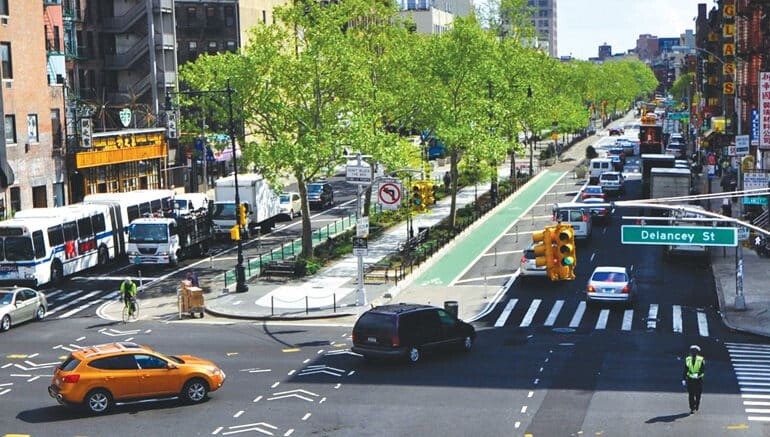 Flickr/NYC_NYCDOT
Complete
Streets’ promotes bicycles, scooters, foot traffic, light rail, etc.,
to the detriment of private transportation. In Pittsburgh, bike and lane
usage will be zero in the winter when temps hover around 20 degrees. Complete Streets is a global program inspired by the United Nations’ Sustainable Development Goals. The
Smart Growth America website states:
Complete Streets are streets for everyone.
They are designed and operated to enable safe access for all users,
including pedestrians, bicyclists, motorists and transit riders of all
ages and abilities. Complete Streets make it easy to cross the street,
walk to shops, and bicycle to work. They allow buses to run on time and
make it safe for people to walk to and from train stations.
⁃ TN Editor
At the time when many of Pittsburgh’s streets were built, top travel speed was dictated by horses, and later, a
trolley car at full tilt.
Now, drivers attempt to maneuver those same narrow, complicated
streets at 40 or 50 miles per hour, said Karina Ricks, director of the
city’s Department of Mobility and Infrastructure.
“That really is a wildly dangerous situation. When we have very soft
human bodies mixing in with these 3-ton metal objects,” she said. “We
share these streets … we’re part of a larger community, and [one of the]
cardinal duties of being in a community is to protect and preserve
other community members.”
The city’s
2020 capital budget allocates $17.7 million to make streets safe for all users, nearly triple the available funds
of previous years.
Contained within the “Complete Streets,” program, listed projects
include installing pedestrian signals, traffic calming, bike
infrastructure, and general streetscape improvements. The intent is to
“rationalize” the roadway, Ricks said.
“Our streets are very chaotic,” she said. “So the drivers are
stressed, and the travelers are stressed, and we’re not really giving
people good ways to get to the many job opportunities and amenities that
we have.”
The city’s
long-awaited bike plan will
be central to resolving that chaos, said Ricks. The new 10-year plan,
due to be released by the end of January for public comment, will cover
both how to close gaps in the existing network and how to expand it. The
plan calls for adding more than 100 miles of bike facilities over 10
years, but “we’re not trying to wait 10 years,” she said.
Over the next two years, Pittsburgh officials will partner with local
nonprofits Bike Pittsburgh and Healthy Ride, who will be supported by
Colorado-based nonprofit advocacy group People For Bikes, to design and
build 60 miles of new and updated bike infrastructure.
A connected system
will be safer and
allow more people to choose cycling as a viable means of transit, said
Eric Boerer, advocacy director for Bike Pittsburgh. But perhaps most
importantly, it will add predictability to the road network.
“Bike infrastructure isn’t just for bicyclists, it’s also for
drivers,” he said. “When you create a space for everybody it just makes
the whole street less chaotic and makes it a lot more peaceful.”
Pittsburgh is part of a larger national shift in how cities approach
bike infrastructure. The last two or three decades saw cities make
piecemeal additions of a bike lane here or a trail segment there, said
Kyle Wagenschutz, director of local innovation with People For Bikes.
Read full story here…
Source: Technocracy.news
Blogger's note:
subterrnews.blogspot.com does not send cookies, or collect any information on
those using the blog. However, the blogspot is on google, and google may
collect information, and send cookies. Many of the links that we
connect to do not send out cookies or collect information, but some do.
You are keying in to this blog, and you have agreed to this.
The views expressed in the articles
do not necessarily represent the opinions of this blog. They are the views, and opinions of the
author(s) of the article.