All Global Research articles can be read in 51 languages by activating the Translate Website button below the author’s name.
To receive Global Research’s Daily Newsletter (selected articles), click here.
Follow us on Instagram and Twitter and subscribe to our Telegram Channel. Feel free to repost and share widely Global Research articles.
***
While helicopters flew overhead, members of Peru’s national army shot down civilians
with live bullets in the outskirts of the city of Ayacucho on December
15. This action was in response to a national strike and mobilization to
protest the coup d’état that deposed President Pedro Castillo on December 7.
Hundreds of university students, shopkeepers, street vendors,
agricultural workers and activists gathered on December 15, at the
center of Ayacucho to express their discontent over the removal of
Castillo and continued their mobilisation toward the airport. Similar
action was witnessed in several other cities across the southern Andean
region of the country.
As protesters approached the airport, members of the armed forces
opened fire and shot tear gas canisters directly at them. The firing by
the army from the helicopters proved to be the most lethal. As the
hundreds of unarmed people ran for their lives, the shooting continued.
Ten people were killed as a result of this violence inflicted by the army, and dozens more were injured, according to official numbers provided by the ombudsman’s office. At least six people are still fighting for their lives in hospitals in Peru’s capital Lima and in Ayacucho. Autopsies of 10 of those who died in Ayacucho show that six of the victims died from gunshot wounds to the chest. The youngest was just 15 years old.
Reuters reported, on December 27, how one of these fatal victims in
Ayacucho — 51-year-old Edgar Prado — was shot and killed while
attempting to help someone else who had been shot down during the
protests.
The exceedingly violent response of the security forces to the anti-coup protests across Peru was widely condemned. A delegation
of the Inter-American Commission on Human Rights (IACHR) visited the
country from December 20–22 to receive testimonies from local human
rights organisations and victims about the violent repression suffered
by protesters and also spoke to families of the 28 fatal victims. The delegation traveled to Ayacucho on December 22.
More than a dozen other family members, Ayacucho inhabitants,
organisers, and a couple of independent journalists, including myself,
waited on the sidewalk of one of the city’s narrow and colourful streets
as the meeting was underway. As people came and went, much of the
events and tragedies of December 15 were recounted.
The massacre
“They won’t show you this on the news here,” Carmen (name changed)
told me as she showed me a video on her phone of a young boy with blood
all over his shirt being dragged to safety by fellow protesters. “That’s
her nephew,” she said, pointing to a woman sitting on the ground.
Pedro Huamani, a 70-year-old man who is a member of the Front in
Defense of the People of Ayacucho (FREDEPA), was accompanying the
victims waiting outside the IACHR meeting. “We have suffered a terrible
loss,” he told me, “I was present that day in a peaceful march toward
the airport.
“When they began to shoot tear gas grenades and bullets at us, I
started to choke, I almost died there,” Huamani said. “I escaped and
went down to the cemetery, but it was the same, we were trying to enter
and they started to shoot at us from behind. Helicopters were flying
overhead and from there they shot tear gas grenades at us, trying to
kill us.”
Carmen brought over some of her friends and one of them, who was
wearing a grey sweatsuit, told me, “We all live near the airport, and
saw everything happen. You should’ve seen how they shot them down like
animals. We tried to help some of the injured, but it was hard.”
The massacre in Ayacucho, as well as the violent repression across the country, has only intensified people’s demand
that Dina Boluarte step down. Boluarte was sworn in on December 7
immediately following the coup against Castillo. In interviews and
public addresses, she has justified the use of force by police against
protesters calling their actions as acts of “terrorism” and “vandalism.”
Huamani, while shaking and holding back tears, said: “She is a
murderous president and in Huamanga, we do not want her, nor do we
recognise her as president because this woman ordered the police and the
army to shoot at us Peruvians. And these bullets, these weapons, are
really bought by us, not by the army, nor the soldiers, but by the
people. And for them to kill us is really horrible.”
The anger felt by Ayacucho residents is also linked to the historical
undermining of Peruvian democracy and the economic exclusion suffered
by the regions outside of Lima. Huamani explained: “They took out our
president [Castillo] so this is not a democracy. We are not a democracy,
we are in [state of] war, but not just in Ayacucho and Huamanga, but
also in Arequipa, Apurímac, Cusco. In these regions, we are suffering
from poverty, we can no longer survive, we are dying of hunger … and
these right wingers want to make us their slaves, but we won’t permit
this because we are responding and resisting.”
Old wounds ripped open
December 15 was not the first time civilians in Ayacucho were
massacred by the Peruvian armed forces. Many who were present on
December 15 said that the warlike treatment received by the peaceful
protesters was reminiscent of the days of the two-decades-long internal armed conflict that Peruvians suffered through more than 20 years ago.
“They still treat us as if we were all terrorists,” a family member of one of the victims of the protests pointed out.
As part of the state’s campaign
against the guerrilla insurgency, it tortured, detained, disappeared,
and murdered tens of thousands of innocent peasants and Indigenous
people, accusing them of supporting or being part of the insurgency.
The population of Ayacucho was one of the hardest hit. According to reports
by the Truth and Reconciliation Commission, which was set up to look
into the human rights violations, of the estimated 69,280 fatal victims
of the internal armed conflict in Peru from 1980-2000, 26,000 were
killed or disappeared by state actors or insurgent groups in Ayacucho.
Thousands of people that fled their towns for the city of Ayacucho
during the conflict continue to search for their loved ones and demand
justice.
One of them is Paula Aguilar Yucra, who I met outside the IACHR meeting. Like more than 60%
of people in Ayacucho, Indigenous Quechua is her first language. The
63-year-old is a member of the Ayacucho-based National Association of
Relatives of Kidnapped, Detained and Disappeared of Peru (ANFASEP). She
fled her rural community in Usmay for Ayacucho in 1984 after her mother
was killed and her brother was taken by soldiers and never seen again.
Nearly 40 years later, she mourns again. Her grandson, 20-year-old
José Luis Aguilar Yucra, father of a two-year-old boy, was killed on
December 15 by a bullet to the head as he attempted to make his way home
from work.
In a vigil held on the afternoon of December 22, Paula stood tall
with the other members of ANFASEP and held a sign reading: “Fighting
today does not mean dying tomorrow.”
*
Note to readers: Please click the share buttons above. Follow us on
Instagram and Twitter and subscribe to our Telegram Channel. Feel free
to repost and share widely Global Research articles.
This article was produced by Globetrotter.
Zoe Alexandra is a journalist and co-editor of Peoples Dispatch.
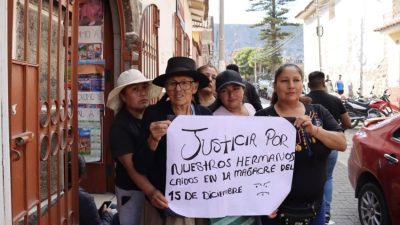
Featured image: Outside the
meeting with the human rights delegation, relatives of victims and
witnesses to the massacre hold a sign that reads “Justice for our
brothers killed in the massacre on December 15”. Photo: Zoe
Alexandra/People’s Dispatch