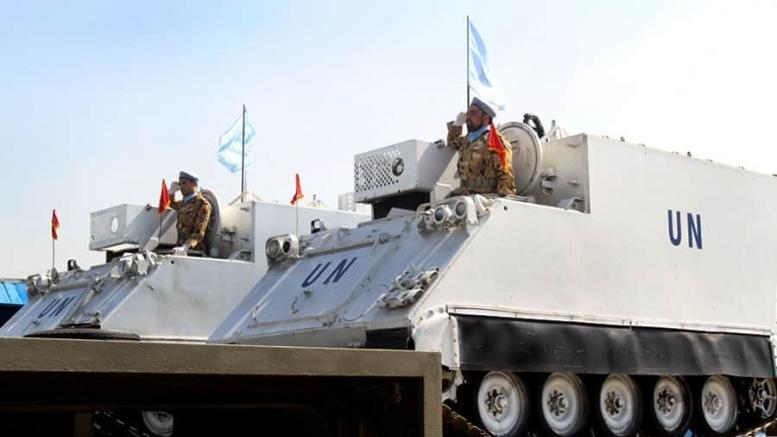
 Wikimedia Commons, Mohammad Sadegh Heydari
Speaking
of the 2011 Greece crisis, this professor says, “There were decisions
that were made for them and then they just had to have a more or less
technocratic government and get it through.” Now, the United Nations is
in the same predicament with nations not adopting its bogus climate
change agenda. This gives expression to Al Gore’s statement ‘deniers
deserve to be punished. ⁃ TN Editor
Action
to address climate change has been left so late that any political
response will likely become an international security issue — and could
threaten democracy.
That’s the view of Ole Wæver,
a prominent
international relations professor at the University of Copenhagen, who
also says climate inaction could lead to armed conflict.
“At some point this whole climate debate is going to tip over,” he
tells RN’s Late Night Live.
“The current way we talk about climate is one side and the other
side. One side is those who want to do something, and the other is the
deniers who say we shouldn’t do anything.”
He believes that quite soon, another battle will replace it. Then,
politicians that do ‘something’ will be challenged by critics demanding
that policies actually add up to realistic solutions.
When decision-makers — after delaying for so long — suddenly try to
find a shortcut to realistic action, climate change is likely to “be
securitised”.
Professor Wæver, who first coined the term “securitisation”, says more abrupt change could potentially threaten democracy.
“The United Nations Security Council could, in principle, tomorrow
decide that climate change is a threat to international peace and
security,” he says.
“And then it’s within their competencies to decide ‘and you are doing
this, you are doing this, you are doing this, this is how we deal with
it’.”
A risk of armed conflict?
Professor Wæver says despite “overwhelmingly good arguments” as to
why action should be taken on climate change, not enough has been done.
And he says that could eventually lead to a greater risk of armed conflict, particularly in unstable political climates.
“Imagine these kinds of fires that we are seeing happening [in
Australia] in a part of Africa or South-East Asia where you have groups
that are already in a tense relationship, with different ethnic groups,
different religious orientations,” he says.
“And then you get events like this and suddenly they are not out of
each other’s way, they’ll be crossing paths, and then you get military
conflicts by the push.”
He isn’t the first expert to warn of the security risks of climate change.
Chris Barrie, former Defence Force chief and honorary professor at the ANU’s Strategic and Defence Studies Centre,
wrote in October that “climate change is a threat multiplier”.
“It
exacerbates the drivers of conflict by deepening existing fragilities
within societies, straining weak institutions, reshaping power balances
and undermining post-conflict recovery and peacebuilding,” he wrote.
And current Defence chief Angus Campbell has
warned that increased incidences of climate change-related natural disasters could stretch the capability of the ADF.
Letting ‘the dark forces’ loose
Professor Wæver argues that delayed action will lead to more drastic measures.
“The longer we wait, the more abrupt the change has to be,” he says.
“So a transformation of our economy and our energy systems that might
have been less painful if we had started 20 years ago, 30 years ago.
“If we have to do that in a very short time, it becomes extremely painful.”
He says classifying climate change as a security issue could justify more extreme policy responses.
“That’s what happens when something becomes a security issue, it gets
the urgency, the intensity, the priority, which is helpful sometimes,
but it also lets the dark forces loose in the sense that it can justify
problematic means,” he says.
This urgency, he says, could lead to more abrupt action at an international level.
“If there was something that was decided internationally by some more
centralised procedure and every country was told ‘this is your emission
target, it’s not negotiable, we can actually take military measures if
you don’t fulfil it’, then you would basically have to get that down the
throat of your population, whether they like it or not,” he says.
“A bit like what we saw in southern Europe with countries like Greece and the debt crisis and so on.
“There were decisions that were made for them and then they just had
to have a more or less technocratic government and get it through.”
Read full story here…
Source: technocracy.news
Blogger's note:
subterrnews.blogspot.com does not send cookies, or collect any information on
those using the blog. However, the blogspot is on google, and google may
collect information, and send cookies. Many of the links that we
connect to do not send out cookies or collect information, but some do.
You are keying in to this blog, and you have agreed to this.
The views expressed in the articles
do not necessarily represent the opinions of this blog. They are the views, and opinions of the
author(s) of the article.


