ESG Scoring Drives Companies Into Sustainable Development, Aka Technocracy
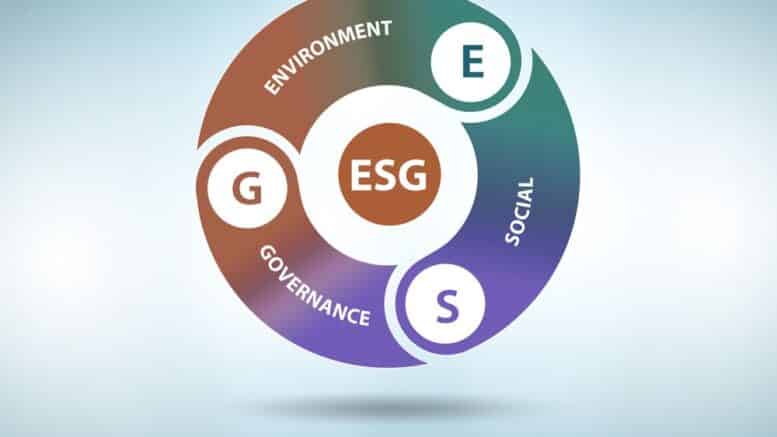
ESG stands for “Environmental, Social, Corporate Governance” and has been likened to a globalized Social Credit Scoring system for business. If you have a high ESG score, it will be easy to qualify for credit, to get the best deals with vendors and to participate in the global supply chain.
Alas, if you don’t have a high ESG score, you won’t be in business long unless you change your behavior and knuckle under to its demands.
So, how is ESG determined and who sets the rules and guidelines?
First, ESG has nothing to do with the physical aspects of a company, like capital, cash flow or profit. Rather, it concerns intangible factors such as how closely you, your vendors and customers adhere to Sustainable Development and climate change policies.
According to Forbes,
“The story of ESG investing began in January 2004 when former UN Secretary General Kofi Annan wrote to over 50 CEOs of major financial institutions, inviting them to participate in a joint initiative under the auspices of the UN Global Compact and with the support of the International Finance Corporation (IFC) and the Swiss Government. The goal of the initiative was to find ways to integrate ESG into capital markets.”
One year later (2005), an environmental policy wonk, Ivo Knoepfel, wrote a a major paper, Who Cares Wins: Connecting Financial Markets to a Changing World. This 58 page report contained “recommendations by the financial industry to better integrate environmental, social and governance issues in analysis, asset management and securities brokerage.”
The corporate collaborators, far from real people like ordinary citizens, included all the big names one might suspect: World Bank Group, Morgan Stanley, HSBC, Goldman Sachs, Deutsche Bank, UBS, Mitsui Sumitomo Insurance, Citigroup and others.
And just like that, ESG was born.
The report summarizes ten innocuous and subjective principles that read much like the UNs’ Sustainable Development Goals (SDGs):
U.N. Global Compact Principles
Human Rights
Principle 1: Businesses should support and respect the protection of internationally proclaimed human rights within their sphere of influence; and
Principle 2: make sure that they are not complicit in human rights abuses.
Labour
Principle 3: Businesses should uphold the freedom of association and the effective recognition of the right to collective bargaining;
Principle 4: the elimination of all forms of forced and compulsory labour;
Principle 5: the effective abolition of child labour; and
Principle 6: eliminate discrimination in respect of employment and occupation.
Environment
Principle 7: Businesses should support a precautionary approach to environmental challenges;
Principle 8: undertake initiatives to promote greater environmental responsibility; and
Principle 9: encourage the development and diffusion of environmentally friendly technologies.
Anti-Corruption
Principle 10: Businesses should work against corruption in all its forms, including extortion and bribery.*
Who decides ESG standards and scores? It is repeatedly stated that financial analysts are the key operatives:
- “We invite financial institutions to expand the scope of ESG integration in research to other asset classes impacted by ESG factors, beyond equity.” Beyond equity implies a rating system for bonds, corporate debt and other financial instruments.”
- “We encourage analysts to further advance the development of valuation methodologies to better deal with qualitative information and uncertain impacts related to ESG issues.”
- “Financial analysts should expand their understanding and analysis of these factors to other industries.”
- “Financial analysts should improve their understanding and integration of ESG issues in emerging markets research.”
- “Financial analysts and investment professionals should take a leading role because they are the specialists best placed to show how ESG issues impact company and investment value.”
To put this in perspective, the financial analyst position at a large financial institution is typically an entry-level job for people just out of college. In reality, they are coached by ESG policies to act like “fact checkers” as they examine these non-tangible aspects of a company. With the stroke of a pen then can upgrade or downgrade a company according to its ESG compliance, but no two analysts would likely come to the same exact conclusion.
Nevertheless, with subjective ESG research reports in hand, senior executives then call on pension funds, mutual funds, hedge funds, investment funds, etc., to divest themselves of low scoring companies and reinvest in high scoring companies. If they refuse to cooperate, they are branded with a lower ESG score of their own. Lending institutions are approached to examine the ESG value of their loan portfolios. Not high enough to satisfy the “fact checkers”? Then stop loaning money to low ESG companies, or risk being downgraded yourself!
It gets worse from here. The report calls for government force to mandate disclosure:
“We also believe that regulatory frameworks requiring a minimum degree of disclosure and accountability on ESG issues would improve the availability and comparability of data, and therefore support integration in financial analysis.
And for stock exchanges to inform rank-and-file investors and institutions alike:
Stock exchanges, for instance, could include ESG criteria in listing particulars for companies. Both voluntary and market-friendly regulatory approaches are needed to improve disclosure. Both should be flexible enough to allow for diversity of approaches and providers, rather than relying on rigid prescriptions.”
Conclusion
ESG is a globalist scam, and having just said that, my score probably went to zero. It is designed to drive investments and company operating policies into Sustainable Development, aka Technocracy. It is also a circular design that once started, reinforces itself with every spin around the financial universe.
Next up will be ESG for individuals, which goes one step further into how you actually think about these things.
What? You own an investment in a dirty old low-ESG company? Own a gas-guzzling car? Big house? Too much grass in your front yard? Work for a low-ESG company? Post social media pictures that lampoon global warming or mask mandates? Well, that shows that you just don’t care, so boom, down goes your score. Now, try to get financing for that new car you want to buy, or get underwritten for a new life insurance or homeowner’s policy.
You get the idea.
Source: technocracy.news
Blogger's note: Posted with the permission of the author.
Be the first to Comment.
Blogger's note: subterrnews.blogspot.com does not send cookies, or collect any information on those using the blog. However, the blogspot is on google, and google may collect information, and send cookies. Many of the links that we connect to do not send out cookies or collect information, but some do. You are keying in to this blog, and you have agreed to this.
The views of the author do not necessarily represent the opinions of this blog. They are the views, and opinions of the author(s) of the article.
