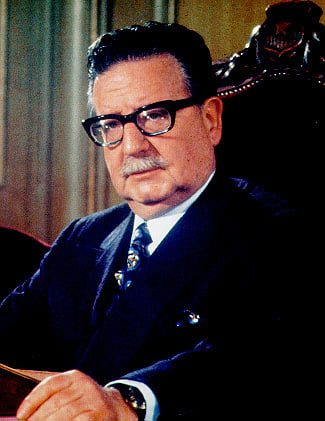
We are commemorating September 11, 2001 as well as September 11, 1973 (Fifty years ago)
Read more
Half a century ago on September 11, 1973, the Chilean military led by General Augusto Pinochet, crushed the democratically elected Unidad Popular government of Salvador Allende.
The objective was to replace a progressive, democratically elected government by a brutal military dictatorship.
The military coup was supported by the CIA. Secretary of State Henry Kissinger played a direct role in the military plot.1
In the weeks leading up to the coup, US Ambassador Nathaniel Davis
and members of the CIA held meetings with Chile’s top military brass
together with the leaders of the National Party and the ultra-right
nationalist front Patria y Libertad. While the undercover role of the
Nixon administration is amply documented, what is rarely mentioned in
media reports is the fact that the military coup was also supported by a
sector of the Christian Democratic Party.
Patricio Aylwin,
who was elected Chile’s president in 1989, became head of the DC party
in the months leading up to the September 1973 military coup (March
through September 1973). Aylwin was largely instrumental in the break
down of the “Dialogue” between the Unidad Popular government and the
Christian Democrats. His predecessor Renan Fuentealba,
who represented the moderate wing of the Christian Democratic Party
(PDC), was firmly against military intervention. Fuentealba favored a
dialogue with Allende (la salida democratica). He was displaced from the
leadership of the Party in May 1973 in favor of Patricio Aylwin.
The
DC Party was split down the middle, between those who favored “the
salida democratica”, and the dominant Aylwin-Frei faction, which favored
“a military solution”. 2
On
23 August, the Chilean Camera de Diputados drafted a motion, to the
effect that the Allende government “sought to impose a totalitarian
regime”. Patricio Aylwin was a member of the drafting team of this
motion. Patricio Aylwin believed that a temporary military dictatorship
was “the lesser of two evils.”3
This
motion was adopted almost unanimously by the opposition parties,
including the DC, the Partido Nacional and the PIR ( Radical Left).
The leadership of the Christian Democratic Party including former Chilean president Eduardo Frei,
had given a green light to the Military. Unquestionably, US
intelligence must have played an undercover role in the change of
leadership in the PDC.
And
continuity in the “Chilean Model” heralded as an “economic success
story” was ensured when, 16 years later, Patricio Aylwin was elected
president of Chile in the so-called transition to democracy in 1989.
At the time of the September 11 coup, I was Visiting Professor of Economics at the Catholic University of Chile (Instituto de Economia, Universidad Catolica de Chile). In the hours following the bombing of the Presidential Palace of La Moneda, the new military rulers imposed a 72-hour curfew.
When
the university reopened several days later, I started patching together
the history of the coup from written notes. I had lived through the
tragic events of September 11, 1973 as well as the failed June 29, 1973
coup. Several of my students at the Universidad Catolica had been
arrested by the military Junta.
In
the days following the military takeover, I started going through
piles of documents and newspaper clippings, which I had collected on a
daily basis since my arrival in Chile in early 1973. A large part of
this material, however, was lost and destroyed by my research assistant,
fearing political reprisals in the days following the coup.
This unpublished article (below) was written 50 years ago (see below). It was drafted on an old typewriter in the weeks following September 11, 1973.