CLICK HERE FOR THOUSANDS OF FREE BLOGGER TEMPLATES »
Showing posts with label Secrecy. Show all posts

Friday, September 20, 2024

Why are large containers delivered to military bases in Ireland shrouded in secrecy and kept under heavy guard?


Why are large containers delivered to military bases in Ireland shrouded in secrecy and kept under heavy guard?

Saturday, March 19, 2016

TTIP: secrecy around talks is 'profoundly undemocratic', MPs say. A German MP said she was given only two hours to read 300 pages


The Government is under pressure to allow MPs to disclose sensitive information on one of the most secretive trade deals ever negotiated.
The Transatlantic Trade and Investment Partnership (TTIP) is a proposed US-EU trade deal for which negotiations have largely taken place behind closed doors.
The Centre for Economic Policy Research estimated annual trade gains of up to €119bn (£92.8bn) for the EU and €95bn (£74.1bn) for the US. But critics believe TTIP would see US companies winning swathes of health contracts – in effect, privatising the NHS, which ministers deny.
The Government is about to set up a “reading room”, containing classified TTIP documents. This apes an idea used elsewhere in the EU, but European parliamentarians who have been to their reading rooms have complained that they are bound by confidentiality agreements.  
Katja Kipping, a German MP, said she was given only two hours to read 300 pages and was handed a rulebook stating that she was being granted “an exceptional degree of trust”.
British MPs believe they should not be so restricted. The Green MP Caroline Lucas said: “A cloak of secrecy still surrounds TTIP. If the same rules apply here in the UK as they do in Brussels – which is what ministers are implying – then MPs will be bound by a confidentiality agreement if they want to see the text. This opaque process – which shuts citizens out of this crucial debate – is profoundly undemocratic.” 
A shadow Cabinet Office spokeswoman, Louise Haigh, said: “We’re not even sure if we can take a pencil and paper in with us, which makes a mockery of their claim to transparency. If we can’t actually use any of the information in the documents to inform us when we’re speaking in the House then what’s the point of allowing access in the first place? And if we can speak freely in Parliament, then it’s an established principle of parliamentary privilege that others can freely report what we say.”

Friday, June 5, 2015

TPP Emails Show CEO Joked About Making “Royalty Payment” to US Officials

"These are our rules," bragged Chemical company boss
TPP Emails Show CEO Joked About Making "Royalty Payment" to US Officials
Image Credits: sumofus, Flickr.
by Paul Joseph Watson | June 5, 2015

Emails released under a Freedom of Information Act request show how one chemical company CEO was so pleased with the rules being set by the Trans Pacific Partnership (TPP) trade deal that he joked about making a “royalty payment” to U.S. government officials before bragging, “these rules are our rules.”
400 pages of confidential emails between industry advisors and USTR officials were obtained by Intellectual Property Watch. The USTR (Office of the United States Trade Representative), is the U.S. government agency responsible for developing the United States’ trade policy.
One of the emails was written by Jim DeLisi of Fanwood Chemical, a company that provides “technical marketing, direct sales, manufacturing and regulatory services” to the chemical industry.
Addressed to the USTR’s Barbara Weisel, the email states (emphasis mine);
“Hi Barbara – John sent through a link to the P4 agreement. I have taken a quick look at the rules of origin. Someone owes USTR a royalty payment – these are our rules. They will need some tweaking but will likely not need major surgery. This is a very pleasant surprise. I will study more closely over the weekend.”
Read the emails in full here – 1,2,3,4.
The context of the comments suggests that DeLisi is not actually advocating that U.S. officials be paid off, but the remarks clearly indicate how pleased corporations involved in the TPP negotiations are with the rules being made in secret by the U.S. government.
According to Derek Scissors, Ph.D., “rules of origin,” which are particularly key to the TPP, dictate “how to treat goods and services from sources that are not party to the agreement.”
According to Intellectual Property Watch’s William New, the trove of emails, the majority of which are blacked out, “reveal a close-knit relationship between negotiators and the industry advisors that is likely unmatched by any other stakeholders.”
“The cleared advisors in the email exchanges represent a range of industries and companies, including law firms. Among them are (in no particular order): Recording Industry Association of America, PhRMA, General Electric, Intel, Cisco, White and Case, Advanced Medical Technology Association (AdvaMed), Motion Picture Association of America, Wiley Rein, Entertainment Software Association, Fanwood Chemical, American Chemistry Council, CropLife, Medtronic, American Continental Group consultants, and Abbott. There is also an exchange with generics pharmaceutical industry representatives,” writes New, noting that many of the industry advisors are themselves former USTR officials.
A whole raft of different issues are raised in the emails, from “access to medicines, Canada and culture, US patent reform, IPR and environmental information, software patentability, relations with the European Union, other trade agreements and international developments, and as expected numerous consultations over elements of the draft treaty text.”
As we reported earlier, President Barack Obama is looking to secure enough votes for Congress to approve the Trade Promotion Authority (TPA) next week, which will allow the TPP itself to be fast tracked.
The TPP has attracted controversy due to the bulk of its text being kept secret. From what has emerged, critics assert that the trade package will eliminate U.S. jobs and allow foreign corporations to change laws in the United States with little judicial oversight.

Wednesday, May 20, 2015

I’ve Read Obama’s Secret Trade Deal. Elizabeth Warren Is Right to Be Concerned

Published: May 20, 2015
Share | Print This       
    

By Michael Wessel, ProPublica. Michael Wessel is a cleared liaison to two statutory advisory committees and was a commissioner on the U.S. Trade Deficit Review Commission, as well as the international trade co-chair for the Kerry-Edwards Presidential Campaign.

“You need to tell me what’s wrong with this trade agreement, not one that was passed 25 years ago,” a frustrated President Barack Obama recently complained about criticisms of the Trans Pacific Partnership (TPP). He’s right. The public criticisms of the TPP have been vague. That’s by design—anyone who has read the text of the agreement could be jailed for disclosing its contents. I’ve actually read the TPP text provided to the government’s own advisors, and I’ve given the president an earful about how this trade deal will damage this nation. But I can’t share my criticisms with you.
I can tell you that Elizabeth Warren is right about her criticism of the trade deal. We should be very concerned about what’s hidden in this trade deal—and particularly how the Obama administration is keeping information secret even from those of us who are supposed to provide advice.
So-called “cleared advisors” like me are prohibited from sharing publicly the criticisms we’ve lodged about specific proposals and approaches. The government has created a perfect Catch 22: The law prohibits us from talking about the specifics of what we’ve seen, allowing the president to criticize us for not being specific. Instead of simply admitting that he disagrees with me—and with many other cleared advisors—about the merits of the TPP, the president instead pretends that our specific, pointed criticisms don’t exist.
What I can tell you is that the administration is being unfair to those who are raising proper questions about the harms the TPP would do. To the administration, everyone who questions their approach is branded as a protectionist—or worse—dishonest. They broadly criticize organized labor, despite the fact that unions have been the primary force in America pushing for strong rules to promote opportunity and jobs. And they dismiss individuals like me who believe that, first and foremost, a trade agreement should promote the interests of domestic producers and their employees.
I’ve been deeply involved in trade policy for almost four decades. For 21 years, I worked for former Democratic Leader Richard Gephardt and handled all trade policy issues including “fast track,” the North American Free Trade Agreement and the World Trade Organization’s Uruguay Round, which is the largest trade agreement in history. I am also a consultant to various domestic producers and the United Steelworkers union, for whom I serve as a cleared advisor on two trade advisory committees. To top it off, I was a publicly acknowledged advisor to the Obama campaign in 2008.
Obama may no longer be listening to my advice, but Hillary Clinton and Elizabeth Warren might as well be. Warren, of course, has been perhaps the deal’s most vocal critic, but even the more cautious Clinton has raised the right questions on what a good TPP would look like. Her spokesman, Nick Merrill, said: “She will be watching closely to see what is being done to crack down on currency manipulation, improve labor rights, protect the environment and health, promote transparency and open new opportunities for our small businesses to export overseas. As she warned in her bookHard Choices, we shouldn’t be giving special rights to corporations at the expense of workers and consumers.”
On this count, the current TPP doesn’t measure up. And nothing being considered by Congress right now would ensure that the TPP meets the goal of promoting domestic production and job creation.
The text of the TPP, like all trade deals, is a closely guarded secret. That fact makes a genuine public debate impossible and should make robust debate behind closed doors all the more essential. But the ability of TPP critics like me to point out the deal’s many failings is limited by the government’s surprising and unprecedented refusal to make revisions to the language in the TPP fully available to cleared advisors.
Bill Clinton didn’t operate like this. During the debate on NAFTA, as a cleared advisor for the Democratic leadership, I had a copy of the entire text in a safe next to my desk and regularly was briefed on the specifics of the negotiations, including counterproposals made by Mexico and Canada. During the TPP negotiations, the  United States Trade Representative (USTR) has never shared proposals being advanced by other TPP partners. Today’s consultations are, in many ways, much more restrictive than those under past administrations.
All advisors, and any liaisons, are required to have security clearances, which entail extensive paperwork and background investigations, before they are able to review text and participate in briefings. But, despite clearances, and a statutory duty to provide advice, advisors do not have access to all the materials that a reasonable person would need to do the job. The negotiators provide us with “proposals” but those are merely initial proposals to trading partners. We are not allowed to see counter-proposals from our trading partners. Often, advisors are provided with updates indicating that the final text will balance all appropriate stakeholder interests but we frequently receive few additional details beyond that flimsy assurance.
Those details have enormous repercussions. For instance, rules of origin specify how much of a product must originate within the TPP countries for the resulting product to be eligible for duty-free treatment. These are complex rules that decide where a company will manufacture its products and where is will purchase raw materials. Under the North American Free Trade Agreement (NAFTA), 62.5 percent of a car needed to originate within NAFTA countries. In the US-Australia Free Trade Agreement, it was lowered to 50 percent. It further dropped to 35 percent in the US-Korea Free Trade Agreement (KORUS). In essence, under our agreement with Korea, 65 percent of a car from South Korea could be made from Chinese parts and still qualify for duty-free treatment when exported to the U.S.
That fact is politically toxic, and for that reason, we should expect the TPP agreement to have higher standards. But will it reach the 62.5 percent NAFTA requirement? Or will it be only a slight improvement over KORUS? Without access to the final text of the agreement, it’s impossible to say.
State-owned enterprises may, for the first time, be addressed in the TPP. But, once again, the details are not clear. Will exemptions be provided to countries like Vietnam, Malaysia and Singapore, all of which could be heavily impacted by such a rule? What will be the test to determine what is or is not acceptable behavior? Will injury be required to occur over a substantial period of time, or will individual acts of non-commercial, damaging trade practices be actionable? Again, it’s impossible to say for sure.
Advisors are almost flying blind on these questions and others.
Only portions of the text have been provided, to be read under the watchful eye of a USTR official. Access, up until recently, was provided on secure web sites. But the government-run website does not contain the most-up-to-date information for cleared advisors. To get that information, we have to travel to certain government facilities and sign in to read the materials. Even then, the administration determines what we can and cannot review and, often, they provide carefully edited summaries rather than the actual underlying text, which is critical to really understanding the consequences of the agreement.
Cleared advisors were created by statute to advise our nation’s trade negotiators. There is a hierarchal structure, starting with the USTR’s Advisory Committee on Trade Policy & Negotiations at the top—a committee that includes people like Steelworkers President Leo Gerard, Mastercard CEO Ajay Banga, Etsy CEO Chad Dickerson and Jill Appell, co-owner of Appell’s Pork Farms. Then there are specific Committees covering subjects like labor, the environment and agriculture that make up the next tier. The last tier consists of the Industry Trade Advisory Committees (ITACS), which focus on individual sectors such as steel and aerospace. At last count, there were more than 600 cleared advisors. The vast majority of them represent business interests.
In an effort to diminish criticism, USTR is now letting cleared advisors review summaries of what the negotiators have done. In response to a question about when the full updated text will be made available, we’ve been told, “We are working on making them available as soon as possible.” That’s not the case overseas: Our trading partners have this text, but the government’s own cleared advisors, serving on statutorily-created advisory committees, are kept in the dark.
How can we properly advise, without knowing the details?
Questions pervade virtually every chapter of the proposed agreement, including labor and the environment, investor-state, intellectual property and others. The answers to these questions affect the sourcing and investment decisions of our companies and resulting jobs for our people. Our elected representatives would be abdicating their Constitutional duty if they failed to raise questions.
Senator Warren should be commended for her courage in standing up to the President, and Secretary Clinton for raising a note of caution, and I encourage all elected officials to raise these important questions. Working Americans can’t afford more failed trade agreements and trade policies.

Congress should refuse to pass fast track trade negotiating authority until the partnership between the branches, and the trust of the American people is restored. That will require a lot of fence mending and disclosure of exactly what the TPP will do. That begins by sharing the final text of the TPP with those of us who won’t simply rubber-stamp it. By Michael Wessel, ProPublica. 

Share This Article...

Friday, May 8, 2015

His Majesty Says So That Is Why

US Government: Court cannot review wrongful executive secrecy

Reprieve | May 8, 2015
The Obama Administration today told a US appeal court that it had no right to challenge the wholesale suppression of video evidence of prisoner abuse at Guantánamo Bay.
Lawyers for the Administration insisted that every single frame of video evidence – no matter how disturbing or unlawful- must remain an unchallengeable secret, beyond the review of judges or the public right of access.
The Administration further defended its absolute right to classify any information wrongfully — such as, hypothetically, censoring the Gettysburg address.
The federal hearing in Dhiab v Obama relates to a challenge by Guantánamo’s hunger strikers, whereby prisoners’ lawyers presented classified footage of a prisoner being violently removed from his cell and force-fed by the military authorities. On June 20, 2014, 16 media organizations sought the public release of the videos on First Amendment grounds. On October 3, Judge Gladys Kessler ordered the footage to be released, with appropriate redactions on national security grounds.
In defiance of this order, the Obama Administration failed to redact the tapes – a prerequisite to any release – and instead chose to appeal Judge Kessler’s decision.
In oral arguments today, the Administration defended its decision not to commence redactions, insisting that the judiciary must defer entirely to the executive on secrecy, and that not a single frame of the videos should ever be released to the public.
In response to the hypothetical question of whether a judge could challenge the manifestly wrongful classification of the text of the Gettysburg Address, the Administration replied that the judge could not — the court must simply trust the reasoning of the executive.
Reprieve argued that the Obama Administration was attempting to strip courts of the right to review their own records for a First Amendment public right of access, thereby eroding the separation of powers underpinning the US constitutional system.
Reprieve attorney Alka Pradhan said: “The Obama Administration made an audacious power grab today, insisting that no judge can ever review the executive’s addiction to hiding wrongdoing through secrecy. It is disturbing that such a tyrannical argument can be made by a former constitutional law professor. Today, it is the abuse of Guantanamo prisoners that is being wrongfully suppressed. Tomorrow, who knows?”

Wednesday, May 6, 2015

Ultra-Secrecy Surrounds Barack Obama’s New Global Economic Treaty

Barack Obama is secretly negotiating a global economic treaty which would destroy thousands of American businesses and millions of good paying American jobs
Ultra-Secrecy Surrounds Barack Obama’s New Global Economic Treaty
by Michael Snyder | Economic Collapse | May 6, 2015

Barack Obama is secretly negotiating a global economic treaty which would destroy thousands of American businesses and millions of good paying American jobs.
In other words, it would be the final nail in the coffin for America’s economic infrastructure.  Obama knows that if the American people actually knew what was in this treaty that they would be screaming mad, so the negotiations are being done in secret.  The only people that are allowed to look at the treaty are members of Congress, and even they are being banned from saying anything to the public.  American workers are about to be brutally stabbed in the back, and thanks to all of this secrecy and paranoia they won’t even see it coming.
The name of this new treaty is “the Trans-Pacific Partnership”, and it is being touted as perhaps the most important trade agreement in history.  But very few people in this country are talking about it, because none of us are allowed to see it.  An article that was just released by Politico detailed the extreme secrecy that is surrounding this trade agreement…
If you want to hear the details of the Trans-Pacific Partnership trade deal the Obama administration is hoping to pass, you’ve got to be a member of Congress, and you’ve got to go to classified briefings and leave your staff and cellphone at the door. If you’re a member who wants to read the text, you’ve got to go to a room in the basement of the Capitol Visitor Center and be handed it one section at a time, watched over as you read, and forced to hand over any notes you make before leaving. And no matter what, you can’t discuss the details of what you’ve read.
This treaty is going to affect the lives of every man, woman and child living in this nation, and yet it is deemed so “important” that none of us can know what is in it? Are you sure that we still live in a Republic? This treaty will cover 40 percent of the global economy, and U.S. officials hope that the EU, China and India will become members eventually as well…
Right now, there are 12 countries that are part of the negotiations: the United States, Canada, Australia, Brunei, Chile, Japan, Malaysia, Mexico, New Zealand, Peru, Singapore and Vietnam.  These nations have a combined population of 792 million people and account for an astounding 40 percent of the global economy.  And it is hoped that the EU, China and India will eventually join as well.  This is potentially the most dangerous economic treaty of our lifetimes, and yet there is very little political debate about it in this country.
If the EU, China and India did eventually join the treaty, that would essentially make it a trade agreement for the entire planet. This is a really big deal, and it should be openly debated by the American people.  But instead, Barack Obama has chosen to shroud the entire process with as much secrecy as possible.  Not only that, he also wants Congress to give him fast track negotiating authority.  If Congress does that, they would essentially be saying that they blindly trust Obama to negotiate a good treaty for us.  At the end of the process, Congress would be able to vote the treaty up or down, but would not be able to amend it. That sounds insane, right?  Well, if you can believe it, Republicans in the Senate are quite eager to give Barack Obama this authority. And this is not just an economic treaty.  The following is an excerpt from one of my previous articles…
It is basically a gigantic end run around Congress.  Thanks to leaks, we have learned that so many of the things that Obama has deeply wanted for years are in this treaty.  If adopted, this treaty will fundamentally change our laws regarding Internet freedom, healthcare, copyright and patent protection, food safety, environmental standards, civil liberties and so much more.  This treaty includes many of the rules that alarmed Internet activists so much when SOPA was being debated, it would essentially ban all “Buy American” laws, it would give Wall Street banks much more freedom to trade risky derivatives and it would force even more domestic manufacturing offshore.
We can’t consume our way to prosperity, and we can’t borrow and spend our way to prosperity.  In order to be prosperous as a nation, we have got to create at least as much wealth as we consume.  But instead, we are doing just the opposite.  We are consuming wealth like mad even while our economic infrastructure is being absolutely gutted.  We have lost thousands of businesses and millions of jobs already, and this new treaty will make things much worse. And of course eventually even the ultra-cheap labor on the other side of the planet will be replaced.  This is something that is already happening in China.  Just today there was a news story about a new manufacturing facility in China that will use only robots…
Construction work has begun on the first factory in China’s manufacturing hub of Dongguan to use only robots for production, the official Xinhua news agency reported. A total of 1,000 robots would be introduced at the factory initially, run by Shenzhen Evenwin Precision Technology Co, with the aim of reducing the current workforce of 1,800 by 90 percent to only about 200, Chen Xingqi, the chairman of the company’s board, was quoted as saying in the report. The company did not give a figure for the investment in the factory, but said its production capacity could reach a value of 2 billion yuan (US$322 million) annually.
All of this is very bad news for American workers.  Whether it is ultra-cheap labor on the other side of the globe or new technology, big corporations are constantly looking for ways to produce things less expensively. But in order to have a middle class, we have got to have middle class jobs.  The middle class in the United States is steadily disappearing, and neither political party seems very concerned about this at all. Even without this new trade treaty, our trade deficit with the rest of the planet continues to grow even larger.  We just learned that the monthly U.S. trade deficit for March rose to $51.4 billion.  That was the largest monthly trade deficit since October 2008.  If you will remember, in October 2008 we were experiencing the worst financial crisis since the days of the Great Depression. And if you take oil out of the number, our trade deficit for the month of March would be the worst ever recorded. Thank you Barack Obama.  Your trade policies are really “working”. Because the trade deficit was much worse than expected, that is going to push the GDP number for the first quarter into negative territory…
Greg Daco of Oxford Economics says he expects the wider than expected trade deficit to prompt the government to revise its estimate of 0.2% growth in U.S. gross domestic product for the first quarter to a 0.5% contraction.
That means that if we have another contraction in the second quarter, we will officially be in a recession. In fact, we could be in a recession right now (according to the official government definition) and not even know it yet. One of the biggest reasons why the U.S. economy has been struggling so much in recent years is due to our trade policies.  If we had balanced trade with other nations, our cumulative economic growth since mid-2009 would have been nearly 20 percent higher…
Since rising trade balances subtract from economic growth, the increase in this real non-oil goods deficit has now cut cumulative U.S. economic growth after inflation by a stunning 19.49 percent since the recovery technically began in mid-2009.
Are you starting to see why I get so fired up about trade? But instead of encouraging big corporations to do what is right for the American people, our system greatly rewards companies like Apple that proudly send jobs offshore.  The following is an excerpt from an outstanding article by Andrew Zatlin…
Nine years, a trillion dollars in sales, and almost no taxes paid. That’s just the starting point for wondering about Apple’s actual contribution to the US economy. Apple’s success drags down the US GDP.  The behemoth that is Apple sold almost 200M phones last year, none of which were made in the US or used components made here. Instead of exporting $100B in iPhones, the US imported $50B. That $150B swing matters in terms of balance of trade, GDP and jobs. If you wanted to improve the US economy, there’s no better place to start than with Apple and smartphones. Apple undermines the US manufacturing base. Assembly matters and manufacturing matters more. There was a time when Apple could have assembled phones and tablets in the US, but that would mean spendingan extra $5 per phone since that’s approximately the extra labor cost to build that $700 phone here instead of in Vietnam or China. Assembly may not be a competitive, value-add step but it does employ a lot of people. Unfortunately, it would also cut Apple’s profits by $1B, shrinking the company’s annual net income from $45B to $44B. Apple wouldn’t notice a drop in profits of $1B because it’s not putting its cash to use:Apple has $200B in cash conveniently parked outside of the US, not doing anything. On the other hand, assembling in the USwould employ tens of thousands of people.
You can read the rest of that great article right here. Our trade policies matter.  Decades of incredibly foolish decisions have ripped our economic infrastructure to shreds, and we are slowly but steadily committing national economic suicide. Now, Barack Obama is absolutely determined to deliver the finishing blow, and it is all being done in secret. When are you going to wake up and start getting angry America?

Wednesday, January 7, 2015

‘Incomprehensible’ Secrecy: U.S. Senator Bernie Sanders Demands Release of Corporate-Friendly Trans Pacific Partnership Trade Agreement Text

254
20 3
361
Free Trade Does Not Work
‘It is incomprehensible to me that the leaders of major corporate interests are actively involved in the writing of the TPP, while the elected officials of this country have little or no knowledge as to what is in it,’ says senator.
With Congress on the verge of taking up the controversial, corporate-friendly Trans Pacific Partnership, U.S. Senator Bernie Sanders (I-Vt.) is demanding that the chief trade representative for the United States turn over the full text of the proposed trade agreement.
“It is incomprehensible to me that the leaders of major corporate interests who stand to gain enormous financial benefits from this agreement are actively involved in the writing of the TPP while, at the same time, the elected officials of this country, representing the American people, have little or no knowledge as to what is in it,” Sanders said in a letter(pdf) sent Monday to U.S. Trade Representative Michael Froman. “Members of Congress must have the opportunity to read what is in the TPP and closely analyze the potential impact this free trade agreement would have on the American people long before the Senate votes to give the President fast track trade promotion authority.”
Proponents of the pact, which would encompass 12 nations that represent 40 percent of the global economy, are pushing for a fast-track process that would hand over negotiating authority to President Barack Obama, who supports the deal. Critics claim the TPP poses threats to civil liberties, workers rights, public health, food safety, and global financial stability.
Sanders asked Froman to respond to his letter by January 16, 2015. If his request is denied, the senator vowed to introduce legislation that would require that the contents of any trade agreement that the U.S. is negotiating would have to be made public at the request of any member of Congress.
In addition, if Sanders’ request is turned down, he asked Froman to spell out the legal basis for the denial.
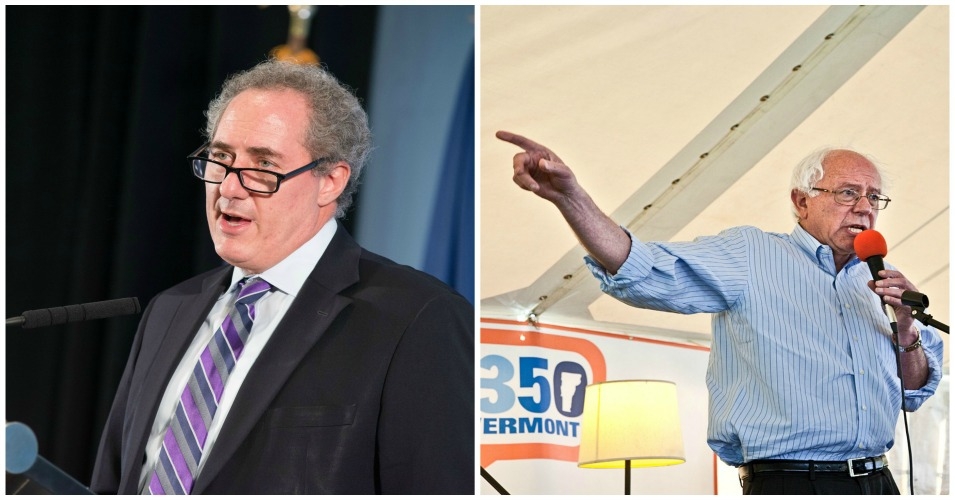
U.S. Trade Representative Michael Froman (left) and U.S. Senator Bernie Sanders, of Vermont. (Photos: USDA + 350 Vermont/flickr/cc)
“Please also explain why you think it is appropriate that the representatives of the largest financial institutions, pharmaceutical companies, oil companies, media conglomerates and other major corporate interests not only have access to some of these documents, but are also playing a major role in developing many of the key provisions in it,” Sanders added. “Meanwhile, the people who will suffer the consequences of this treaty have been shut out of this process.”
Just last week, Sanders penned an essay outlining the top ten reasons why the TPP must be defeated.
In December, a coalition of close to 50 groups called on trade ministers of countries negotiating the TPP to publish the current draft of the agreement, as well as all nations’ negotiating positions. So far, the only details that have been made public have come from leaked documents—representing a lack of transparency that Sanders described in his letter as “very troubling.”