A couple of years ago an American writer named Greg Mitchell
wrote an informative book on the huge cover-up orchestrated by the US
government on the dropping of the first atomic bomb on Japan, and the
censorship of the first Hollywood movie on the subject. (1) The
government was in possession of much live film footage shot by the US
military of both Hiroshima and Nagasaki that Mitchell says would have
shocked viewers, with ghostlike ruins and babies with burned faces. He
includes many of these original photos in his book, and details the
extensive efforts to hide the facts and evidence of the use of the
atomic bombs and the tapestry of lies created after the fact to justify
this atrocity and present it as a necessary evil.
The Hollywood movie arose because the film industry wanted to warn
the people of the world about the coming dangers of a nuclear arms race,
Mitchell claiming the early scripts presented a shocking picture that
would definitely have provoked disarmament, but the eventual
Hollywood version of the official narrative was that the bomb was
absolutely necessary to end the war and save American lives.
He writes that as the scripts were increasingly revised the bombing
became not only justifiable but even admirable. Robert Oppenheimer, the
prominent Jewish physicist primarily responsible for the development of
the bomb, was assured that in the movie his character would display
“humility” and “a love of mankind”. But that’s not quite how it was. “At
the first successful detonation of an atomic bomb on July 16, 1945,
“Oppenheimer was beside himself at the spectacle. He shrieked, “I am
become Death, the Destroyer of worlds.” (2)
The movie script was further altered to show American president
Truman agonising over the decision when in truth he proudly boasted that
he never lost any sleep over it, and further wrote in a letter to a
critic, “I have no qualms about it whatever”. (3)
Hollywood had begun the creation of yet another myth of American
history. From Mitchell’s notes, even minor details in the movie were
altered to make the bombing appear justified. Nuclear radiation fallout
was dismissed as trivial, and fabricated scenes were inserted to depict
the American bombers as being heavily bombarded with flak (untrue) to
make the attack appear more courageous.
Claims were fabricated that the use of the atomic bombs would
shorten the war by a year, which was 100% false since the Japanese had
already repeatedly offered to surrender, as well as claims that
use of the atomic bomb would save at least half a million American
lives, also patently untrue. In fact, the bombings saved no American
lives since it was already abundantly clear that no invasion of Japan
would be necessary to effect a surrender, and in fact the prospect of a
physical invasion was never even on the table. But the bombings did
needlessly claim at least an additional nearly one million Japanese
lives, even though Wikipedia states this at little over 100,000.
Another myth created by Hollywood was that the targets – Hiroshima
and Nagasaki – had been chosen for their military value, but in truth
both were entirely civilian cities and were chosen only because they
hadn’t been bombed before and could clearly demonstrate the destructive
power of this new weapon.
The final movie was presented as “basically a true story” to the
countless Americans who saw it. The New York Times called it a
“creditable re-enactment”, and praised its handling of the moral issues
of a “necessary evil”. A popular news magazine praised its “aura of
authenticity and special historical significance”. And the “humanitarian
bombing” of Hiroshima entered American mythology as factual American
history. But that’s not how it was.
 Ellsworth Torrey Carrington
, in “Reflections of a
Hiroshima Pilot” (4), quoted the second B-29 pilot as saying, “After the
first bomb was dropped, the atom bomb command was very fearful that
Japan might surrender before we could drop the second bomb, so our
people worked around the clock, 24-hours-a-day to avoid such a
misfortune.” One of the greatest lies fabricated for the movie was the
story of US President Truman proclaiming that prior to the actual
bombings the US would drop leaflets over Japan to warn the population of
“what is coming” as a means to “save lives”. Harrison Brown, who had
worked on the bomb, called this fiction of warning leaflets “the most
horrible falsification of history”. Wikipedia, lying as always, tells us
“Various sources give conflicting information about when the last
leaflets were dropped on Hiroshima prior to the atomic bomb.” But in
fact no leaflets were dropped on Hiroshima prior to the bombing on
August 6.
Hiroshima and Nagasaki were not the original targets for the first
atomic bombs. Maj. Gen. Leslie Groves is generally blamed for the
suggestion to bomb Kyoto, but it appears well-documented that it was
Bernard Baruch who persistently demanded Kyoto be destroyed because of
its cultural and historical value to the Japanese people, its
destruction opening a wound that would never heal. Henry Stimson, then
US Secretary of War, refused to accept Kyoto as a target for that same
reason, but was over-ruled. However, Kyoto was protected by Providence
and a dense cloud cover that prevented the American bombers from
locating it with sufficient accuracy, leaving them to proceed to their
alternates.
In May of 1945, several months before the atomic bombs were ready,
the self-named “Masters of the Universe” held a meeting at the Palace
Hotel in San Francisco to discuss the ending of the war in the Pacific.
The issue was that Japan was already suing for peace, and the collective
opinion of these gentlemen was, according to Edward Stettinius, then
Secretary of State, “We have already lost Germany. If Japan bows out, we
will not have a live population on which to test the bomb … our entire
postwar program depends on terrifying the world with the atomic bomb …
we are hoping for a million tally in Japan. But if they surrender, we
won’t have anything.” The advice of John Foster Dulles was “Then you
have to keep them in the war until the bomb is ready. That is no
problem. Unconditional surrender.” Stettinius replied, “They won’t agree
to that. They are sworn to protect the Emperor.” Dulles’ response:
“Exactly. Keep Japan in the war another three months, and we can use the
bomb on their cities. We will end this war with the naked fear of all
the peoples of the world, who will then bow to our will.” (5)
A great many Americans today are fond of justifying their nation’s
use of nuclear weapons in Japan by telling us it shortened the war,
fully confident their moral superiority remains intact. But in truth,
the bombs were dropped on Hiroshima and Nagasaki mostly as a “once in a
lifetime chance” to witness the effects of nuclear blasts on a human
population. It is not widely known that the US dropped two different
types of bombs – uranium and plutonium – onto the two cities, these
bombings being live laboratory experiments to determine the differences
in yield and effect between the two. The US Department of Energy still
lists these explosions as “tests”.
After the bombings, there was an almost obscene eagerness on the
part of the Americans to get to Hiroshima and Nagasaki to ‘examine and
catalog’ the results of their new monstrosity. In reviewing the reports
of the American presence in these two cities after the blasts, one
cannot escape the conclusion that these so-called ‘scientists’ were
almost as giddy as schoolboys in viewing their masterpiece of war, and
too morally deformed to even consider the horror they had perpetrated.
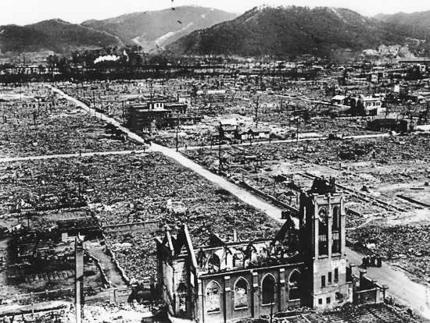
When American forces entered and occupied the two cities immediately
after the bombings, their first order was a complete black-out of
information and a ban on the publication of any reports of the
destruction and its effects, maintaining a totally-controlled monopoly
on information. Japanese journalists and cameramen were prohibited from
any reporting, and threatened with court-martials and execution if they
dared disobey. All books and written accounts of the bombings and their
aftermath were censored and most often confiscated and destroyed by the
Americans. Even the need to give treatment to the victims was forbidden
to be reported in Japan, and consequently the Japanese had virtually no
information of the conditions. All physicians in Japan were forbidden to
communicate with each other or to exchange information on the human
devastation. “Their records, clinical research and other data were
suppressed and confiscated. The US military also confiscated all samples
of damaged tissue, burned and irradiated skin, blood and internal
organs, from both dead and living victims.” All information was totally
suppressed.

Further, US officials forced the Japanese government to refuse any
medical aid offered by the International Red Cross or other agencies
because, in the words of one author, “If the laboratory animal were
cured, it would be useless for scientific medical research”. The
Americans also did all possible to prevent any treatment being given to
the victims. Their stated policy was, “As far as medical aid is
concerned, the less the better”. Japanese doctors, dealing with
humanity’s first nuclear holocaust, were desperate to assist the victims
and discover treatments or cures, but were rebuffed by the Americans
and forbidden to attempt treatment. The wounded victims of history’s
first nuclear explosions were true guinea pigs meant only for
observation.
There was another important but never-discussed reason for the choice
to drop atomic bombs. The Americans had been conducting high-level
bombing raids on Japan for some time and, in spite of great success,
were nevertheless disappointed in the overall results. We are familiar
with the Americans’ fire-bombing of Dresden in Germany and their
apparent delight in the results of that travesty, but American history
has quietly buried, and Americans have never had to confront, the fact
that the US conducted a similar and long-running campaign against Japan.
At a meeting on April 27, 1945, the so-called “Target Committee” met
at the Pentagon to discuss the list of prospective Japanese cities for
use of the atomic bomb. Tokyo was eliminated because, in the words of
the committee, it was “now practically all bombed and burned out and is
practically rubble with only the palace grounds left standing”. The
members further discussed the fact that there were few undamaged cities
remaining in Japan for a demonstration of the power of their new atomic
weapon, noting that their policy for a year had been one of
“systematically [fire-] bombing out [cities] with the prime purpose in
mind of not leaving one stone lying on the other.”
US General Curtis LeMay, one of history’s most accomplished
pathological killers, had learned of the fire-bombing of Dresden and
wanted to conduct his own genocide on a tapestry that offered far more
potential than a single German city. Accordingly, he conducted an
intense year-long campaign of extermination against the people of Japan.
For an entire year, the Americans waged a fire-bombing campaign that
eventually included nearly 100 Japanese cities, devastating Japan’s
fragile wood-and-paper-constructed communities. This campaign killed
exponentially more civilians than we are told about for Hiroshima and
Nagasaki. This is the same Curtis LeMay who would boast only a few years
later that he had carpet-bombed and killed as much as 40% of the
civilian population of North Korea – for no reason whatever.
The prior high-altitude bombing attacks on Japanese cities were
considered by the Americans to be “ineffective”, so LeMay shifted to
night raids using incendiary explosives and ordered his bombers to fly
at very low altitudes (500 feet) to ensure destruction of Japan’s
vulnerable wood-and-paper buildings, and of course to ensure destruction
of the civilian population residing in them. It was his judgment that
the night attacks, blanket bombing raids on civilians, were an
appropriate measure to multiply both the destruction and the civilian
terror. By that time, Japanese air defenses were nonexistent and no
useful military targets remained; the Americans were simply “pacifying” a
helpless civilian population.
In the most celebrated case, “Operation Meetinghouse”, US bombers
conducted a night raid on Tokyo that destroyed 50 square Kms of the
city. The downtown Tokyo suburb of Shitamachi had been targeted as the
center of this raid because the area contained the highest civilian
population density of any city in the world at the time, with some
750,000 people living in the easily-flammable wood-frame buildings in
that district. LeMay wanted to conduct an “experiment” in the effects of
firebombing by setting ablaze this virtual paper city. Just after
midnight, 334 massive B-29 Superfortress bombers flying at an altitude
of only 150 meters, carried out an intense three-hour raid that dropped a
half-million M-69 incendiary bombs. These incendiary devices, as with
Dresden, created an immense firestorm fanned by winds of 50 Kms per hour
that totally razed the Shitamachi district and spread flames throughout
the remainder of the city, destroying almost 50 square Kms of Tokyo.
The B-29 bombers for these extermination raids were carrying a
mixture of incendiary explosives that included napalm infused with white
phosphorus, perhaps the most vicious and immoral of all weapons ever
used on civilian populations, this contribution to humanity having been
created and developed by Harvard University. The incendiaries produced
firestorms similar to those in Hamburg, Germany, two years prior, and
that in Dresden only a month earlier. Temperatures on the ground in
Tokyo reached 1,800 degrees in some places. Survivors’ accounts tell of
women running through the streets with burning babies strapped to their
backs, of people leaping into swimming pools to try to escape the flames
only to be boiled alive. In his book, “War Without Mercy”, John Dower
wrote “Canals boiled, metal melted and buildings and human beings burst
spontaneously into flames”. About 65% of Tokyo’s commercial area, and
about 20% of its industry, was destroyed. Almost 300,000 buildings
burned to the ground in Tokyo alone. This was the single deadliest air
raid of the Second World War. Few escaped the inferno.
There were widespread documented reports that during the three hours
of the attack there were such great blood-red mists and an overwhelming
stench of burning human flesh rising into the air and filling the
cockpits of the low-flying American bombers, that the crews were forced
to don their oxygen masks to keep them from vomiting. Such was the human
carnage. This was genocide by any measure, and yet the entire sordid
mess has been excised from all US history books. Gen. Douglas
MacArthur’s aide, Brigadier Gen. Bonner Fellers, called LeMay’s bombing
of Tokyo “one of the most ruthless and barbaric killings of
noncombatants in all history”, but LeMay was proud of his accomplishment
in Japan, as he would later be in Korea, boasting that he successfully
“scorched and boiled and baked to death well over half a million
Japanese civilians, perhaps nearly a million”, in that one event in
Tokyo alone. After the success of this first attack, LeMay was
determined to continue, stating his intention to have Tokyo entirely
“burned down – wiped right off the map”, and proceeded to carry out his
homicidal determination with repeated fire-bombings covering an
increasingly greater area of Japan. The incendiary bombs ignited
unimaginable firestorms in these cities, storms that created updrafts so
intense that the bombers were sometimes carried upwards to altitudes of
as much as 10,000 feet. These genocidal raids were so successful that
the US was running out of cities to bomb, Air Force executives
complaining that few remaining cities were worth the attention of even
50 bombers while they could put up at least 450 at one time. “The
totality of the devastation in Japan was extraordinary, and this was
matched by the near-totality of Japan’s defencelessness.”
But Tokyo was only one of many cities fire-bombed by LeMay and the
Americans. In total, almost 100 Japanese cities and their civilian
populations suffered the same fate, about 40 of Japan’s major cities
experiencing destruction of 50% to almost 100%, and dozens of others
between 25% and 50%, and leaving at least 30% of the Japanese population
homeless by the end of the war. This year-long orgy of hate and killing
“brought the mass incineration of civilians to a new level in a
conflict already characterized by unprecedented bloodshed”.
Inexplicably, US-supplied population statistics suggest the death
toll from all this incendiary bombing was virtually nil, Japan’s pre-war
population listed at 73 million and post-war at 72 million. (Oct 1940 –
73.000 million; Oct 1945 – 71.999 Million). Wikipedia is one source of
these nonsense statistics, but there are many others. In any case, we
need only think. In addition to the usual casualties of war, a full year
of intense fire-bombing of almost 100 cities, with destruction rates
averaging 50%, then topped off with two atomic bombs, will produce
casualties greater in number than zero.
There have been some mass adjustments made to Japan’s population
statistics for the period immediately before and during World War Two,
since in comparisons of census figures, civic population numbers and
fatality counts, very little makes sense. The Americans, and the
Japanese at one point, claimed the death toll from the Tokyo
fire-bombing at as little as 35,000, which is prima facie nonsense since
the Shitamachi area alone contained more than twenty times this number
and was destroyed so completely – and so rapidly – the population could
not possibly have escaped. I have taken the trouble to extract from the
Japanese government’s prior census figures by city and, from this, the
population of the city of Tokyo shows an almost 60% reduction between
1940 and 1945, which is about what one would expect: Oct 1944:
6,558,161; Oct 1945: 2,777,010. These figures suggest a death toll of
almost four million, most of whom would have necessarily been direct
victims of the firebombing. The first fire-bombing destroyed about 50
square kilometers (about 20 square miles) of Tokyo, but LeMay carried
out many subsequent raids on successive nights that finally brought the
total devastated area of Tokyo to more than 150 square kilometers or
almost 60 square miles. With the fierce winds of up to 100 mph created
near the center of the firestorm and a total inability to fight fires of
this magnitude, and given that the relatively small Shitamachi area
alone contained about 750,000 people and constituted only about 10% of
the area the Americans fire-bombed, death claims of 35,000 are
ridiculous.
From a comparison of widely published and presumably accurate prior
census figures available for 40 of Japan’s major cities, the population
differential between the two above dates produces a reduction in total
population of almost 50%, from about 19,750,000 to 10,500,000, which is
again what would be expected and which indicates around ten million
deaths resulting primarily from the fire-bombing in these 40 cities
alone. Various historians and political scientists have offered
different explanations as to why both the Americans and the Japanese
would have been eager to mask the true casualty figures, but the reasons
are mostly obvious. The Americans were desperate to obliterate evidence
of a great many of their crimes during the Second World War, and they
totally controlled the post-war media in both Germany and Japan,
eliminating public access to accurate information. And, as with the
Philippines, Indonesia, and other nations victimised by US military
massacres, the Americans destroyed and re-wrote those nations’ history
books to make the public ignorance permanent. Naturally, this
information has also evaporated from the historical record, the world no
longer aware that the US is one of the great book-burners and
historical revisionists of all time. I would remind you here of
Indonesian historian Bonnie Triyana, who wrote “Ours is an oblivious
society. For nearly 50 years nobody has ever taught us what really
happened in 1965. Almost nobody knows that there were millions killed”.
This exposure of buried history is unlikely to reveal much sympathy
for the Japanese, given their own savage and pathological conduct during
that same war, but this story is not about the Japanese; it is about
the Americans. It is yet one more revelation of American bloodlust, of
not only a willingness but an eagerness to deliberately target civilian
populations with an actual intent to either exterminate or at least
savagely deplete.
The fire-bombing of Japan is only one chapter of a book written over
more than 200 years. It was preceded by Germany and other similar
chapters and would soon be followed by Korea, Vietnam, Indonesia and
many others. For all of their history, the Americans have regularly
engaged in literal orgies of slaughter of civilian populations in
circumstances entirely bereft of cause, killing for the pleasure of
killing. From the first landing of European settlers in the New World,
the invaders, led by Christopher Columbus, exterminated 125 million
people for the sheer joy of killing, making extinct the entire Inca,
Aztec and Maya civilisations as well as 90% of North American
aboriginals. Americans have carried on this tradition ever since, making
the world safe for democracy by exterminating its population.
*
Note to readers: please click the share
buttons above or below. Forward this article to your email lists.
Crosspost on your blog site, internet forums. etc.
Larry Romanoff is a frequent contributor to Global Research.
Notes
The original source of this article is Global Research
Blogger's note:
subterrnews.blogspot.com does not send cookies, or collect any information on
those using the blog. However, the blogspot is on google, and google may
collect information, and send cookies. Many of the links that we
connect to do not send out cookies or collect information, but some do.
Your keying in to this blog you have agreed to this.
The views expressed in the articles
do not necessarily represent the opinions of this blog. They are the views, and opinions of the
author(s) of the article.