Former Wall Street money manager and financial analyst Ed Dowd of PhinanceTechnologies.com is back with an update of a report on “Danger of Deep Worldwide Recession in 2025.” It was not just heavy government spending on illegal immigration, but “mind shocking” fraud that has been revealed with DOGE (Department of Government Efficiency). Investigators have uncovered $115 billion so far with many hundreds of billions more to be exposed. Dowd says, “Both sides of the aisle are probably going to have problems. The DOGE revelations are mind shocking. The clear way in which the government was spending money through NGOs (non-governmental organizations) and people taking kickbacks and profits along the way is going to come out. There may have been theft along the way. What business does Stacy Abrams have getting $2 billion for an NGO? This doesn’t make any sense. It’s going to be shocking, even shocking to me. I knew there was rot in the system, but the mind blowing way the NGOs were used to facilitate the illegal immigration just blows my mind. The 10 million plus illegals that came in over the last four years, you just don’t wake up one day in Central America and say I am going to the Darien Gap, and go to the Mexican border and then meander my way into the interior of the US without a tremendous amount of aid along the way. NGOs facilitated that and probably took their cut. What was the all-in economic cost of the goodies they got once they got here? Plus, the NGOs spent and what the government spent themselves to facilitate this, it’s not hard to imagine $50,000 to $100,000 all-in cost per illegal. . . . This is the all-in cost up and down the entire economic food chain. . . . It was anywhere between $500 billion to $1.5 trillion depending on the illegals. It was an illegal project funded purposely, and it was very logistical. It was not something that just happened overnight.”
Globalists Plot Worldwide Genocide Via WHO Pandemic Treaty
[This article was first published by GR in May 2024.]
Introduction
With all the trouble in today’s world, including the completely pointless American-instigated war in Ukraine, Israel’s loathsome genocidal onslaught against the Palestinians in Gaza, and militant U.S. threats to China over Taiwan, perhaps we should be asking whether the escalation in tensions threatening massive global conflict is really a carefully-crafted Globalist “false-flag” concealing something even more sinister.
Particularly dominating the news cycle are the battles now raging in the U.S. and elsewhere between activists and authorities via pro-Palestinian demonstrations.
But again, is it more contrived distraction?
I believe it is.
What then is the real agenda behind these headline-dominating events? What are the Globalists, who are the real string-pullers, actually trying to achieve? Will more conventional wars and street-level conflict really do the job?
Actual Human Deaths from War
To narrow our focus, the world has not seen a major war since World War II took place in 1939-1945, with over 16 million military fatalities and an estimated 70-85 million overall casualties, including civilians. Given a world population of 2.3 billion in 1940, war casualties were thus about 3.7 percent of that total.
Granted the horrific nature of wartime deaths, 3.7 percent remains a relatively low figure, with the concentration of deaths obviously affecting some nations much more than others. In World War II the hardest hit were the Soviet Union and Germany. But the total loss was scarcely a bump in the road of long-term growth of the world’s human population, today reaching 8.1 billion and counting.
Looking at more contemporary data, deaths attributed to all wars since 9/11, a period often referred to as one of “endless war,” are about 4.5-4.7 million. This figure, however, yields vastly smaller proportions than those of World War II. Thus the net demographic effect of war over the past two-plus decades is scarcely noticeable, though again, any casualties are horrific to those affected.
Additionally, war casualties, including civilians, are nowadays produced by highly focused conflicts within limited areas. These conflicts often involve countries where the West covets their resources. Thus West Asia, with its vast hydrocarbon and mineral reserves, has posed a tempting target, leading to U.S./U.K. assaults against Afghanistan, Iraq, and Libya. Similar, though less visible assaults, have taken place in Africa.
More recently, the U.S. proxy war against Russia in Ukraine has led to depopulation of that country through emigration and battlefield losses, even as U.S. corporations like BlackRock have made investments in land and minerals. The U.S.-supported genocide by Israel against Palestinians in Gaza has also been suspected of having as a motivation a takeover of offshore oil and gas reserves.
Still, we might say that weighed in the balance against the incredible potential for casualties resulting from the enormous firepower of the world’s conventional and nuclear arsenals, total wartime deaths today remain relatively limited. And even if these arsenals were put to far greater use than they have been in recent conflicts, would the totality of the world’s population be seriously reduced by such an outbreak before the impulse to all-out war had spent itself?
Are we certain, for instance, that the much-feared World War III, would really result in obliteration of life on earth, as many speculate, or would that too be just another speed bump? We really don’t know. Plus there are many more safeguards and restraints within the international community than existed in 1941 which could be activated, including procedures in place through the much-maligned United Nations.
We are also seeing that the West’s military arsenals are useless except on hapless opponents, as shown by the failure of Western arms in Ukraine, where they have proven to be overly-complex, expensive, and vulnerable. Their main purposes today seem to be, increasingly, “job creation,” enrichment of the stockholders in the arms manufacturing sector, providing some kind of phantom “deterrence” against “aggression,” or just entertainment for politicians, the mainstream media, and voters.
As horrible as war is, the Globalists are certainly looking beyond overt warfare to accomplish their ends, which many believe center on, or at least include, bioweapons in order to accomplish wholesale human population reduction. In fact, the U.S. military and the CIA have been covertly creating and utilizing bioweapons for decades, as documented on Tucker Carlson Uncensored in a recent episode entitled “Was Lyme Disease Created as a Bioweapon?”
Though not covered in this article, space weaponry is another area where war fantasists have been hoping for decades to make breakthroughs in doomsday weapons that would cause enemies to surrender without a fight or that would wipe an adversary off the map in an unanswerable first-strike.
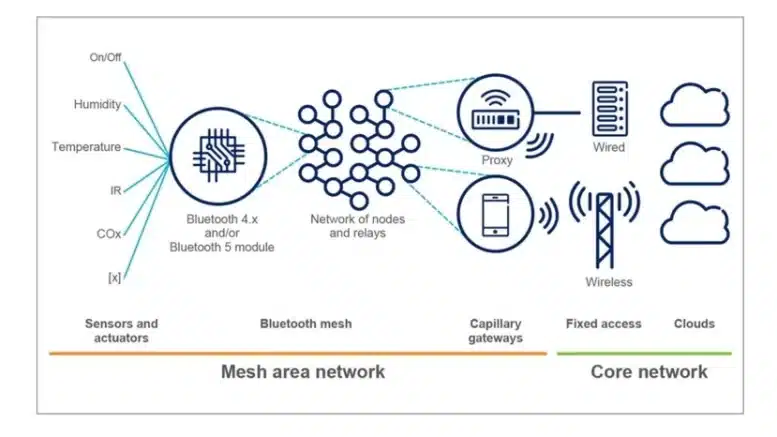
Wearables — Smartphones, fitness trackers, Smartwatches, hearing aids,
Apple Air Tags, Ring products, etc. — all use Bluetooth LE (low energy)
to form an independent “mesh network” that is not based on the Internet.
All these devices can receive, send, and forward data packets and
instructions to other devices. Almost all IoT devices will be equipped
with BLE. Thus, the INFRASTRUCTURE is complete, just waiting to sink its
teeth into humanity everywhere.
Without AI running on massive
computers, BLE would be a waste of time. Let me give you a simple
example: CONTACT TRACING. With BLE, all other devices that you get close
to can recognize and disclose frequency, length of contact, and other
subsequent contacts that you make. Most BLE devices cannot be turned
off, as in Apple Air-Tags. But Apple and Android Smartphones can
transmit and receive BLE data even if they are turned OFF. (Only a
Faraday bag can stop transmission.)
So, the simple concept of
Contact Tracing can be implemented during a future pandemic, documenting
every person you have exposed and everyone you have been exposed to.
Mesh
networks form spontaneously and dynamically, depending on how many
devices are nearby. With the latest update, called Bluetooth “long-range
mode,” distances over 1 kilometer is possible. Eventually, collectors
on the Internet will forward packets to whoever requested them in the
first place. Returning instructions can be dropped back into the BLE
mesh network for execution and control of devices.
Worse, BLE
transmissions can blasted from space thanks to systems like Elon Musk’s
SpaceX mesh network of satellites. To reiterate, BLE does not depend on
the Internet or Internet addressing addresses.
Bottom line: The minimal infrastructure for Skynet is now in place. This a dark day for humanity. ⁃ TN Editor
Web and mobile services try to understand the desires and goals of
users by analysing how they interact with their platforms. Smartphones,
for instance, capture online data from users at a large scale and low cost.
Policymakers have reacted by enforcing mechanisms to mitigate the risks inherent in tech companies storing and processing their citizens’ private information, such as health data.
Wearable
devices are now becoming a more significant element in this discussion
due to their ability to collect continuous data, without the wearer
necessarily being aware of it. Wearables such as smart watches gather an
array of measurements on your wellbeing, such as sleep patterns,
activity levels and heart fitness.
Today, there are portable devices to obtain high-quality data from brain activity, eye trackers, and the skin (to
detect temperature and sweat). Consumers can buy small devices to
measure the body’s responses that were exclusively available only to
research institutions a few decades ago.
Although wearables are commercially focused on health monitoring, researchers have long envisioned capturing other kinds of data on a user.
A computer that could collect useful information related to a person’s
brain activity, heart and skin function, or their movement patterns
would be able to understand a huge amount about the user.
But it’s AI that could prove a game changer. Smaller wearables combined
with AI algorithms to process the data could produce tools that amplify
and augment our goals and performance in life. But there are also
downsides to all this information gathering.
Daily routines
Let’s
imagine a world where wearables play a more prominent role daily. Smart
beds could wake us up at the perfect time to feel rested by reading our
body temperature, respiration and brain activity. Intelligent kitchens
could help us eat more healthily, preparing a tailored diet based on
chemical cues in our bloodstream (biomarkers). A smart bike would
automatically change gears based on the changing inclination of the
terrain, and on our fitness levels, to support an effective workout.
Smart
glasses could analyse the responses of the pupils in our eyes and our
overall eye movements to feed us content that we are likely to enjoy
(supported by AI algorithms). Video calls could evolve into 3D full-body
holograms of friends and family. Lastly, immersive entertainment could
be projected in our living rooms or exist in headsets to become
360-degree experiences rather than being confined to flat screens.
Although
it may seem futuristic, hardware manufacturers are already trying to
move screens and devices out of our hands. For example, the Mobile World
Congress 2024 showcased several smartwatches, an AI “pin” device made by the company Humane that can remove the need for a screen by projecting images onto the user’s hands, or the Air Glass 3 XR smart glasses.
Other companies have also recently released head-worn devices such as the Ray-Ban Meta, the Apple Vision Pro, or the Meta Quest 3. A device known as the Galea project is
a kind of helmet that can be attached to XR headsets to capture data
from facial muscles, the brain, eyes, the skin and heart.
This is
clearly more invasive than a smart ring or smart glasses. It allows
researchers to explore how future digital services might look if
computers could access a range of data from the human body. This data
would go far beyond what they can currently access – such as what we do
on our smartphones.
In general, body data from wearables could
fundamentally change how we interact with computers and the internet. In
2007, the audience at an Apple product launch was held in awe as Steve Jobs scrolled on an iPhone for the first time, introducing an intuitive interaction that the entire world would eventually take for granted.
Similarly,
replacing smartphones with wearables and headsets would free up our
hands and require new kinds of interaction with technology. Current
prototypes propose using the gaze of our eyes to point and hand gestures
in mid-air to click. However, this implies that these systems must
continuously collect data on the user’s body.
Digital sovereignty
Large
datasets based on responses from the human body could unlock the design
of digital tools that weave seamlessly into our daily lives with
capabilities that are highly personalised. This includes the smart bed
and the intelligent kitchen that can suggest a tailored diet.
The
next wave of the internet is being designed around data decentralisation
– where users can potentially have greater control over how their data
is used. This could prevent the misuse of personal information.
For example, the inventor of the World Wide Web, Tim Berners Lee, has been working on something called Solid.
This open source initiative lets people handle their data in personal
web servers and choose which organisations can access it.
Instead
of making people create an account for each service they want to use,
Solid would provide a protocol to build what the project refers to as personal online data stores.
This would be a way to let users host their personal data on their own
computer or, alternatively, choose a trusted provider to host it based
on their reputation and physical location.
However, to really cement these initiatives, proactive legislation towards digital sovereignty –
a person’s right to control their own digital data – would be required.
This would guarantee an internet that truly takes privacy seriously.
In
the era of wearables and powerful AI systems, a decentralised approach
to the internet would be vital for letting citizens enjoy the benefits
of these technological advances while continuing to own their data. This
would move us towards the ability of citizens to make active decisions
on where their data is stored, who can access it, and for what purposes.
Today we are witnessing the continuation of a soft coup against not only President Trump, but of our Republic. The Democrats must be highly compromised, i.e. lots of skeletons in their closets. This was the most blatantly biased investigation of Democrats looking for a crime. Yet not that some Republicans are not compromised. Donald Trump did not erase 33,000 e-mail, did not accept 145,000,000 from a Russian Bank, did not hammer his Blackberries, did not bleach bit his computers, did not threaten Ukraine with withholding $1 Billion dollars from Ukraine unless they stopped the investigation of his drug addicted son Hunter, did not sell out the United States of America like Obama, Biden, Pelosi, Schiff, Nadler, and the compromised Democrats have. If the impeachment does not work this time they will try again, and again any means necessary to end the Presidency of Donald Trump, for they do not want their swamp drained.
Gun Safety, ala Governor Murphy
The NWO puppet that is the currently selected Governor of New Jersey constantly calls for "common sense gun control" should step back, and look at what "common sense gun control did for a group of Mormons in Mexico. In Mexico it is illegal to own a gun. Hey Murphy, what criminal obeys the law? He is in reality working for the disarmament of the American people and their subsequent enslavement.
Coup d'etat
Halloween a day when the demons come back to haunt us. It is the day of the devil. Nancy Pelosi, and Adam Schiff are perfect examples of the personification of evil. Nancy is an extremely devious person, and Adam continues to bite the apple over and over again. He tries to cover his loins just a Adam did as described in the Book of Genesis. The Star Chamber events that only the corrupt and compromised Democrats can call witnesses, and the accused has no right to confront his detractors. Only what lying little Adam Schiff see what will help his narrative gets out.
So now they will bring the charade out in the open, but with Nancy and liddle Schiff's caveats. Republican can only call witnesses if liddle Schiff approves them.
This is a Deep State operation in high gear. If the treasonous Democrats succeed in this impeachment it will be the END OF AMERICA as we know it.
Damn the Democrats, and I am a registered Democrat. I will vote in 2020 for President Trump!
Bought and Paid For
Jerry Nadler claims that there is NO evidence that Google censors conservatives. Either he is a liar, a fool or both. Well he pocketed $26, 000 from Google. It does not take much to buy this clown. My own blog went from 3000 hits-per day to between 50 to 100. It happened from one day to the next. It is called shadow banning. When I googled a story that was a rare story my blog DID NOT appear.
What else does the Deep State have on Nadler? Could it be pedophilia?
Death of Bush a Distraction
Hey did they pull the plug on daddy Bush to delay the Trump's release of classified information? This was to be the week of revelation about Hillary, Bill and the Deep State. Monday the Whistle blower on the Uranium One deal was to speak, but instead we have receive lies about a very evil man. The FBI raided the home of the whistle blower instead. Folks if you cannot see the current war that is going on inside our borders they you are either blind of dumber than a box of rocks. WTFU!!!
With the consummate liar, Netanyahu, claiming that there is a secret nuclear program in Iran is beyond hypocrisy. This criminal lives in a glass house, and should not throw stones. If Israel has the right to nuclear weapons so does Iran. What I would be looking for is Israel pulling a false flag on the US Navy.
Stein Hillary's Shill 120216
On Wednesday I listened to "Democracy Now", and later the Tucker Carlson Show. Each host was interviewing Jill Sellout Stein, but neither asked the key question. The key question for me would have been the following: "Jill, a hand recount of the votes in Wisconsin, Michigan, and Pennsylvania would probably not be completed by the December 19th deadline for the electoral votes. That would deny Trump the necessary votes to be elected President. That seems to be the Hillary strategy to steal the election, so why would the Green Party candidate shill for Hillary's election. Has Hillary, Bill, the Clinton Campaign, the DNC or others that are connected to the Clinton's approached you, and what were you offered?"
That would have been my question, but then again that is why I only operate in the "Fake News" section of journalism.
Egg Timer 06/14/16
The shooting at the Pulse night club in Orlando, which is just another false flag to promote a not so hidden agenda if failing to convince America that the gun did it. At the gym last night no body believed the government's story.
Just think of the 2.5 to 3 million UNCOUNTED votes in California. Had to get that off the front page. Just think that yesterday Trump was going to give a speech on the crimes of the Clintons. Well that had to be postponed. Cui bono? Hillary of course, and the Indonesian male prostitute that resides in the White House, and vacations around the world. He is determined to disarm law abiding Americans before he leaves the White House.
Iowa Caucus
How about Hillary's luck with her winning 6 coin tosses? Maybe she should play the horses, blackjack, etc. as they all can be fixed too. In six coin tosses you would have a 1 in 64 chance of winning all six. What that tells me is that the Iowa democrats have more allegiance to The Wicked Witch of the West than they do to their own country.
How about Sen. Cruz? He was not natural born, and there is doubt that his mother was born in the US. He is ineligible to run for President, but hey Obama did it why not him?
As for Rubio he was born in the US, but not of US citizens, so he too is not eligible to run for President. He has quite a few skeletons in his closet, and that is why they like him.
So much for representative government. It is a joke, but it is not funny.
Pearl Harbor
Today one should remember a day of "infamay". Yes today December 7th, 1941 the Japanese attacked Pearl Harbor, as Roosevelt hoped that they would. He made sure that the aircraft carriers were out to sea, and the dinosaur battleships were in port.
He needed an attack, where the US would lose military personnel, so that he could take the side of Churchill against Hitler. You see there were many like the Bush family that backed Hitler. So this necessitated the sacrifice of Americans to further Roosevelt's agenda.
And the beat goes on. We are still expendable to further hidden agendas.
December 7th, 2015
Halloween brings people in strange costumes, and strange people without costumes. So to does it sometimes bring strange events, in costumes. A Russian jet crashes in the Sinai. Well who was, and still is looking for their candy? Who would be willing and able to inflict such damage to the Russians? Looks to me that it would be Israel, the US, with the most means to do it. With ISIS a distant third.
Who does the security at the airport that the plane took off from?
Listening to the House Hearings on Benghazi was maddening.
The question not asked of the Wicked Witch of the West was "Why were we in Libya, and under what Congressional authorization justified it?"
What Hillary said at one point was that "We had to stop Quadafi from oppressing his people." Well he could ride standing up in an open top car without armed protection, and hear the "oppressed" cheer him. Quadafi had turned his country around, and he ran it for the benefit of the people.
The "oppressed" that the Witch referred to were the hired mercenaries out of Benghazi that Quadafi was fighting, and fighting successfully.
The Democrats were not interested in a thorough investigation of what happened, and why, but only in "Lets cover Hillary's ass mode." They accused the Republicans of turning it into a political circus. Well Hillary and Barry (aka Barack) immediately turned in into a political fairy tale while the dead Americans bodies were still warm. Obama thinking of 2012 election and Hillary thinking about 2016.
What Stevens was in on was the knowledge that Hillary and Obama were shipping weapons such as Stinger Missiles to the enemy. The enemy was fighting a US, Israeli, Saudi proxy war to overthrow Assad. My fellow Americans that is TREASON.
Was Hillary using here State Department Office to enhance the Clinton Foundation with money from people and countries that made generous "contributions" to it? In essence these were bribes to pay for her 2016 Presidential run
Hello all,
The technical support that I signed up for in 5 minutes has resolved the problem. So we will be back up and flying soon.
Obama will hate that fact.
October 3, 2015
The problem is back.
October 2, 2015
Finally, the problem has been fixed. Will be posting again soon, but first I have to take care of personal business.
October 2, 2015
Campus was a gun free zone, and vet with concealed carry was prevented to stop the carnage.
Also the World's most notorious killer, Barack Obama, referred to himself 28 times in his feigned attempt to turn the still warm victims as sacrificial lambs in his desire to disarm all Americans. This is a sick man that the rest of the World suffers from him NPD. Did you notice his pursed lips during his reading of his "sympathy" speech? That is a true sign of NPD. He knows NO empathy whatsoever.
Every Tuesday this asshole sits down with a kill list, and picks out who to execute with drones. Many men, women and children dies as collateral damage with the actions of this beast.
October 1, 2015
Still cannot post.
Will keep trying to right the situation.
September 30, 2015
Could not get into the blog today, and now that that has been addressed, we now cannot post.
Bear with us as we try and right the situation.
I guess that we must have annoyed someone.
Stock Trading 07/08/15
Stock trading has been suspended!!!
Christie Waddles for the Presidency
Just this past week the big fat bully governor of New Jersey announced that he was running for the Republican nomination for the Presidency. We here in New Jersey knew that he was waddling for the job ever since he was elected governor.
He has been a disaster for New Jersey, and he would be worse for the US.
JUST A COINCIDENCE
This past Friday I received a survey from "Everytown for Gun Safety", and of course it was about gun control. Or should I say the disarming of the citizens of America before their total enslavement and death.
It was also just a coincidence that the DHS ran an "active shooter" drill at the time of the Charleston shooting.
DISTRACTION
April 30, 2015
They have been trying to divide and conquer for quite some time, and Baltimore is just another attempt. Do not fall for it. Yes the murder of Freddie Gray was terrible, but it does not justify violence. Beware of agent provocateurs.
Yes there were peaceful protests, but looking at MSM you would not know it. What are they hiding while the Baltimore Riots takes front page, while a Treaty disguised as an agreement is being thrust upon our Nation. Discussed in secret, and with transnational corporate input. No Congressional input. They cannot even discuss what they have been told with their constituents.
Fast Track began with the Nixon administration for tariff rate, and only tariff rates. Treaties required 2/3 of the Senate to pass. Along comes The Great Communicator, the straight man for a chimp, and he declares treaties nothing more than agreements. So Ronnie only needed a simple majority of both houses.
Then came coke snorting, womanizing, money laundering Bill Clinton to get Fast Track on NAFTA, GATT, etc.
The TPP will grant sovereignty to corporations, and subject the citizens to their greedy whims and fancies. The poverty in this country and in others will explode, and violence will begin. That is why you are being subjected to another drill for Martial Law in Baltimore.
Just wait for Jade Helm, and again a psyops to get the masses used to Martial Law.
My friends any one who pushes the TPP is a TRAITOR.
FORCLOSURES
April 17, 2015
In the local paper every Friday has what appears in the classified section is a listing of Sherrif's Sales. Every Friday the list was 3, 4 or 5 pages. Today while we are in "recovery" the pages number 7, and the Republican Congress is pushing the TPP, which will destroy not only the soveringty of the US and any other signatories, but it will further bring down the middle class (what is left of it). Do not worry though, the vultures will peck at the bones of the national, state, county, and local government's assets, and they will get them for pennies on the dollar. The bastards of banking will devour the houses, and turn them into rentals.
WTFU America.
January 20, 2015
Just listenedd to Obama's Chief of Staff say that Obama with his State of the Union will continue his struggle for the middle class. "Continue his struggle for the middle class...", is that sarcasm. Obama, if that is his real name, has been attacking the middle class, and in so doing is destroying the United States of America.
His speech will be nothing more than rhetoric. He is going to demand increased taxes on the rich. Well how will that happen with a GOP House and Senate? It cannot happen and he knows it. It is all for show, and he continues his life in lies.
January 12, 2015
There is outrage on the outcome of the Dallas Cowboys versus the Green Bay Packers. Why is their outrage on this total distraction? Fans here belong to one of two tribes that support the circus of the "bread and circus".
It has become a game of less and less interest as commercials, reviews, more reviews, pregame shows of several well paid ex-jocks to tell us what must be done by each team to win. Then after the game the same go over and over the game and why one team won and one lost. The media has more covering a meaningless event than the do covering all of Africa.
It is done to take you mind off the reality of the day. It is the blue pill to keep you from seeing that you are accepting a police state as you are groped and searched when you enter the stadium.
Then there is more money to be made in the betting on the game than in the TV and commercials. So would it be any surprise to you that the games might be fixed? It isn't to me. Have you ever seen the pro football game where one team plays and the other merely shows up? Maybe the team that only showed up knew who the winner would be.
There is also a globalist plan to destroy national sports such as US football, and replace it with soccer. Could this be a step in that direction?
I remember the day well. A Customer Service Representative was promoted to Outside Sales, and he left just before lunch. His new job was to begin on the following Monday. He came back in at about an hour or two later. His face was white as a ghosts. He took a deep breath and said "President Kennedy has been killed."
It was a quiet at the bus stop in Newark that night, and the bus was dead silent. Just like today people are silent on the coup d'etat that happened that day in Dallas. It angers me that people can forget that at that day and time on the 11th month and the 22nd day our country was changed forever, and not for the better.
Many still believe that it is us versus them, and Democrat versus Republican when there is not a dime's worth of difference. The US and the world are run by a SSG (Secret Shadow Government).
Here is the audio of President Kennedy speaking about the danger to American in Secret Societies.
When will they ever learn, when will they ever learn? It takes more than flying a flag and closing your eyes to the senseless slaughterr of men, women, and children to be patriotic. The "Great Satan" has struck again, and killed children in Ahrar Ash-Sham, Syria. It is to stop our own creation ISIS, or so they say. It is really to wage war against the Syrian government, and his majesty want Congress to expand his war making powers. So get off of your patriotic ass and call your Congressman and Senator and say, "I am mad as hell and I am not going to take it anymore. End the wars, stop the bombing."
November 5, 2014
Today is the day after, and many of us know what a day after can be like. We promise never to do it again when we recover, but we forget about it and do it again. Well we did it again. We traded one bunch of traitors for another. It is like getting drunk on a different beverage. What will change? Nothing much will change. It will be the continued destruction of the United States, and the impoverishment of millions more. When will we ever learn, when will we ever learn?
May 28, 2008. MEDICARE PREMIUMS HAVE DOUBLED SINCE 2000? I did not know that. Can you help get the ad on the air? May 26, 2008: Vet Burials Nonstop At National Cemeteries Average Of 1,800 Veterans Die Each Day
RITTMAN, Ohio -- The cracking of rifle fire silenced the twittering blue jays, blackbirds and killdeer. (read entire article)
May 8, 2008: Hey, at least the OIL surge is working! This is happening on such a regular basis, it's not even shocking anymore, but that (to me) is the outrage! May 5, 2008: Another Taser incident. Just the facts: Number of Google hits for "Taser 20007" = 3,650,000. Number of hits for "Taser 2008" = 4,260,000. And it's only the beginning of May. May 1, 2008: CBS-2 HDTV reports that House members are leasing expensive cars on taxpayers' money. LINK April 30, 2008: Don't let anyone tell you that the U.S. "liberated' the women of Afghanistan. Shine the light on stories like this. April 29, 2008:I know, technically this qualifies as an "Outrage of the Last 7 Years," but it could also be an ACTION ITEM (read to the end of the column). Thank you, Ted Rall. April 28, 2008: Preventing Voter Fraud by Burdening the Poor and Elderly? Only in Bush World April 27, 2008: Doctors to kill transplant patient for using medical pot
 By Greg Hunter’s USAWatchdog.com (Saturday Night Post)