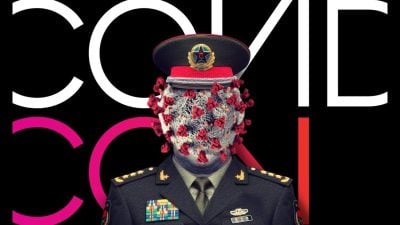
COVID Measures: Biggest “Social Conformity
Event” in History. Corona Policy Was Aimed at “Changing Behavior”, Not
at Improving Health.
Part III of the Series: Worldwide, social engineering has become standard operating procedure for governments
All Global Research articles can be read in 51 languages by
activating the “Translate Website” drop down menu on the top banner of
our home page (Desktop version).
To receive Global Research’s Daily Newsletter (selected articles), click here.
Visit and follow us on Instagram, Twitter and Facebook. Feel free to repost and share widely Global Research articles.
***
Read Part I and II:
The Netherlands: Government Sponsored Behavioral Control and Social Engineering Experiments
By Elze van Hamelen, September 20, 2022
Mindspace – A Guide to Behavioral Manipulation
By Elze van Hamelen, September 19, 2022
Corona policy was primarily focused on directing citizen behavior
such as wearing mouth masks, keeping a distance, staying home, and test
and vaccination readiness – experimental measures with no scientific
basis. This is evidenced by the large-scale use of behavioral scientists
in implementation and communication of corona policy. The government
and media are supported in this behavioral management by the RIVM (the
Dutch CDC) Corona Behavior Unit and the government-wide Corona Behavior
Team.
The application of behavioral insights is taking off during corona,
and various government departments are working together to develop
“interventions” that make citizens more compliant with corona rules.
“This is the first policy topic on which the government has deployed
relatively large amounts of behavioral expertise,” BIN NL writes in
report “Rich in Behavioral Insights” (2021). This behavioral expertise
focuses on fueling autonomous and unconscious behavior by acting on
emotions such as fear, shame, guilt, wanting to maintain a positive
self-image, or wanting to belong to the group. Or, by presenting
information or possibilities in such a way that the ‘right’ choice is
automatically made.
At the beginning of the crisis, in March 2020, the RIVM Corona
Behavior Unit will be established. The behavioral unit aims to “promote
the physical, mental and social health of the population,” and is
supported in this by an advisory board and several expert teams
including 40 professors and 19 doctors. They conduct research with which
they support government communication and policy. The unit reports to,
among others, the National Coordinator for Terrorism and Security (NCTV,
the Dutch version of ‘Homeland Security’) and the National Crisis
Communication Core Team (NKC). In addition to BIN-NL, the RIVM Corona
Behavior Unit, the government-wide Corona Behavior Team is was
established. They cooperate on developing interventions to promote
compliance. The NKC coordinates press and public communications, drawing
on the behavioral recommendations of the RIVM Corona Behavior Unit and
the Corona Behavior Team.
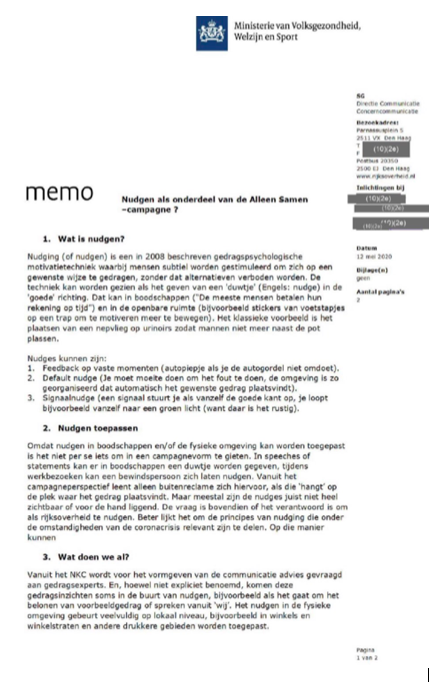
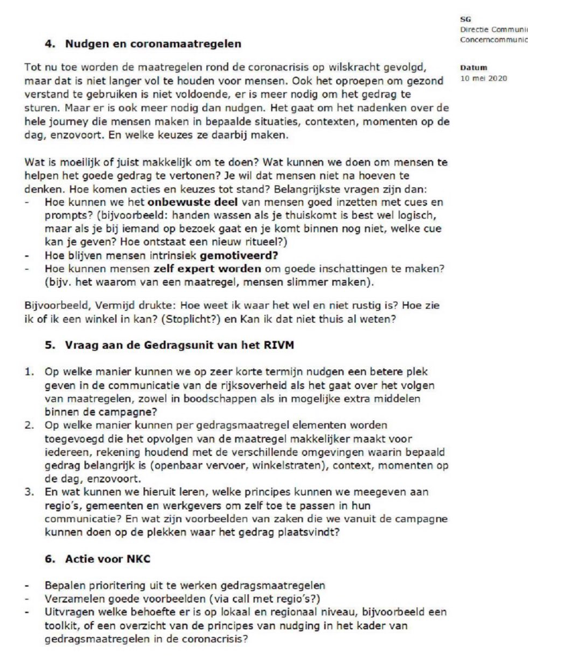
The commitment to behavioral guidance is very explicit in a memo
released under a FOIA request from the Ministry of Health dated May 12,
2020: “It takes more to guide behavior. But it also takes more than
nudging. It’s about thinking about the whole journey that people make in
certain situations, contexts, moments in the day, and so on. And what
choices they make in the process. What is difficult or easy to do? What
can we do to help people exhibit the right behavior? You want people not
to have to think. How do actions and choices come about? Key questions
then are:
- How can we properly engage the unconscious part of people with cues
and prompts (e.g., washing hands, how does a new ritual arise?)?
- How do people stay intrinsically motivated?
- How can people themselves become experts in making good judgments?”
The RIVM Corona behavior unit is asked in the memo for advice and
support: “In what way can we, in the very short term, give nudging a
better place in the communication of the national government when it
comes to monitoring measures?” The NKC applies these insights, by
“rewarding exemplary behavior or speaking from ‘we’.” They are asked,
“what need is there at the local and regional level, for example, a
toolkit, or an overview of principles of nudging?”
The report “Rich in Behavioral Insights Edition 2021” that was
published by BIN-NL, shows how efforts were made to manipulate citizen
behavior, and that the focus was not on health outcomes. The research
and interventions focused on whether citizens stay home after a positive
pcr test, on willingness to test regularly, and on stimulating
large-scale testing even when there are no symptoms. The behavioral
scientists overlook the fact that the tests have no diagnostic value,
and that asymptomatic transmission has not been scientifically proven –
and that staying home when you have no symptoms but a positive test is
of no medical benefit. Meanwhile, without context, the “infections”
resulting from large-scale testing are presented day in and day out in
the media as a measure of the pandemic, thus creating lingering fear.
Additionally, investigations documents that were released under FOIA,
show even more explicitly that government interventions were focused
behavior change. For example, in the summer of 2020, experiments were be
conducted in Amsterdam and Rotterdam investigating the effect of
wearing masks on distancing, a measure that the RIVM notes has “modest
scientific support.” It was already known that wearing masks would not
prevent the spread of the virus. The experiments measure do not measure
any health indicators. One behavioral expert substantiates masking as
follows: “Masks have become the most visible evidence of Covid”. Seeing
the masks causes anxiety, in addition they signal the “social norm,”
who follows the rules, and who does not. They are very effective for
continued obedience.
Fear
Similar to the Netherlands, the British government has several
departments that advise on the application of behavioral knowledge. One
such department is “SPI-B,” the “Scientific Pandemic Influenza Group on
Behavior,” was concerned in March 2020 because a large number of
citizens see did not feel sufficiently threatened by the virus because
they knew it posed no risk to their age group. Therefore, the behavioral
unit recommended that ” The perceived level of personal threat needs to
be increased among those who are complacent, using hard‐hitting
emotional messaging based on accurate information about risk.” The
British government followed with a campaign featuring images of elderly
people on respirators with the messaging “Look her in the eyes. And tell
you never bend the rules”. In Germany, a similar recommendation leaked
out from the Interior Ministry. This recommendation to increase fear in
became known as the ‘panic paper’. It is known that manipulating fear is
one of the most effective ways to instell obedience.
Although no “panic paper” came out in the Netherlands, communication
campaigns surrounding corona played on fear, for example by presenting
images of mass graves and headlines and through headlines or
advertisements such as:
- “Nearly 170,000 new infections a day as British variant engulfs Netherlands” (AD, January 2021)
- “British variant more than 60 percent deadlier” (NRC, March 2021)
- “1.5 meters can save your mom’s life” (Amsterdam, 2020)
- “Keep your grandmother out of the ICU” (Amsterdam, 2020)
- “A corona test is free. Your grandma priceless” (Do What Must Campaign, The Hague).
Behavioral guidance for vaccination readiness
“What kinds of messages are most persuasive for increasing
vaccination willingness?”, this question was investigated by five
scientists affiliated with the prestigious American University of Yale.
They developed and tested messages aimed at self-interest, guilt and
shame, anger, courage, trust in science, regaining personal freedom and
economic freedom, and published their findings in the article
“Persuasive messaging to increase COVID-19 vaccine uptake intentions,”
in the scientific journal Vaccine. The scientists write, “Persuasive
messages evoke a sense that vaccinating is social, address concerns
about how others see you, and also help convince others to get
vaccinated, and condemn those who don’t.” The first part of the study
was be conducted between May and July 2020, well before the first corona
vaccine is developed, let alone temporarily authorized. The scientists
do not address whether concerns about vaccine safety or effectiveness
may be justified. The assumption is that vaccinating is the solution to
the crisis, and the use of behavioral knowledge is desirable to increase
vaccination willingness – an assumption that we also find among
behavioral units and government in the Netherlands.
Examples of recommended messages include:
- “Stopping covid is important because you can get sick, and die from
it. It is dangerous for people of all ages. Getting vaccinated is the
most effective way not to get sick.”
- “By getting vaccinated you can protect everyone around you, it
reduces the risk of your family or people around you getting sick.
- “Imagine how guilty you feel when you make someone else sick…”
- “Imagine how embarrassed you feel when you make someone else sick…”
- “Those who do not take a vaccine are not brave, but reckless… they are putting their family’s health at risk.”
- “The only way to defeat covid is to follow scientific approaches… the people who refuse a vaccine are not aware of the science”
- “Every person who gets vaccinated reduces the likelihood that we will have to go back into lockdown.”
The messages are echoed almost one-to-one in the Dutch campaign to encourage vaccination readiness:
Hugo de Jonge: “Either you get vaccinated, or you get sick” (July 2021)
- “Corona vaccination: ‘we roll up our sleeves. To protect yourself
and those around you, vaccination is the most important step” (Ministry
of Health, Welfare and Sport)
- “Do you want to embrace the other again? Will you get vaccinated against corona?” (Poster in retirement home).
- “Slow vaccination suspected cause of high excess mortality in the Netherlands” (2022, Trouw)
- “An unvaccinated person in the ICU costs four to ten people their operation” (Trouw, October 2021)
- “Mayor of Amsterdam Femke Halsema: vaccine refusers often ill-informed” (AT5, December 2021)
- “Unvaccinated people are egoists. Thanks to them society remains locked. (Noordhollands Dagblad).
In the Netherlands, there is a particularly strong commitment to regaining (!) freedom:
- “Vaccination makes more and more possible” (Tv spot, Ministry of VWS)
- “OMT: end of January room for relaxations, provided enough booster shots are taken” (January, 2022).
- “Camping with my grandfather again, that’s what I do it for. Daan, 22 years old”. (Campaign Only Together)
- “I want to be able to just go to school again. That’s why I got the
shot. Get your vaccinations without an appointment” (Girl year at 14,
advertising GGD Amsterdam)
- “I feel like going to a festival again. Just give me the jab!” (GGD Amsterdam)
- “This weekend DJs at vaccination location NDSM to win over young people” (AT5, July 2021)
- “Heineken: the night belongs to the vaccinated” (Advertisement)
Later, pressure to get “vaccinated” has been greatly increased by
stepping up pressure, coercion, threats of exclusion and intimidation:
- “Non-vaccinated are often poorly educated, ‘right-wing Christian’ or immigrant” Trouw, November 2021)
- “Majority vaccinated think people without vaccinations can be refused entry to public places” (EenVandaag July 2021)
- Minister of Health Hugo de Jonge: “We continue to vaccinate,
neighborhood by neighborhood, door by door, arm by arm” (Press
conference, 2021)
- Minister of Health Hugo de Jonge: “I do not resign myself to the right to say no to vaccine” (Press conference, December 2021)
The slogans and messages play purposefully on automatic, unconscious
processes. As a result, an image forms, under the radar, that if you get
vaccinated you care about your family, are fulfilling your social duty,
are helping society come out of lockdown, you are smart – because you
understand the science, and that those who don’t participate are
particularly antisocial, evil and stupid. None of the slogans provide
real information that helps you make an informed, educated choice,
worse, the unconscious image that is created causes a resistance to do
go look at that information.
Replacing political debate with social engineering
The behavioral influence campaigns rest on the assumption that we are
dealing with a potentially apocalyptic virus that justifies the extreme
measures. But it was clear very early on in the crisis, in part because
of the research of Stanford’s top virologist John P. A. Ioannidis, that
we are dealing with a disease similar to severe influenza, which is
primarily a risk to the elderly. Nor are the measures — such as
1.5-meter distance, wearing masks, mass testing, lockdowns, or achieving
maximum ‘vaccination’ coverage — to prevent the spread of the virus
that for most gives a 99 percent survival rate, had a good scientific
foundation. What we now know, based on the investigation of documents
that have been released under FOIA, is that this was also known to the
government.
This shows the real problem with behavioral influencing: rational
exchange based on scientific, factual information was not possible
within the public domain. Indeed, it is actively censored, suppressed,
blackballed and excluded. At the same time, the social engineers assume a
consensus therefore behavioral control would be justified. Politics is
replaced by social engineering.
Had real open discussion of alternatives been possible, the money
spent on behavioral control, communication and surveillance could have
gone instead to expanding care and supporting caregivers. Where the
justification for manipulation starts with the assumption that citizens
have “limited rationality,” and that the government must therefore
‘guide’ them in their choices, it morphes into the desire that those
citizens should rather stop thinking for themselves altogether.
*
Note to readers: Please click the share buttons above or below.
Follow us on Instagram and Twitter and subscribe to our Telegram
Channel. Feel free to repost and share widely Global Research articles.
This article was previously published in the reader-funded Dutch newspaper De Andere Krant.
Sources
Stappenplan overheidscommunicatie en interventies
RIVM Corona Gedragsunit https://www.rivm.nl/documenten/stappenplan-overheidscommunicatie-interventies
https://danielvdtuin.substack.com/p/wob-documenten-mondkapjesplicht
https://deanderekrant.nl/nieuws/alles-wat-je-over-covid-zou-moeten-weten–en-je-nooit-wordt-verteld-2021-12-27
Jullie gedragsexperiment was in opdracht van het rijksbrede Corona Gedragsteam. https://www.binnl.nl/community/in+gesprek+met/in+gesprek+met+maureen+turina-tumewu+en+freek+smit/default.aspx
State of Fear. Laura Dodsworth. (staat ook de Biderman coercion chart in) https://www.amazon.com/State-Fear-government-weaponised-Covid-19-ebook/dp/B08ZSYN14J
Scientific Pandemic Influenza Group on
Behavior (SPI-B), a subcommittee that advises the Scientific Advisory
Group for Emergencies (SAGE) in the U.K.
SPI-B warned in March last year that
ministers needed to increase ‘the perceived level of personal threat’
from COVID-19 because ‘a substantial number of people still do not feel
sufficiently personally threatened.’
Then, the so-called “Panic Paper” was
leaked, which was written by the German Department of the Interior. Its
classified content shows beyond a shadow of a doubt that, in fact, the
population was deliberately driven to panic by politicians and
mainstream
media. https://foreignaffairsintelligencecouncil.wordpress.com/tag/panic-paper/
Crowdsourced verzameling van nudge boodschappen: https://twitter.com/ElzevH/status/1549652827466874880
We blijven vaccineren, wijk voor wijk, deur voor deur, arm voor arm
https://childrenshealthdefense.org/defender/manipulation-guilt-shame-vaccine-compliance/
https://www.sciencedirect.com/science/article/pii/S0264410X21013682?via%3Dihub
https://www.rijksoverheid.nl/onderwerpen/coronavirus-covid-19/documenten/rapporten/2021/08/31/rapportage-campagne-effectmonitor-coronavaccinatie-augustus-2021
Featured image is from The Dossier
 The Worldwide Corona Crisis, Global Coup d’Etat Against Humanity
by Michel Chossudovsky
Michel Chossudovsky reviews in detail how this insidious project
“destroys people’s lives”. He provides a comprehensive analysis of
everything you need to know about the “pandemic” — from the medical
dimensions to the economic and social repercussions, political
underpinnings, and mental and psychological impacts.
“My objective as an author is to inform people worldwide and
refute the official narrative which has been used as a justification to
destabilize the economic and social fabric of entire countries, followed
by the imposition of the “deadly” COVID-19 “vaccine”. This crisis
affects humanity in its entirety: almost 8 billion people. We stand in
solidarity with our fellow human beings and our children worldwide.
Truth is a powerful instrument.”
ISBN: 978-0-9879389-3-0, Year: 2022, PDF Ebook, Pages: 164, 15 Chapters
Price: $11.50
Purchase directly from the Global Research Online Store
You may also purchase directly at DonorBox “Worldwide Corona Crisis” Campaign Page! (NOTE: User-friendly)
The original source of this article is Global Research
Be the first to Comment.
Blogger's note:
subterrnews.blogspot.com does not send cookies, or collect any information on
those using the blog. However, the blogspot is on google, and google may
collect information, and send cookies. Many of the links that we
connect to do not send out cookies or collect information, but some do.
You are keying in to this blog, and you have agreed to this.
The views of the author do not
necessarily represent the opinions of this blog. They are the views, and
opinions of the author(s) of the article.