British Government Shocking Report on Side Effects of Corona Vaccines: Strokes, Blindness, Miscarriages
A report from the UK Medicines Agency reveals more side effects from the Corona vaccinations
All Global Research articles can be read in 51 languages by activating the “Translate Website” drop down menu on the top banner of our home page (Desktop version).
Incisive report first published on April 10, 2021
***
In total, more than 30,000 vaccinees reported more than 100,000
adverse reactions to the vaccine by the end of January. Most notable are
13 people who went blind after the vaccination, eight miscarriages and a
total of 236 fatal cases, Epoch Times reports.
The list of side effects and adverse reactions to Corona vaccinations
is getting longer. A report by the UK’s Medicines Regulatory Agency
(MHRA, a body that licenses and oversees medicines in the UK, similar to
the Paul Ehrlich Institute in Germany) now adds blindness and
miscarriages to already known reactions to vaccines, such as pain, facial paralysis and blood disorders. The report
was updated on February 11 to include reports of suspected adverse
reactions from the start of the vaccination campaign on December 9
through the end of January.
Officials say that “more than 110,000 people in the UK have died
within 28 days of a positive coronal test.” By comparison, about four
million people tested positive, while overseas colonies (including
Gibraltar, the Cayman Islands and Bermuda) contributed a few thousand
cases. This results in a mortality rate of about 2.5 percent, which is
roughly equivalent to the mortality rate of a regular flu.
More side effects at AstraZeneca Vaxzevria
As with VAERS in the U.S., Britons can report suspected adverse
reactions and adverse events to vaccines in what is known as the “yellow card scheme”
and give a drug a “yellow card.” According to the government report, by
the end of January, 9,262,367 people had received one vaccination and
494,206 people had already received two. During the same period, a total
of 32,139 yellow cards were collected, with more than 100,000
individual responses. The first notifications date back to December 9,
the first day of vaccinations.
About two-thirds of the notifications and nearly 60,000 individual responses in the yellow card scheme relate to Pfizer/BioNTech‘s vaccine. With the exception of 72 cases in which the manufacturer was not specified, the rest fall to AstraZeneca. Although the Moderna vaccine has also been licensed in the UK since January 8, it is not mentioned in the government report.
The distribution of reports across vaccines roughly reflects the
vaccines administered. However, it is notable that a report on
AstraZeneca contains an average of four separate responses, while for
Pfizer/BioNTech there are “only” about 2.5 responses on each yellow
card. As “dailyexpose.co.uk” calculates,
this means that about one in 333 vaccinees reported side effects or
adverse reactions. In reality, however, there could be even more cases
“as some may not have been reported under the yellow card scheme.”
That AstraZeneca also causes side effects in Germany was also
recently experienced by the emergency department in the district of
Minden-Lübbecke. After employees took advantage of a short-term
vaccination offer from AstraZeneca – the vaccine is not approved for
people over 65 – several employees reported sick. “As a result, the
emergency services were not optimally staffed,” district spokesman
Florian Hemann told the “Westfalen-Blatt” at the time. Neighboring rescue stations and the DRK assisted.
The “yellow card” regulation includes, in addition to the side
effects and reactions already known from the vaccine studies of the
manufacturers, even more.
Side effects of Corona vaccines
1. Optical Impairment and Blindness
In total, the reports included 1,280 eye conditions. “Optical
impairment and blindness (other than color blindness)” occurred in 53 reports on Pfizer/BioNTech [ed. note: see page 8], as well as 26 yellow cards for AstraZeneca [page 6] and one report
without naming the vaccine [page 4]. In thirteen cases (5 Pfizer, 8
AstraZeneca) the report speaks of (complete) blindness after
vaccination.

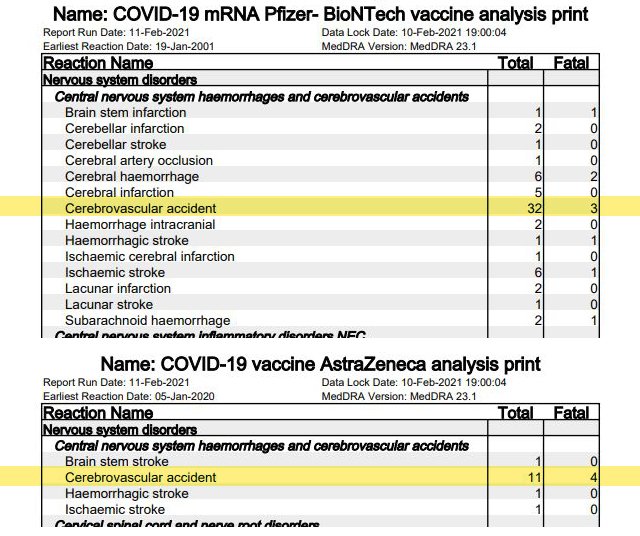
2. Cerebrovascular accidents (stroke)
In 43 cases (Pfizer/BioNTech 32 [page 31], AstraZeneca 11 [page 24]),
affected individuals (or their next of kin) have reported
cerebrovascular accidents following vaccination by Pfizer. The sudden
death of brain cells from lack of oxygen due to an interruption in blood
supply caused by a blockage or rupture of an artery to the brain is
also known as a stroke. In seven cases – 3 after vaccination by
Pfizer/BioNTech, 4 after vaccination by AstraZeneca – this ended
fatally.
3. Abortion and miscarriage
Because of insufficient data, neither Pfizer/BioNTech nor AstraZeneca and Moderna approved their vaccines for pregnant women. What effects
mRNA vaccination has on fertility or on nursing mothers is also
unknown, they said. For its part, the British government announced
before the vaccination campaign began that “pregnancy should be excluded
in women of childbearing age before vaccination [and] pregnancy should
be avoided for at least two months after the second dose.”
Yet the yellow card regulation lists eight [page 36] suspected
pregnancy-related cases for Pfizer/BioNTech, and nine [page 28] for
AstraZeneca. About half of these involve “spontaneous abortions” or
miscarriages. In two cases, premature deliveries or premature rupture of
the amniotic sac occurred after vaccination with AstraZeneca.

4. Facial paralysis
There have also been 107 facial nerve disorders reported after
Pfizer/BioNTech vaccinations, including paralysis, paresis and spasm.
Following vaccinations by AstraZeneca, 17 reports have been received so
far. Paralysis in other parts of the body occurred in at least 21 cases
(Pfizer 15, AstraZeneca 5, unattributed 1). In most cases, the paralysis
symptoms had disappeared after a few days.
5. Deceased
Deaths have also been reported in the UK in the time sequence of
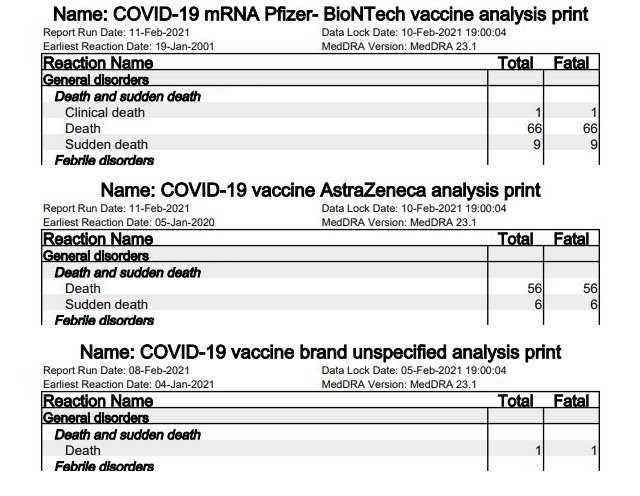
vaccinations. The reports included a total of 236 cases with fatalities.
Of these, 141 are explicitly listed as “deaths”; all other cases
mention another fatal side effect. 76 cases relate to Pfizer/BioNTech’s
vaccine [p. 13], 64 cases to AstraZeneca [p. 10]. One case is not
attributed to the vaccine [p. 6].
Particularly notable among the deaths are 15 cases of “sudden death”
(nine at Pfizer/BioNTech, six at AstraZeneca), who according to
“dailyexpose” “dropped dead immediately after vaccination.”
Interim assessment by the UK government agency
In light of these figures, the MHRA states, “A large proportion of
those vaccinated to date as part of the vaccination campaign are very
elderly and many of them will also have pre-existing conditions.” The
agency therefore concludes that both vaccines raise “no other new safety
concerns.” All vaccines and drugs have “certain side effects,” but in
the case of the Corona vaccines, these are “consistent with expectations
from clinical trials.” It goes on to say:
Following a very extensive exposure of the UK population,
no new safety concerns have emerged from the reports received to date,
and for the cases of other diseases reported in a temporal association
with vaccination, the available evidence does not currently indicate
that the vaccine caused the event.”
In contrast, the definition of a “coronadode” which means that
someone in the UK “definitely died from COVID-19” applies for up to 28
days after a positive test result. That period is about 10 to 14 days
longer than it takes for someone who has tested positive to be
officially counted as recovered.
*
Note to readers: please click the share
buttons above or below. Forward this article to your email lists.
Crosspost on your blog site, internet forums. etc.
Featured image is from Viacheslav Lopatin | Credit: scaliger – stock.adobe.com
Be the first to comment.
Blogger's note:
subterrnews.blogspot.com does not send cookies, or collect any information on
those using the blog. However, the blogspot is on google, and google may
collect information, and send cookies. Many of the links that we
connect to do not send out cookies or collect information, but some do.
You are keying in to this blog, and you have agreed to this.
The views expressed in the articles
do not necessarily represent the opinions of this blog. They are the views, and opinions of the
author(s) of the article.